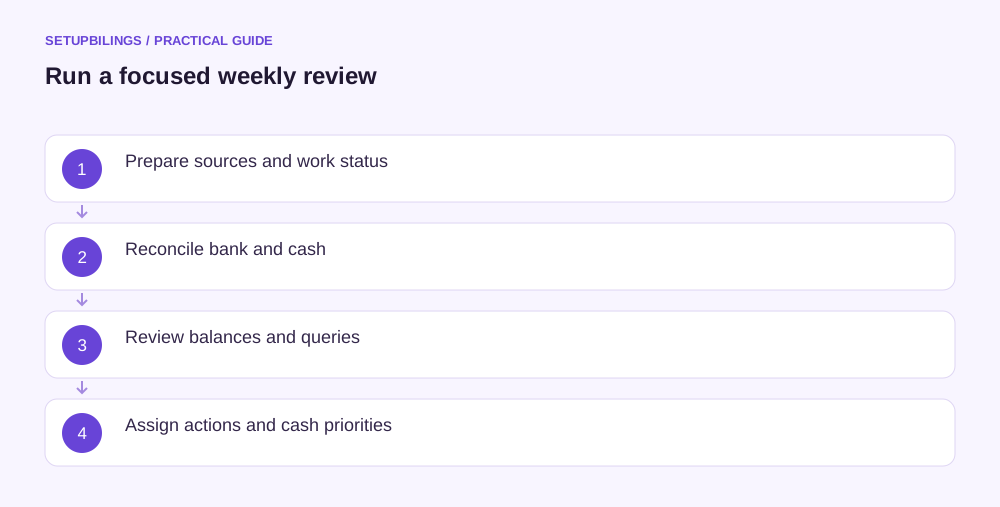
A useful weekly bookkeeping routine checks that transactions are complete, cash and bank movements are explained, customer and supplier balances make sense and unresolved questions have owners. Reserve a recurring review slot and prepare the information before it begins. The routine should reduce surprises, not require the owner to re-enter the week’s transactions.
Divide the work into preparation, reconciliation, exception resolution and decisions. Daily capture supplies the documents; the weekly review tests the records and focuses attention on items that can affect collections, payments or the next close.
Prepare a compact weekly pack
Choose a consistent week-ending date and reporting scope. Gather sales and purchase summaries, bank statements or exports, settlement reports, cash records, receivable and payable lists, and the open-query register. Identify any sources not yet received.
Ask the bookkeeper to show work status as well as figures. “All entries through Friday except two supplier bills” is more useful than a current-looking report with no completeness statement. A polished dashboard can conceal unprocessed documents.
Use the same definitions each week. Separate sales from collections and purchases from supplier payments. This prevents the owner from interpreting a strong collection week as new revenue or a stock-purchase week as an equivalent expense increase.
Reconcile bank and payment channels
Match statement movements to recorded receipts, payments and transfers. Inspect unmatched items individually, including fees, refunds, reversals and receipts with unclear descriptions. Link card or gateway settlements to the provider’s detail rather than assuming each bank credit equals gross sales.
ICAI’s bank-reconciliation material explains why the bank statement and cash-book balance can differ through timing and other items. The weekly task is to identify the cause and evidence, not force both totals to agree through unexplained entries.
Review old reconciling items as well as new ones. A transfer labelled “in transit” for several weeks may require a different explanation. Match transfers between the business’s own accounts so both sides are recorded once.
Count and check cash
Compare the physical cash count with the cash book and supporting vouchers. Check that cash expenses, deposits and staff advances were recorded. Ask the custodian to explain differences with evidence while the events are still recent.
An illustrative Nagpur stationery distributor expects ₹12,400 closing cash but counts ₹11,900. The ₹500 difference may arise from a missing delivery receipt or another issue. Record the query and investigate; do not immediately assume theft or invent a miscellaneous expense.
Review cash held by field staff or branches separately. A bank withdrawal handed to an employee is not automatically an expense; track the advance and later supported settlement.
Review collections and customer issues
Read overdue invoices by due date and value. Prioritise material disputes, broken payment promises and documentation problems. Check receipts after the report date so the review does not chase amounts already collected.
For the distributor, suppose overdue customer dues total ₹2.4 lakh: ₹1 lakh awaiting delivery proof, ₹80,000 promised next week and ₹60,000 disputed for damaged goods. These require different actions: supply the document, confirm the promised receipt and resolve the claim.
Keep the owner’s decisions specific. Name the person contacting each buyer, the evidence needed and the date to update the cash forecast. A generic instruction to “improve collections” is difficult to review the following week.
Review suppliers and upcoming commitments
Compare unpaid invoices with supplier statements, goods receipts and agreed due dates. Identify bills awaiting entry, disputed quantities and advances not yet adjusted. Payment approval should use supported obligations rather than a list assembled only from reminder messages.
Prepare the next week’s cash commitments, including wages, rent, loan instalments and relevant statutory payments. Verify external deadlines separately for the business’s actual status; an internal weekly meeting does not determine them.
| Weekly decision | Evidence to bring |
|---|---|
| Which customers need action? | Due-date ageing and receipt history |
| Which suppliers should be paid? | Verified bills, terms and cash plan |
| Which entries need correction? | Original entry and supporting record |
| Which documents are missing? | Reference, owner and request date |
| What cash pressure is ahead? | Dated receipts and payment commitments |
Clear the query queue in priority order
Resolve high-value, old and deadline-sensitive items first. Ask one precise question per item. “What is this ₹18,000 payment?” is less effective than showing the bank reference, recipient and likely invoice while asking whether it settled that bill or represented an advance.
Post approved corrections through the normal process and retain their references. Recheck affected balances after correction. Agreement of the trial balance does not establish that every entry is complete or correctly classified, as ICAI’s error material illustrates.
Do not allow cleared questions to remain in the live queue. Record the answer and resulting entry, then close them so the next review focuses on unresolved work.
Use the same checklist each week but change the discussion according to the evidence. The routine should make exceptions visible, not encourage a mechanical tick without investigation.
Finish with a short forward view
Summarise verified cash, expected receipts, committed payments and material uncertainties for the coming week. Distinguish confirmed receipts from assumptions. An available bank balance may already be committed to wages or supplier dues.
Record a short action list with owners and dates, and check last week’s actions before adding new ones. Repeated unresolved issues may indicate a process problem, such as missing delivery evidence or unclear responsibility for employee expenses.
A weekly routine works when the owner spends time making decisions from checked records. The result should be fewer unexplained balances, more realistic collections and payments, and a clearer path to a reliable monthly close.