Bank reconciliation explains why the balance in your business's bank ledger differs from the bank statement at the same date. Match the transactions, correct supported errors or omissions in the books, and list genuine timing differences separately. The final reconciliation should connect the two balances with identifiable items, not an unexplained balancing entry.
A difference does not automatically mean money is missing. A cheque may have been recorded when issued but not yet presented, while a documented deposit may not yet appear on the statement. Conversely, bank charges or direct customer receipts can reach the bank before accounts records them.
Compare the same account and date
Consider an illustrative Nashik electrical wholesaler reconciling one current account at month-end. Its books show a positive bank balance of ₹1,50,000 and the statement shows ₹1,72,800. Both figures relate to the same account, currency and closing date.
Keep separate reconciliations for different bank accounts. Combining balances can hide an error in one account behind an opposite error in another. Obtain the complete statement period, the detailed bank ledger and the previous reconciliation before examining the difference.
ICAI's bank-reconciliation chapter distinguishes timing differences from transactions and errors requiring attention in the cash book. That distinction is the core of a useful reconciliation: some items need a posting, while others need evidence and follow-up.
Match transactions before adjusting balances
Compare receipts and payments using amount, reference, date and counterparty. Mark a transaction as matched only when the evidence supports the link. Several customer receipts can have the same amount, and one bank transfer can settle several invoices.
Work from both directions. For every ledger transaction, look for a bank counterpart; for every statement movement, look for the book entry. Checking only the books against the bank can miss bank-only charges or credits entirely.
Retain the original transaction references and a match identifier or clear annotation. Another person should be able to see which entries were compared without repeating the whole exercise.
Separate the three items in this example
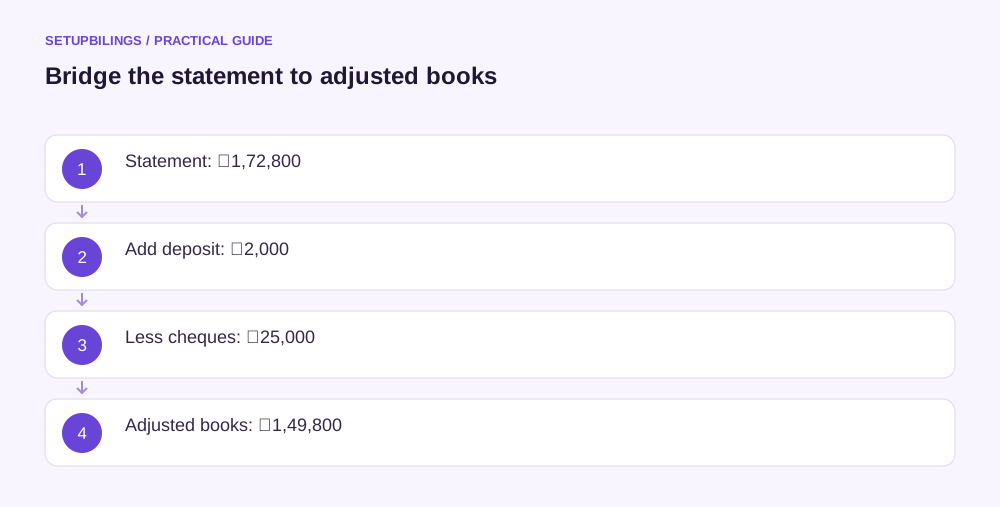
The wholesaler identifies ₹200 bank charges missing from its books, ₹25,000 of issued cheques not yet presented, and a ₹2,000 documented deposit not yet credited on the statement. No other differences remain after matching.
The charges require a supported book entry. In this simplified example, debit the appropriate bank-charge account and credit the bank ledger by ₹200, with any required tax breakdown established from the actual advice. Adjusted book balance becomes ₹1,49,800.
The cheques and deposit are already correctly recorded in the books under the example's facts. They remain reconciling timing items rather than additional expense or income entries.
| Reconciliation from statement balance | Amount |
|---|---|
| Positive closing bank statement balance | ₹1,72,800 |
| Add documented deposit not yet credited | ₹2,000 |
| Less issued cheques not yet presented | ₹25,000 |
| Reconciled amount | ₹1,49,800 |
| Adjusted bank ledger balance | ₹1,49,800 |
| Unexplained difference | Nil |
The direction follows the chosen starting point. The statement has not yet received the deposit, so add it; the bank has not yet paid the cheques, so deduct them. Do not memorise an add-or-subtract rule without identifying the starting balance and the transaction's effect.
Understand what reconciliation does not post
The ₹25,000 cheque total is not a second supplier payment. Recording another expense or bank credit would duplicate the transaction already in the books. When the bank later pays the cheque, clear the outstanding match against that original entry.
Similarly, the ₹2,000 deposit is not additional sales revenue when it appears on the next statement. It is the clearing of a movement already recorded. Keep the link to its deposit record and originating receipt.
A genuine bank error should be raised with the bank and tracked with evidence. Do not rewrite valid books merely to agree with an incorrect statement. An unidentified bank movement needs investigation and appropriate controlled accounting, not an invented category selected to make the totals agree.
Follow timing items into the next period
Check subsequent statement entries for the deposit and cheques. Record the actual clearing date and reference when found. An item should leave the outstanding list because it cleared or was resolved through an evidenced correction, not simply because a new month started.
Give each remaining item an owner and expected next action. Investigate unusual age, duplicate amounts and unsupported deposits. An old timing label can conceal an error or a payment that was never executed.
The reconciliation should preserve a list of outstanding items at the closing date even where they clear soon afterward. That list explains the historical balance and provides the opening position for the next review.
Keep the balance definition visible
A reconciled book balance and immediately spendable bank funds can differ where instruments or restrictions affect availability. Use the reconciliation to explain recorded cash, then check actual commitments and access before authorising payments. A correct historical bridge is evidence for cash management, rather than a complete spending forecast.
Finish with a reviewable record
Save the statement, adjusted ledger, reconciliation schedule and support for corrections. Record the preparation date and reviewer where a separate review is practical. Check that a book adjustment is not also counted again as a timing item in the schedule.
The wholesaler now has an explained ₹1,49,800 book balance and two timing categories to follow. That is the useful outcome: a clear bridge between records, supported corrections and visible unresolved items. Reconcile often enough that transaction evidence remains easy to obtain and the owner can rely on the bank position when deciding what cash is available.