Use the restriction that matches the transaction
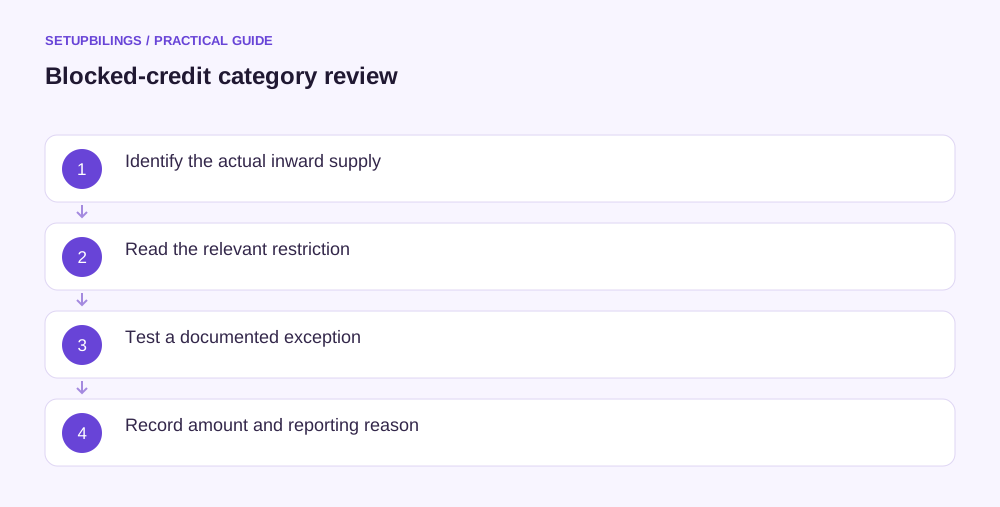
Section 17(5) identifies credits restricted despite the general business-use framework. A purchase can be commercially sensible, properly invoiced and fully paid yet remain blocked. Begin with the actual goods or services and the operative statutory wording rather than a broad ledger label such as welfare, travel or capital expenditure.
A review should record both the restriction and any exception considered. Do not stop at a checklist saying “vehicles blocked” or “business expenses eligible.” The law distinguishes particular vehicle types, uses and services, and other categories also depend on precise facts that a general expense heading cannot capture.
Review vehicles and related services separately
Passenger motor vehicles with approved seating not exceeding thirteen persons, including the driver, have a specific restriction with stated taxable-use exceptions. Goods vehicles and larger passenger vehicles require their own assessment. Do not apply the thirteen-person test to an unrelated asset merely because it is registered with a transport authority.
Related insurance, servicing, repairs and leasing can have different clauses and exceptions. Check the underlying vehicle, use and actual service. A credit decision made for the purchase invoice should not automatically be copied to every later insurance or repair bill without reviewing the applicable provision.
Illustratively, a trader buys a small passenger car for management visits and a delivery vehicle for stock dispatch. Both support business, but their categories and uses differ. A single “vehicle expenses” credit code can conceal that distinction and produce an unsupported result for at least one set of invoices.
Separate employee benefits from statutory obligations
Food, beverages, outdoor catering, certain health and life-insurance benefits, club or fitness membership and vacation travel require careful review under the relevant clauses. Staff satisfaction or a company policy does not by itself establish the legal exception for an employer obligation imposed by law.
CBIC Circular 172/04/2022 clarifies the scope of the employer-obligation proviso in clause (b). Identify the actual law, covered employees, premises and benefit before relying on it. Keep the requirement and the invoice scope connected; a legal obligation concerning one facility should not automatically be extended to every executive benefit.
Other exceptions can involve an outward taxable supply of the same category or an element of a taxable composite or mixed supply. Document the real onward transaction. A business should not describe ordinary staff refreshments as an onward catering supply solely to create the appearance of an exception.
Examine construction and asset categories
Works-contract services for construction of immovable property and goods or services used for own-account construction have specific restrictions, with the relevant plant-and-machinery distinction and other conditions. The business use of a building does not by itself remove those restrictions.
Current wording must be checked against the Finance Act 2025 amendment concerning plant and machinery. An old explanation based only on the earlier phrase “plant or machinery” is not a complete current-law review. Identify the actual asset and statutory definition rather than treating every structure essential to operations as eligible machinery.
Repairs, renovation and capitalisation need factual examination. The construction explanation includes specified work to the extent capitalised, but an accounting label alone does not decide the underlying facts. Obtain the contract, asset description and treatment in the fixed-asset and expense records before selecting a credit code.
Review consumption, loss and promotional goods
Personal consumption is a separate restriction. A business account paying a family expense does not convert it into an eligible business input. Mixed-use items should be distinguished from wholly personal purchases and reviewed under the appropriate apportionment provisions rather than assigned an invented standard percentage.
Goods lost, stolen, destroyed, written off or disposed of as gifts or free samples require the specific section 17(5)(h) review. Do not confuse a physical loss with every production variation or price reduction. Establish the event, affected quantity, original credit and any later disposal before calculating an adjustment.
Promotional schemes can differ from genuine gifts or samples. CBIC Circular 92/11/2019 distinguishes relevant arrangements, including certain bundled sales and Schedule I situations. The word “free” in an advertisement is not sufficient to classify the underlying supply or determine credit treatment.
Review expense masters when a vendor starts supplying a new category. An office-services supplier may later invoice catering or a construction activity, and an existing eligible code should not automatically follow the vendor into that transaction. Use invoice descriptions and purchase approvals to trigger the relevant category review. Similarly, an earlier blocked item should not make every future supply from that vendor ineligible when the facts differ.
Keep permanent and temporary issues distinct
A blocked category is different from an otherwise eligible invoice awaiting receipt, supplier correction or satisfaction of a payment condition. Separate those reasons in the credit register. Otherwise, staff may later reclaim a permanently blocked amount simply because they see a generic status labelled reversed.
Check current reporting instructions, including Circular 170/02/2022 and the live return structure. A statutory block, a temporary reversal and an amount barred by the claim deadline can have different reporting and follow-up. The accounting entry should retain the legal reason rather than only the return table number.
Maintain a short exception file for unusual expenses, with the relevant operative clause, factual evidence, amount and documented decision. Revisit it when the facts or law change. A useful blocked-credit review prevents unsupported claims while preserving genuine exceptions that a blanket expense-category ban would overlook.
Sources and references
- CBIC: current CGST section 17, apportionment and blocked credits
- CBIC: Central Goods and Services Tax Act, consolidated through August 2021
- CBIC Circular 172/04/2022-GST: employee benefits and specified credit issues
- Finance Act 2025, section 124: construction credit amendment
- CBIC Circular 92/11/2019-GST: gifts, samples and promotional schemes
- CBIC Circular 170/02/2022-GST: reporting ITC and reversals