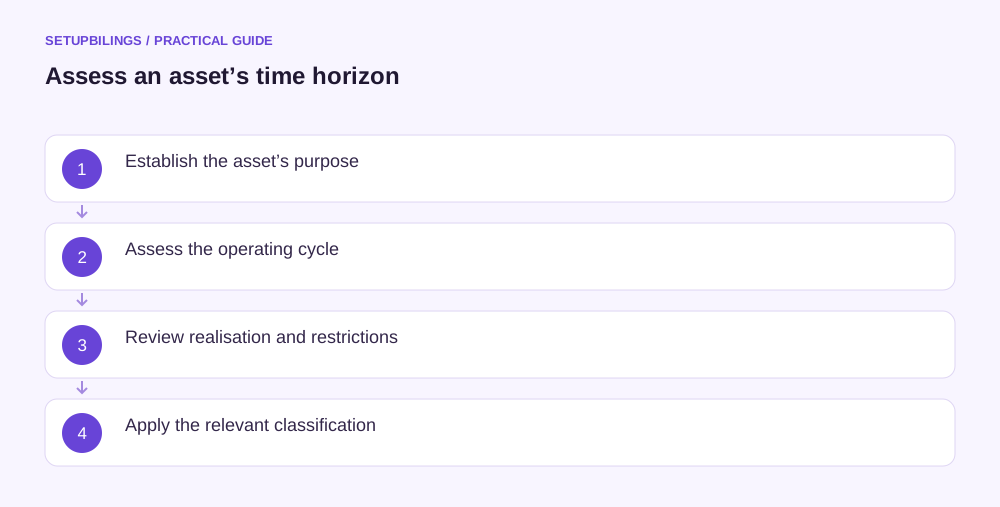
Current assets and non-current assets distinguish resources by criteria such as the operating cycle, trading purpose, expected realisation and restrictions on cash. The distinction helps readers understand how the business’s resources are tied up. It is not simply a division between valuable and less valuable assets.
For companies using Schedule III, the relevant division and accounting framework govern classification. Division I includes normal operating-cycle criteria as well as a twelve-month realisation criterion and specific cash considerations. A business should not assume that every asset lasting more than twelve months must automatically be non-current.
Understand the operating cycle
The operating cycle is the time between acquiring assets for processing and realising them in cash or cash equivalents. A retailer’s cycle may be short. A business producing specialised equipment can have a longer cycle involving procurement, production, delivery and collection.
Schedule III states that where the normal operating cycle cannot be identified, it is assumed to last twelve months. Establish the cycle from the business’s actual activities and the applicable requirements. Do not stretch it merely to achieve a preferred classification.
Consider an illustrative Thane custom machinery producer whose supported normal operating cycle is eighteen months. Inventory and receivables realised within that cycle may meet current classification even when the time extends beyond twelve months. That does not make them immediately available cash.
Apply the criteria to different resources
Under Division I of Schedule III, current criteria include assets expected to be realised, sold or consumed in the normal operating cycle, assets held primarily for trading and assets expected to be realised within twelve months. Cash or cash equivalents are considered with the specified restriction condition. Other assets are non-current.
A machine used in production for several years is ordinarily examined as a longer-term operating resource. Goods the business makes for sale are inventory, even when they are physically similar to machinery. Intended purpose matters alongside timing.
| Illustrative asset | Classification question |
|---|---|
| Finished goods awaiting normal sale | Is realisation within the operating cycle? |
| Customer invoice due after delivery | What are expected collection and cycle facts? |
| Production equipment | Is it held for continuing operational use? |
| Refundable deposit | When can it be recovered, and what terms apply? |
| Restricted bank balance | What restriction exists and how long does it last? |
Use the table to gather facts rather than assign categories from names. An account called “deposit” can contain items with different maturity and restriction terms that need separate analysis.
Separate classification from liquidity
Suppose the machinery producer has current assets of ₹20,00,000: inventory ₹12,00,000, customer receivables ₹6,00,000 and unrestricted bank funds ₹2,00,000. It cannot assume ₹20,00,000 is available to pay tomorrow’s wages.
Inventory must be completed or sold. Customers must pay. Some balances may be disputed or slow-moving. A current ratio can therefore look reassuring while cash remains tight. Review the composition, quality and timing of each component.
Classification also differs from valuation. A customer receivable can remain in the appropriate current category while requiring an adjustment for recovery uncertainty. A stock item may be current but need a write-down under the relevant inventory requirements. Relabelling it non-current does not address the valuation issue.
Split balances where the facts require it
An account may include both near-term and longer-term amounts. A deposit contract might permit part of a balance to be refunded soon while the remainder stays locked in for several years. A loan receivable may have instalments with different expected realisation dates.
Review the underlying schedule and applicable presentation requirements. Do not classify an entire account by whichever single item is largest. Maintain a clear split with references to the contract and repayment or recovery schedule.
For prepayments, identify the service period and expected consumption. For investments, examine maturity, trading purpose, restrictions and the relevant standard. Different asset classes can have specific requirements beyond this introductory framework.
Document the assessment at each reporting date
A classification file can record the balance, purpose, operating-cycle basis, expected realisation, restrictions and conclusion. Retain contracts and forecasts where they support timing. Avoid relying solely on an old account label inherited from the previous bookkeeper.
Changes in circumstances need review. A revised settlement agreement, restriction on funds or altered operating cycle may affect the analysis. An overdue receivable requires an honest assessment of expected recovery and applicable classification, rather than an automatic assumption that next month’s collection remains certain.
Compare the classification schedule with the general ledger and supporting registers. Explain material changes from the prior year. If the business uses internal liquidity categories that differ from statutory presentation, label and reconcile those categories.
A current-asset label should not override collection evidence. If a customer has repeatedly delayed settlement, the cash forecast needs a realistic date and the accounting balance needs the appropriate recovery review. Record the assumptions behind both. They may serve different purposes, but they should not contradict known facts. Clear supporting schedules also help explain why current assets increased without a corresponding improvement in the bank balance.
Use the time horizon to plan funding
Longer-term assets often need funding whose repayment pattern fits their use, while working capital requires attention to stock and collection cycles. These are commercial considerations informed by the accounts, not automatic financing rules.
Current and non-current classifications make the financial position easier to read when they follow the applicable criteria and actual transaction facts. Add a separate liquidity view showing realistic cash conversion dates. The owner can then distinguish resources expected to turn over in business from money genuinely available for the next payment.