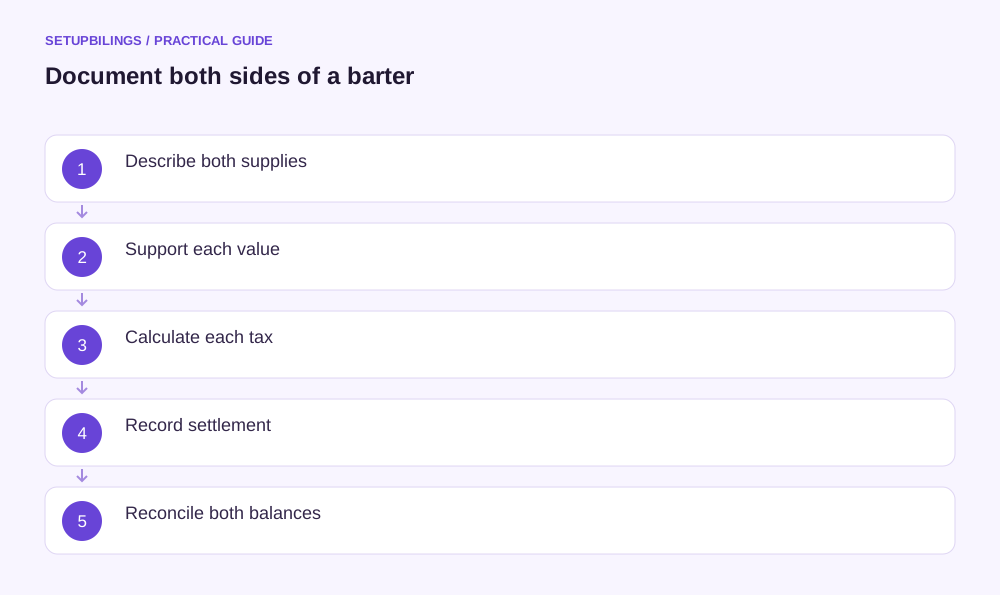
Prepare an exchange or barter deal by documenting the entire consideration, including goods, services or rights received in addition to money. Where consideration is not wholly in money, Rule 27 provides a valuation framework. The cash amount passing between the parties is not automatically the taxable value. Each side may also make its own supply, so do not reduce the transaction to a single net bank settlement.
Describe both obligations in the agreement
State what each party supplies, quantities or deliverables, condition, timing, cash top-up and tax terms. For used equipment, record make, model, serial number, condition and ownership. For services, record the actual deliverables and acceptance criteria. A broad note saying “exchange adjustment” leaves valuation and responsibility unclear.
Clarify whether agreed values are inclusive or exclusive of GST. Identify whether a party is acting as a business supplier, an unregistered customer or another capacity. Those facts affect the documentation and tax review. An exchange does not automatically make the recipient liable under reverse charge for every item it receives.
Start with open-market evidence under Rule 27
The rule starts with open-market value for the supply. Keep contemporaneous standalone prices, comparable sales, technical specifications and terms. If open-market value is unavailable, review the rule's prescribed alternatives, including identifiable monetary equivalent of non-money consideration and like-kind-and-quality evidence.
Record why a step can or cannot determine value. Do not jump to the cash top-up because it is the easiest figure to find. If related persons or a special category is involved, examine the applicable valuation rule rather than assuming the ordinary exchange route covers every arrangement.
Illustrative machine exchange
Assume a supplier sells a new machine for ₹80,000 cash plus an old machine. Reliable standalone evidence supports ₹1,00,000 as the applicable open-market value of the new machine. Under that assumed Rule 27 conclusion, the new machine's taxable base is ₹1,00,000, not the ₹80,000 top-up.
At an assumed confirmed aggregate GST rate of 18%, tax on the new machine is ₹18,000. The contract must explain how the old machine's agreed exchange amount and cash settle the obligation and tax. The example does not determine the old machine owner's separate GST position; that requires its own status, business-use, valuation and credit-history review where relevant.
Analyse the other side separately
A business transferring its old asset can be making a supply of its own. Identify the supplier, applicable value, taxability and any special capital-goods provisions. Do not assume that the new-machine seller's purchase entry is the only document needed or that a personal customer's trade-in and a registered business's disposal are identical.
For a service-for-service barter, each party should identify its own output supply. If a designer provides work in return for accounting support, describe and value both obligations. Setting off receivables can settle balances, but it does not erase the underlying supply records or applicable tax obligations.
Make the settlement arithmetic visible
Suppose two registered businesses each independently make a taxable service supply with an approved exclusive value of ₹25,000 and a confirmed assumed rate of 18%. Each illustrative invoice total is ₹29,500. If the parties lawfully settle reciprocal balances by agreed set-off, the cash payment may be nil while each records ₹25,000 supply value and ₹4,500 output tax.
Keep the settlement agreement separate from the valuation working. If the values differ, show the remaining balance rather than altering one taxable base to force a zero settlement. A clean contra entry is an accounting outcome, not evidence that both supplies have equal GST value.
Collect evidence of condition and comparability
For exchanged goods, photographs and inspection reports can support the description and commercial value. Record defects, age, remaining functionality and accessories. Compare like with like where comparable evidence is used. A price for a refurbished unit with warranty may differ materially from an untested unit sold as received.
For services, compare scope, duration, delivery rights and customer responsibilities. A publicly advertised price can be a starting point, but record whether it applies to the actual package. Keep the evidence date so a later reviewer does not mistake a current price list for contemporaneous support for an older transaction.
Give each non-cash component a clear settlement reference in both parties' records. An old asset accepted at an agreed amount can later be sold for a different price; that resale does not automatically rewrite the original new-equipment valuation. Preserve the contemporaneous evidence and investigate any contractual price adjustment separately. This keeps later profit or loss on the exchanged asset distinct from the value established for the earlier supply.
Check invoice and movement details
Each required invoice should identify the actual supply, approved taxable value, rate, tax heads and relevant parties. Record cash and non-cash settlement references without hiding tax in an unexplained negative line. Where goods move, preserve the transport documents and review applicable e-way bill requirements.
Review time of supply independently. Waiting for both sides to complete their obligations or for the final cash top-up does not necessarily determine every invoice or tax date. Build a timeline from the contract and actual events before finalising the document sequence.
A well-prepared exchange file explains what each party gives, how value was determined and how the balances were settled. The strongest control is to keep those three questions separate. That prevents a convenient net amount from replacing the fuller GST valuation and reporting analysis.