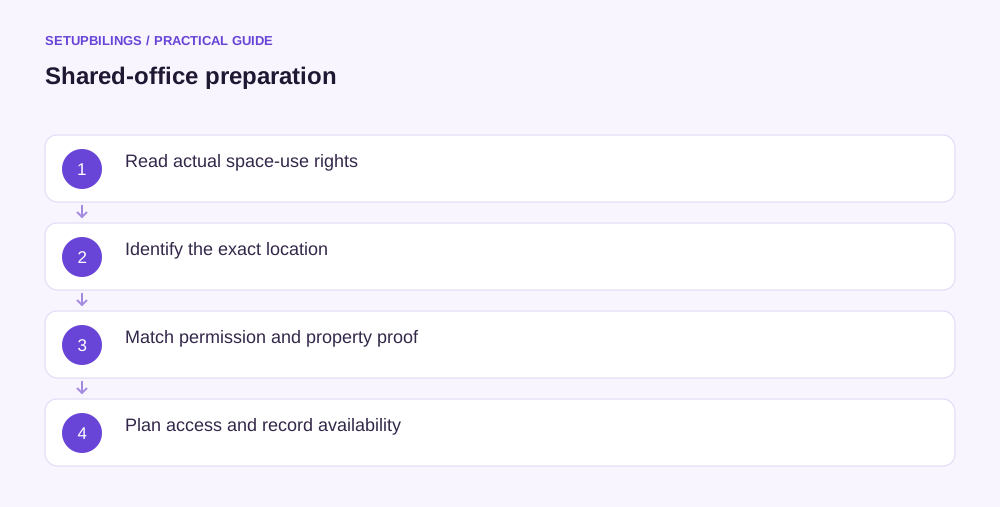
Understand what the office contract provides
A shared office can involve a dedicated cabin, an allocated desk, flexible workspace or a limited correspondence service. These are different factual arrangements. Before using the address for GST registration, establish what the business may actually use, how it can access the premises and where its relevant operations and records are located.
A provider's marketing statement that its address is “GST ready” is not an approval from the tax authority. Read the contract and evidence yourself. The application must describe the applicant's real position, and the person signing it should understand the premises arrangement rather than relying only on a salesperson's promise.
Connect the applicant to the premises
Check who provides the space and what right that provider has over the property. If the provider leases a whole building and licenses desks, the file should explain the applicant's actual permission and location. Do not assume an electricity bill in the building owner's name alone proves the applicant's right to occupy a desk there.
Identify the exact unit, floor and building in the contract and application. Some providers operate multiple centres under one brand, so a brand-wide brochure is not a substitute for evidence relating to the chosen location. Make sure the document names the correct applicant, particularly where a director books space before the company is incorporated.
Where an agreement is signed by a manager or agent, establish the real authority through the relevant business records. This is a practical consistency check, not a claim that every application needs a uniform chain of notarised property documents. Request evidence that supports the actual arrangement instead of demanding an indiscriminate file from the provider.
Apply the shared-premises document guidance
CBIC's Instruction 03/2025-GST expressly addresses shared premises. Where a rent or lease agreement is available, it describes the agreement together with one relevant ownership-supporting document. The instruction distinguishes an unregistered agreement, where lessor identity proof is also described, from a registered agreement, where that additional identity proof should not be sought.
For shared premises without a rent or lease agreement, the instruction describes a plain-paper consent letter, consenter identity proof and sufficient ownership-supporting evidence. Examples in the document list include property tax, municipal khata and electricity records, with similar recognised documents allowed where they clearly establish ownership.
Choose the route that matches the actual arrangement. A licence or membership contract should not be casually rewritten as a property lease if that is not what it provides. Review how the provider's contract and permission support the selected possession category and keep a clear explanation for any genuine difference in terminology.
Check usability before paying a long deposit
Ask how the business will receive official correspondence, respond to a verification visit and access the declared location. Confirm opening hours, identification procedures and who at reception can locate the applicant. A genuine office that nobody can identify during a visit can create avoidable confusion when the address is being verified.
Consider where accounting records are kept and who can produce them. Shared-office membership should not be used to hide the fact that operations occur at another undeclared location. If goods are stored in a separate warehouse, review that premises independently and determine how it fits the registration map.
Illustratively, a marketing LLP pays ₹9,000 monthly for two desks in a Gurugram coworking centre. The contract covers the fourth floor, but its application uses a different centre's ground-floor address copied from the provider's website. Correcting the address and obtaining location-specific evidence is necessary; a higher membership fee would not solve the inconsistency.
Review the form and evidence together
Check the legal name, possession type, activities at the location and complete address. Confirm building and floor information after using the GSTN map feature. If a map pin points to a nearby building, adjust it to the actual location while keeping the written address accurate. Do not let the map result overwrite verified contract details without review.
Make uploads readable and complete. Include the relevant agreement schedules and signatures, and follow current file limits. Where a provider gives one consolidated evidence pack for many clients, ensure it contains the records relevant to your location and arrangement. Another tenant's permission letter should never be passed off as your own.
CBIC's instruction cautions against presumptive queries unrelated to submitted facts. At the same time, an incomplete address, invalid evidence or unreadable file can legitimately require clarification. Keep a document index that explains what establishes permission, ownership connection and the precise location so a response can be prepared quickly if requested.
Maintain the address after registration
Record membership renewal dates, notice periods and the procedure for moving between centres. A provider's internal transfer of a desk does not automatically amend your GST registration. Review whether a change affects the principal place, an additional place or a different State, and use the relevant registration process.
After an amendment, check the profile and downloaded certificate and update supplier and customer address masters. Preserve the old and new premises records so transactions during the transition can be traced. This is especially useful where invoices or courier documents continue to show a former centre for a short period.
A shared-office address works best when it represents a genuine, documented business location. The owner should be able to identify the space, explain the right to use it and maintain access throughout the period for which it remains in the GST profile.