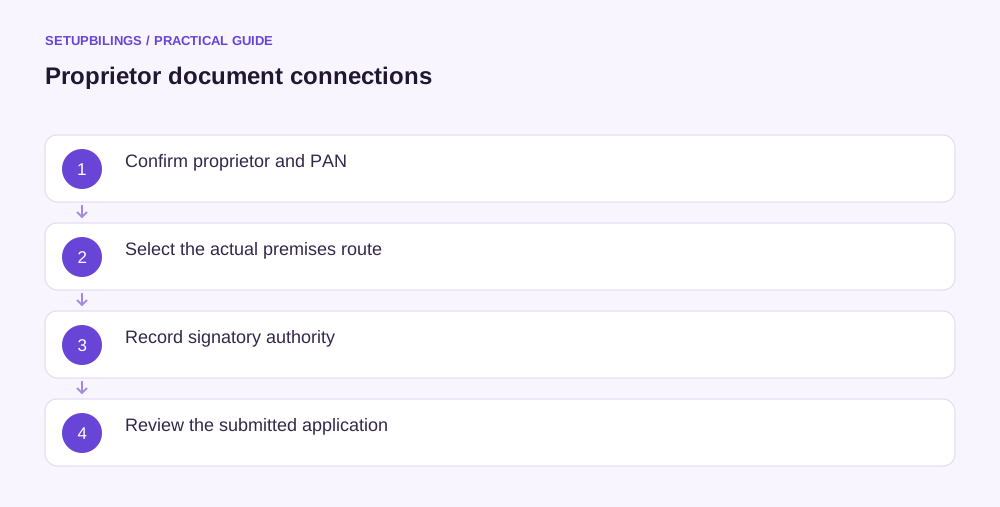
Use the proprietor's identity consistently
A sole proprietorship is operated by an individual, so the normal GST registration process uses the proprietor's PAN rather than a separate PAN invented for the trade name. GSTN's registration manual expressly distinguishes the business entity's PAN from the proprietor's PAN. Enter the legal name as it appears in the PAN database and record the trading brand separately.
Before collecting scans, confirm that proprietorship is the correct constitution. If two people jointly run a partnership, using one person's PAN and describing the other as an employee can create a misleading application. The document file should describe the real ownership and authority, not simply the easiest name available for portal validation.
Prepare the identity and contact file
Keep the proprietor's PAN details, photograph and the personal information requested in the relevant promoter and signatory fields ready. Check spelling, date of birth and contact details against the source records. Where Aadhaar authentication applies, the person must be able to complete the communicated process; an adviser cannot substitute their own identity for the proprietor.
Use an email address and mobile number that the business owner controls and checks. These support OTPs, application messages and later account access. A consultant can help prepare records, but the permanent contact details should not leave the proprietor dependent on a former employee's personal phone.
Do not submit more identity documents than the application and relevant instructions require simply to make the file look substantial. Instead, make the required documents clear and complete. Crop scans carefully so that names, dates, addresses, signatures and document references remain readable and relevant pages are not missing.
Match address evidence to possession
For owned premises, CBIC's 17 April 2025 instruction accepts an appropriate ownership-supporting document from the indicated list or a similar recognised record. Examples include property tax, municipal khata and electricity records. The instruction explains that one sufficient ownership document should not routinely lead to demands for additional ownership evidence.
For rented premises, prepare the valid rent or lease agreement and the relevant supporting address or ownership record. The instruction distinguishes registered and unregistered agreements: an unregistered agreement also calls for the lessor's identity proof under that guidance. Where the utility connection is in the tenant applicant's name, the instruction addresses using that evidence with the agreement.
For family-owned premises used by permission, use the consent route that reflects the arrangement. The instruction describes a plain-paper consent letter, the consenter's identity proof and a sufficient ownership-supporting document. Do not describe a consent arrangement as ownership merely because the proprietor and property owner share a surname.
Make the address easy to verify
Read the proposed portal address next to the agreement and utility record. Confirm building or flat number, floor, street, locality, city, district, State and PIN. If the electricity bill uses an older locality name, obtain a relevant explanation or supporting record. Do not alter the underlying bill to create an artificial match.
An illustrative home baker uses a room in her mother's Ahmedabad flat. She has no tenancy agreement and pays no rent. A sensible application file records the mother's permission and ownership evidence, identifies the actual business address, and states the business activity accurately. It should not manufacture a ₹5,000 monthly lease solely because someone assumes every GST applicant needs a rental agreement.
If goods are stored at another location, assess whether it needs to be declared as an additional place of business. The proprietor should describe where stock, work and records actually sit. A shipping warehouse should not disappear from the application merely because customers know only the shop's address.
Document any authorised signatory
The proprietor may act as the authorised signatory. If another person is appointed, prepare the appropriate authorisation and acceptance records requested for that role. Define who can submit applications and receive communications, while retaining owner control over the account. An authorised representative or GST practitioner role should not be confused with ownership of the business.
Check whether the person entered in promoter details is also marked as the primary authorised signatory. Their name and contact information should agree across the relevant tabs. Where the application selects persons for authentication, coordinate their availability before submission instead of discovering later that an essential phone number is inactive.
Check the proprietor's existing GST registrations and applications under the same PAN before creating another one. A second trade name is not automatically a separate applicant. If an earlier application was rejected or another registration is suspended, preserve that history and understand its significance. This is particularly useful when a new preparer inherits only a folder of identity scans without the owner's earlier portal correspondence.
Review the application as a single file
Use a simple checklist: legal identity, constitution, trade name, principal address, additional locations, business activity, signatory authority and verification route. Enter the actual goods and services in the relevant fields. A proprietorship document pack is not improved by adding an unrelated trade licence or another business's registration certificate.
Keep the final submitted application, all uploads and the acknowledgement together. If a clarification notice is issued, compare its request with the exact records submitted. Respond to genuine gaps with a readable document and a direct explanation, preserving a copy of the portal reply and submission evidence.
After approval, check the certificate against the source file and arrange bank details through the applicable post-registration process. The strongest sole proprietor application is small enough to understand and complete enough to show who operates the business, where it operates and who has authority to act for it.