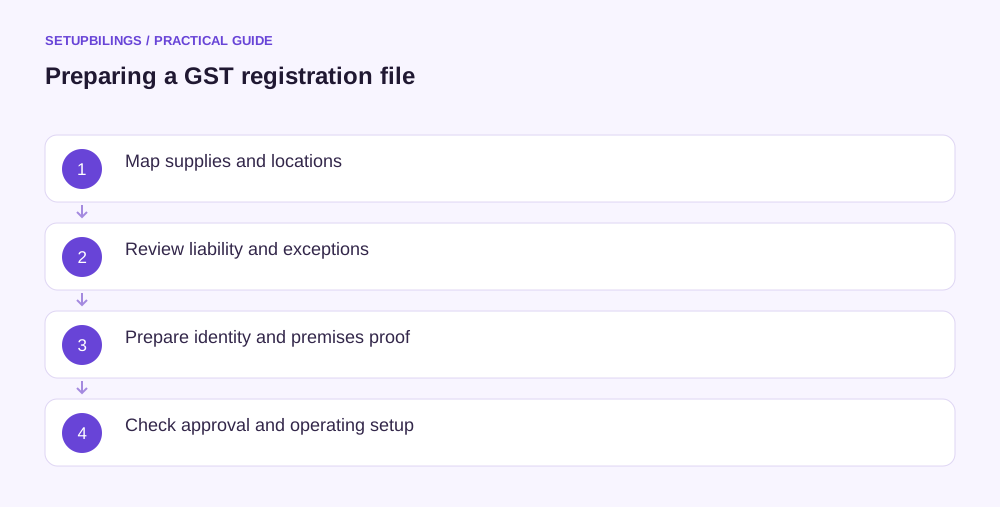
Start with liability, not the application form
GST registration gives a business a tax identity for a particular State or Union territory and registration category. The right starting question is whether your actual supplies, locations and turnover require registration. A shop, consultancy and overseas digital supplier can face different registration rules even when they earn similar revenue.
Separate the legal person from the brand. A sole proprietor normally uses the proprietor's PAN; a partnership, LLP or company uses its own PAN. Then list every business conducted under that PAN. Registration thresholds cannot safely be assessed by looking only at one shop's bank receipts or one online marketplace account.
Build the registration decision file
The CGST Act links ordinary registration liability to aggregate turnover and the State from which taxable supplies are made. Aggregate turnover is an all India measure for the same PAN, including taxable supplies, exempt supplies and exports, while excluding GST and inward supplies taxable under reverse charge. It is not profit or the balance collected after payment charges.
Do not treat ₹40 lakh as an India-wide entitlement. The notification introducing that exemption for exclusive suppliers of goods has conditions and exclusions. Services, particular goods, specified States and compulsory registration situations need their own assessment. Also check notified exemptions before assuming every inter-State transaction or marketplace sale makes registration compulsory.
Keep a dated note identifying the rule applied, your supply classification, relevant State, current financial year turnover and any special business model. This makes a later expansion easier to review. Where the answer depends on a contract, retain the contract with the note rather than recording only a verbal conclusion.
A practical decision file can be only one page, provided it links to the underlying records. Include the owner responsible for tracking turnover and a review trigger, such as a new warehouse or sales channel. That keeps a threshold conclusion from becoming a permanent assumption after the business changes. Retain the date of the review so later staff know which operating facts were considered.
Choose the correct registration category
Normal registration and the composition scheme have different billing, credit and reporting consequences. Composition is an option only when its eligibility conditions are met; it is not a default form of small-business registration. Special categories include casual taxable persons, non-resident taxable persons, Input Service Distributors and organisations deducting or collecting GST under the applicable provisions.
An illustrative Bengaluru design studio has ₹18 lakh in Indian client fees and ₹5 lakh in export service revenue during a year. It should not assess turnover as ₹18 lakh merely because the export invoice carries no Indian output tax under its chosen export route. Nor should it count a ₹2 lakh owner capital contribution as customer revenue. The supplies and receipts require separate classification before the liability decision.
Prepare one consistent set of records
Organise legal identity, promoter or partner details, authorised signatory authority, business address evidence and the goods or services you actually supply. The GSTN registration manual separates these into application tabs. Enter the legal name as recorded against PAN, and distinguish it from the trade name displayed to customers.
For premises, match the evidence to your possession arrangement. Ownership, a registered lease, an unregistered rental agreement and family consent are different cases. CBIC's 17 April 2025 instruction explains acceptable evidence and cautions officers against routine demands for unrelated documents. A clear address and readable supporting record matter more than a large unsorted upload bundle.
Before submission, compare building number, floor, road, locality and PIN across the form and evidence. Explain an actual discrepancy using a relevant document. Do not quietly change an electricity bill or reuse a former tenant's agreement to make the addresses appear consistent.
Complete the portal process carefully
Use the official GST portal and start the new registration workflow. Part A captures basic identity and contact information; Part B contains the fuller business details. Keep the Temporary Reference Number and monitor its validity. Saving a draft does not mean that a registration application has been submitted or approved.
Follow the Aadhaar authentication or verification route communicated for your application. GSTN states that biometric authentication is risk based, not mandatory for every applicant. Where a GST Suvidha Kendra visit is required, coordinate the selected person's availability and original records. A failed or incomplete authentication step can prevent ARN generation.
Keep the acknowledgement, submitted application and every attachment together. The Application Reference Number is used to track the submitted application. If a clarification notice appears, read its specific issues and respond through the prescribed workflow; an email to an adviser alone does not complete a portal response.
Treat approval as the start of operations
Download and check the registration certificate. Confirm the GSTIN, legal and trade names, places of business, registration type and effective date. Resolve discrepancies promptly using the correct process. The certificate issue date and the effective date can have different implications for the first transactions you report.
Set up business-controlled access, bank details, invoice masters and a return calendar for your registration category. Reconcile sales and purchase records from the effective date, including transactions entered while the application was pending. Decide who prepares records and who authorises filings, with a clear handover if an outside professional helps.
A sound first registration is a documented business decision followed by accurate portal work. Once those two pieces agree, future branches, new sales channels and ownership changes become easier to assess without rebuilding your history from scattered messages.
Sources and references
- CBIC: Central Goods and Services Tax Act, consolidated through August 2021
- GSTN: Applying for normal taxpayer registration
- CBIC Instruction 03/2025-GST, 17 April 2025
- GSTN: Registration and biometric authentication FAQs
- Notification 10/2019-Central Tax: conditional goods registration exemption
- Notification 34/2023-Central Tax: conditional exemption for goods through ECOs