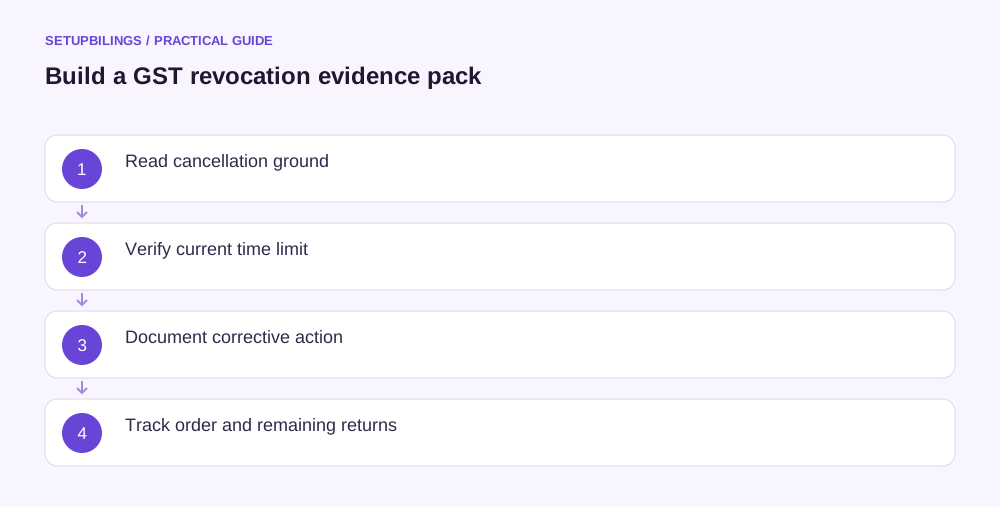
Organise a GST revocation application around the cancellation reason, the evidence addressing it and the conditions for the applicable restoration route. Preserve the cancellation order, earlier notice and response history. A collection of recent returns without an explanation of the original ground may leave the central issue unresolved.
Confirm that revocation is the appropriate route
Rule 23 concerns registration cancelled by the proper officer on the officer’s own motion, subject to the rule’s conditions. It does not automatically apply to cancellation voluntarily requested by the taxpayer.
Identify the order reference, GSTIN, effective date and reason. Record whether the cancellation is retrospective and which intervening periods are affected.
The usual application form is REG-21. Check the actual portal workflow and applicable requirements before preparing the filing; the order history determines what must be answered.
Use the amended application period
Notification 38/2023 amended rule 23 with effect from 1 October 2023 to provide ninety days from service of the cancellation order for the application. It also provides a conditional extension, for sufficient cause and recorded reasons, by the specified authority for a further period not exceeding 180 days.
Do not treat that extension as automatic or assume every applicant has 270 days without approval. Preserve service evidence and have the reviewer calculate the relevant dates promptly.
An older FAQ or article stating a thirty-day base period should not override the amended rule. Keep the operative amendment with the calendar working.
Build a cancellation-to-cure chronology
| Stage | Evidence to retain |
|---|---|
| Original allegation | Notice, annexures and service records |
| Earlier response | Filed reply and attachments |
| Cancellation | Full order and effective date |
| Corrective action | Completed filings, amendments or factual evidence |
| Payments | Approved working and actual ledger debits |
| Application | Final REG-21 set and acknowledgement |
Use dates and exact references. “Default resolved” is not enough when the reviewer needs to know which returns were filed, what was paid and whether an address amendment was actually completed.
An illustrative nonfiling cancellation file
An Indore supplier’s registration is cancelled on an officer’s initiative for identified return defaults. The business prepares a schedule of each listed period, its filed return, tax payment and applicable interest or late-fee treatment.
Assume the reviewed working identifies ₹84,000 tax and ₹6,500 of other applicable dues, totalling ₹90,500. Those figures must reconcile to the actual returns and debit evidence; they are not a standard restoration charge.
For cancellation due to failure to furnish returns, rule 23 contains preconditions concerning those returns and related amounts. Do not describe a cash-ledger deposit or an unfiled return draft as completed compliance.
Address nonfiling and other grounds separately
If the order concerns premises, provide the occupancy and actual business evidence relevant to the allegation. If it concerns transaction anomalies, build the invoice, receipt and reporting trail.
Filing returns may be necessary but may not answer a separate finding that the business was not operating at its declared address. Identify every ground in the order rather than assuming one corrective action cures all of them.
Where facts have changed, state the change and its actual date. A newly executed agreement or current photograph should not be presented as though it existed during an earlier inspection.
Plan for intervening returns after restoration
Rule 23 also addresses returns due for the cancellation-to-revocation period and retrospective-cancellation situations, with a thirty-day filing requirement from the revocation order under the relevant provisos.
Build the transaction and return working before restoration so the team is ready to meet that requirement if revocation is granted. Do not assume every blocked period can or must be filed before the application; distinguish preconditions from post-revocation obligations.
Review input-credit eligibility and timing under the law applicable to those facts. Restoration does not justify indiscriminate claims without checking the relevant conditions and any specific relief.
Prepare a concise application narrative
Explain the order, reason for seeking revocation, corrective actions and evidence. Reference annexures directly and identify any delay requiring a supported extension request.
Avoid generic claims of hardship as the only explanation where the ground is factual noncompliance. The authority needs a clear basis for reviewing the cancellation and the current position.
Obtain signatory approval of the exact final version. Save the submitted narrative, annexures and acknowledgement together so a later query can be answered consistently.
Respond to further queries through the correct process
A proposed rejection or request for clarification may require a further response, commonly involving REG-23 and REG-24 under the rule. Read the actual communication and its deadline immediately.
Do not assume the original application acknowledgement means registration is active. Continue controlling affected transactions according to the verified status and applicable restrictions.
If the application is rejected or another order is issued, preserve it and review available next steps separately. Informal discussions do not replace the operative document.
Confirm the outcome and remaining work
Save the revocation order, generally REG-22, and verify the resulting status and effective treatment. Reconcile the post-restoration return calendar, outstanding amounts and customer documents.
A complete revocation pack shows the entire chain from allegation to corrective evidence and formal outcome. That gives the business a practical restoration file while keeping deadlines, payments and remaining reporting obligations visible.