Start with the deductor category
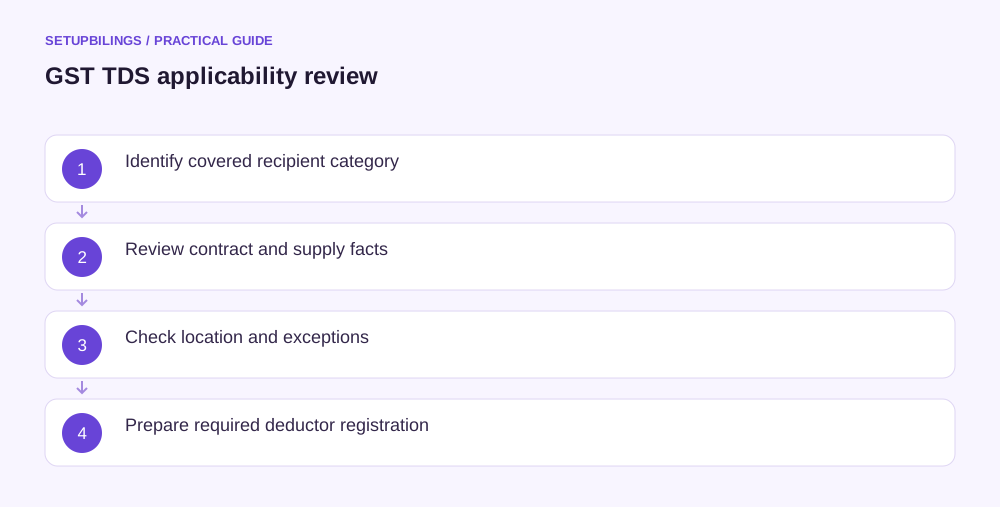
GST tax deduction at source is governed by section 51 and the relevant notifications. It does not apply to every business merely because that business deducts income-tax TDS. Begin by checking whether the recipient falls within a specified GST deductor category, then assess the contract and supply conditions.
The statutory framework identifies government departments or establishments, local authorities, governmental agencies and notified persons or categories. Establish an organisation's actual legal status and applicable notification rather than relying on a name containing “government,” a public grant or an informal description as a public institution.
Include the notified metal-scrap category
The applicability review is no longer confined to the familiar public-sector examples. Notification 25/2024-Central Tax added registered persons receiving metal scrap falling under Chapters 72 to 81 from other registered persons, effective 10 October 2024. A private registered business dealing in that material should therefore review the notified recipient role.
Check the actual product classification, supplier registration and recipient facts. Buying a finished metal machine is not automatically the same as receiving metal scrap within the specified chapters. Nor should the registered-to-registered TDS notification be confused with a different reverse-charge rule concerning purchases from unregistered suppliers.
Retain purchase descriptions, classification support and supplier GST details with the assessment. A general ledger labelled “scrap” may include several types of material, and a vendor may supply both scrap and finished goods. The tax decision should follow the actual supply rather than a broad accounting code applied to everything from that vendor.
Assess the contract threshold correctly
Section 51 uses a contract-based threshold: the total value of taxable supply under a contract must exceed ₹2.5 lakh, with the statutory tax-value exclusion applied. Do not examine only an individual instalment or payment voucher. Several small payments can relate to one contract whose value crosses the threshold.
Illustratively, a covered organisation enters a taxable maintenance contract valued at ₹3 lakh before GST and pays three ₹1 lakh instalments. It should assess the contract as a whole rather than concluding that no deduction question arises because every payment is below ₹2.5 lakh. The deductor category, supply and place conditions still require review.
Separate taxable and other elements carefully where the agreement includes different supplies. Identify the actual contract terms and statutory basis for the value used. Do not subtract unrelated procurement expenses or treat the threshold as annual turnover of the supplier; it is a different measure answering a different question.
Review location and exceptions
Section 51 contains a place-based exception where the supplier's location and place of supply are in a State or Union territory different from the recipient's State or Union territory of registration. Establish those facts before applying a deduction. A supplier's bank branch or payment gateway location does not determine the place of supply.
Read applicable notifications and exceptions for the relevant category and period. Notification 25/2024 also amended the treatment of specified transactions between covered persons while preserving the stated metal-scrap exception. Avoid reducing that detailed wording to a universal claim that all transactions between government-related bodies are either deductible or exempt.
Keep the contract, supplier invoice and location analysis together. Where a procurement team cannot identify the correct recipient registration or place of supply, resolve it before payment processing. A decision made from the billing address alone can be wrong where the underlying GST place rule depends on other facts.
Prepare the deductor registration file
Persons required to deduct GST must review the special registration requirement even if they already hold a normal business GST registration. Rule 12 provides the FORM GST REG-07 registration process for the deductor or collector role. A normal GSTIN should not automatically be used as a substitute for the required TDS setup.
Section 25 permits TAN in lieu of PAN for a person required to deduct under section 51. Use the correct applicant identity and authorised person, with the supporting organisation and contact records requested by the form. A particular employee's personal tax identity should not be substituted for the organisation's lawful registration details.
Confirm the registration's State, responsible office and signatory arrangements. Organisations with several payment offices should map how contracts, deductions and reporting will be controlled. Duplicate or mismatched recipient records can cause deductions to be reported against the wrong supplier or administrative unit.
When the contract is amended, reassess the total value and effective terms rather than leaving the original threshold conclusion untouched. Keep the amendment with the procurement record. A later increase, additional work order or changed supply description can require a fresh review even when the vendor and monthly payment amount look familiar.
Connect registration to payment controls
Maintain a contract register with value, taxable classification, supplier GSTIN, location facts and deduction decision. Link invoices and payments to that contract so instalments do not escape review. Record the basis for a non-deduction where an exception applies instead of leaving the field blank and expecting staff to remember the reasoning.
Set up the current GSTR-7 and payment calendar, including applicable nil-reporting requirements, certificate information and correction processes. Verify the relevant rates and tax heads from the law for the transaction. A purchase-account deduction in the ledger is not complete compliance unless the prescribed deposit and reporting steps are also performed.
Reconcile deductions with supplier records and resolve GSTIN or amount errors promptly. The practical objective is a supported applicability decision followed by the correct special registration and transaction-level reporting. That gives both the organisation and its suppliers a clear explanation of why an amount was deducted and where it was reported.