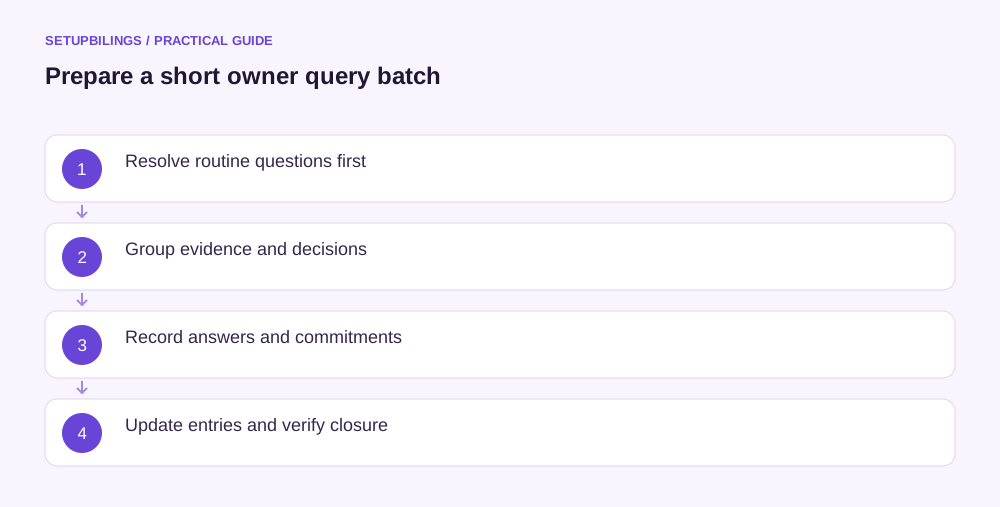
Batch bookkeeping questions for owner review by collecting related issues, resolving routine facts first and presenting a short list of decisions with evidence and consequences. Give each item a precise question and a recommended next step where appropriate. The owner should not have to decode bank screenshots or repeat information already held by the team.
Batching works best with a regular review slot and an urgent route for genuinely time-sensitive matters. It should reduce interruptions without allowing important payments, closing adjustments or missing evidence to wait indefinitely.
Decide what actually needs the owner
Route supplier-delivery questions to purchasing or operations, project codes to the relevant manager and technical accounting questions to a suitable reviewer. The owner is needed where their personal knowledge, authority or commercial judgement is essential.
Examples include explaining a personal transfer, approving a material unsupported exception, deciding a disputed payment or confirming an unusual related-party arrangement. Do not make the owner the default respondent for every missing receipt.
An illustrative Indore distributor begins with 18 open queries. Accounts resolves six from statements, operations answers four and the accountant handles three classification questions. Five remain for the owner. Preparation reduces the review load without concealing the unresolved issues.
Prepare one concise record per issue
Include a stable reference, date, amount, counterparty, known facts, missing information and supporting documents. State the exact decision or fact required. Keep longer history available behind the summary.
For a ₹40,000 transfer to the proprietor, ask whether it was a drawing, repayment of a documented owner advance or another transaction, with relevant records. Do not label it as an expense simply because the business bank paid it.
A clear prompt might say: “TX-908, ₹40,000 to your account on 10 October. Please confirm its purpose and whether it settles owner funding shown in schedule OF-03.” This narrows the question while allowing the owner to correct the assumption.
Group questions by decision type
Use a few useful groups, such as owner transactions, commercial disputes, payment approvals and missing business context. Place urgent or material items first and keep low-value routine items together.
| Review group | Preparation needed |
|---|---|
| Owner transactions | Bank record and owner-balance schedule |
| Supplier disputes | Invoice, receipt confirmation and correspondence |
| Expense exceptions | Available evidence and policy route |
| Customer allocation | Receipt detail and candidate invoices |
| Reporting adjustments | Calculation and effect on the result |
Grouping should aid attention, not merge separate transactions into an unanswerable question. Preserve individual references and amounts within a related batch.
Show the consequence of waiting
Explain whether the question affects payment, customer allocation, a provisional expense, a report or only an internal tag. This helps the owner prioritise without guessing which item matters most.
If the five Indore queries include ₹1.2 lakh of uncertain supplier payments and three small project-code questions, the payment issues may deserve earlier attention. The project questions still need owners and dates so they do not disappear.
Avoid artificial urgency. A red flag on every row makes the batch harder to use. Apply priority consistently based on real timing, financial exposure and dependencies.
Offer choices only when the facts support them
Where helpful, show the plausible interpretations and evidence for each. Do not force a choice between two guesses when the correct answer may be different. Leave space for factual correction and additional documents.
For the ₹40,000 transfer, the owner may explain that ₹25,000 repaid a recorded advance and ₹15,000 was a drawing. The resulting split should be supported and reviewed; the original single amount does not require a single classification.
Accounting and tax judgement should remain with the appropriate reviewer. Owner confirmation of purpose does not establish every recognition or tax condition. Separate the business answer from the technical treatment.
Run a short review with a visible record
Share the batch with enough preparation time for the actual urgency and schedule. During review, record the answer, evidence promised, decision owner and follow-up date. Confirm ambiguous statements immediately rather than interpreting them later from memory.
Keep unresolved items open. “Will check” is an action, not a completed answer. Assign who will supply what and when. If the owner delegates the response, record the new responsible person.
Do not include bank passwords or sensitive credentials in the batch. Provide controlled access to supporting documents and share only the information needed for the decision.
Translate answers into bookkeeping action
After review, update the query log and make the approved entry, allocation or correction. Link the accounting reference and recheck affected balances. A completed meeting does not by itself change the books.
ICAI’s source-document and rectification material supports evidence-linked entries and clear treatment of errors. Preserve the owner’s factual response and the reviewer’s decision so another person can understand the result.
For the split transfer, the relevant owner balances should reconcile after posting. If the answer requires further documents, keep the amount and reporting effect visible until those arrive or an approved treatment is determined.
Improve the next batch
Track which questions repeatedly reach the owner. Missing purpose on every personal payment may call for a standard owner-transfer note. Repeated supplier disputes may need better goods-receipt confirmation. Fix the source rather than making the review longer each week.
Measure the proportion resolved completely, time spent and issues reopened because answers lacked evidence. A short meeting with many reopened questions is not necessarily efficient.
The best owner-review batch is small because preparation is strong, not because uncertainty has been hidden. It turns the owner’s knowledge and authority into precise, recorded answers that the bookkeeping team can act on once.