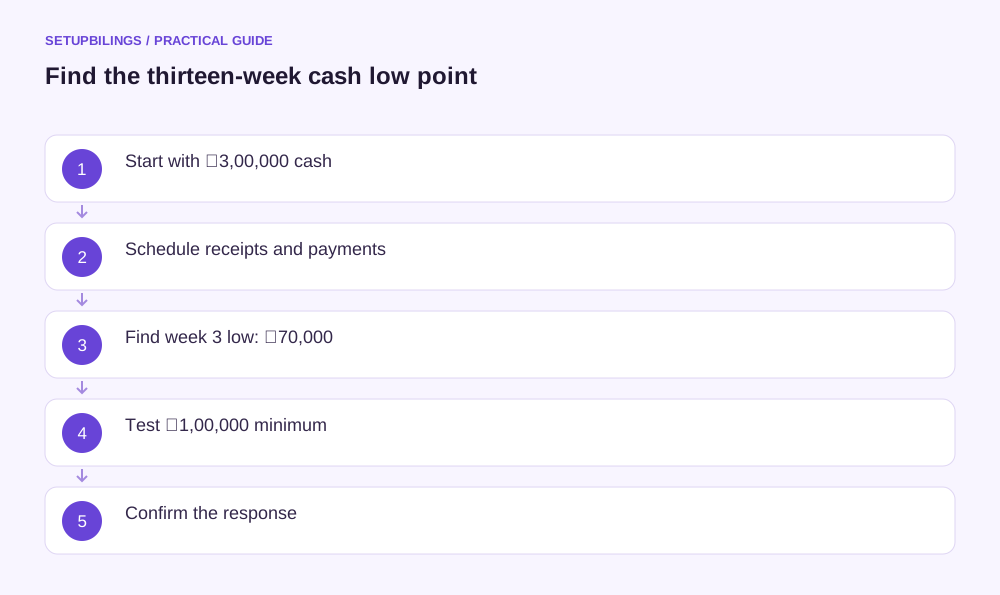
Build a 13-week cash flow forecast by starting with available opening cash, adding expected receipts and subtracting dated payments for each week. Carry each closing balance into the following week's opening balance. Compare the lowest projected balance with the minimum operating cash the business needs, then model specific actions to close any gap.
Thirteen weeks is a practical planning horizon covering roughly a quarter; it is not a universal statutory format. The near weeks should be grounded in invoices and commitments, while later weeks use documented trading assumptions. Update the schedule weekly as actual cash movements replace estimates.
Start with cash that can actually be used
Consider an illustrative Chandigarh distributor with ₹3,00,000 available across its operating bank accounts at the forecast start. The preparer reconciles the balances and checks for uncleared payments, restricted deposits and transfers between the business's own accounts.
Do not count the same transfer as an external receipt in one account and an expense in another. Keep undrawn borrowing capacity separate from cash already held. A facility can have conditions, limits or timing requirements that affect whether it is usable in the week needed.
ICAI's cash-management material describes the receipts-and-payments approach: add expected inflows to opening cash and deduct outflows to obtain closing cash. The forecast below applies that principle weekly.
Build receipts from collection dates
List major outstanding customer invoices individually, with expected receipt date, amount, confidence and person responsible for follow-up. A contractual due date is useful evidence, but the expected bank receipt should also reflect actual customer behaviour and known disputes.
For future sales, estimate when customers will pay rather than treating invoice value as immediate cash. Keep cash sales, card settlements and credit collections distinct where timing differs. Avoid counting an opening receivable again as collection from a future sales forecast.
Schedule payments from commitments
Use supplier invoices, approved purchase orders, payroll, rent, tax obligations, financing payments and planned equipment expenditure. Include periodic and exceptional payments that a monthly average can hide. Use actual applicable payment amounts and dates; no standard percentage can substitute for the business's tax or contract facts.
Separate committed payments from proposed discretionary spending. The forecast should reveal choices without pretending existing obligations vanish. Any rescheduling needs a genuine agreed or otherwise valid basis and a revised date.
Calculate the weekly balances
The distributor's illustrative schedule is shown in ₹ lakh. It assumes no new financing and starts with ₹3.00 lakh.
| Week | Receipts | Payments | Closing cash |
|---|---|---|---|
| 1 | 2.00 | 2.60 | 2.40 |
| 2 | 2.20 | 3.10 | 1.50 |
| 3 | 1.80 | 2.60 | 0.70 |
| 4 | 2.60 | 2.00 | 1.30 |
| 5 | 3.00 | 2.30 | 2.00 |
| 6 | 2.50 | 2.80 | 1.70 |
| 7 | 2.80 | 2.60 | 1.90 |
| 8 | 3.00 | 3.00 | 1.90 |
| 9 | 2.70 | 2.40 | 2.20 |
| 10 | 3.20 | 2.80 | 2.60 |
| 11 | 2.90 | 2.50 | 3.00 |
| 12 | 3.10 | 2.60 | 3.50 |
| 13 | 3.40 | 2.90 | 4.00 |
The lowest closing balance is ₹70,000 in week 3. If the business's chosen operating minimum is ₹1,00,000, the forecast shows a ₹30,000 shortfall against that minimum despite never reaching a negative weekly balance. This minimum is an illustrative management policy, not a prescribed reserve.
Model actions without double counting benefits
Suppose a customer confirms that ₹50,000 originally expected in week 4 can arrive in week 3. Move the receipt between weeks; do not add ₹50,000 to week 3 while leaving it in week 4. Week 3's closing balance rises to ₹1,20,000, while week 4's ending balance returns to the original path.
A supplier extension similarly moves a payment; it does not create profit or eliminate the eventual outflow. New borrowing adds a receipt and brings interest, fees and repayment commitments that must be scheduled separately.
Assign each action an owner and a confirmation date. Keep unconfirmed actions outside the base case or clearly identify their status so a speculative collection does not appear as cash already secured.
Stress the uncertain receipts
Run a case where the largest uncertain collection arrives later. Review the resulting minimum balance and the week in which action is needed. Probability-weighted receipts can be misleading for a single large invoice because the bank receives the actual settlement, not an average fraction of several possible outcomes.
For a tight week, open a daily schedule. A positive Friday closing balance can conceal a Tuesday payment shortfall if the week's receipts arrive after the commitments fall due.
Set one ownership rule for the opening balance
The person preparing the schedule should obtain a reconciled opening position from accounts and document its cut-off. Payments already sent but not yet reflected in a displayed balance need consistent treatment. Without that rule, the first week can be overstated and every later balance inherit the error, even when the receipt and payment formulas are correct. Resolve the starting point before debating the forecast's distant weeks.
Refresh the forecast on a fixed cadence
Replace the completed week with actual bank movements, explain major differences and add a new week at the end. Retain the previous version so recurring collection optimism or missing payments can be identified.
A useful 13-week forecast is a decision register as well as a calculation. It should identify the cash low point, the assumptions causing it and the specific confirmed response. That gives the owner time to collect, renegotiate, stage spending or arrange funding before the difficult week arrives.