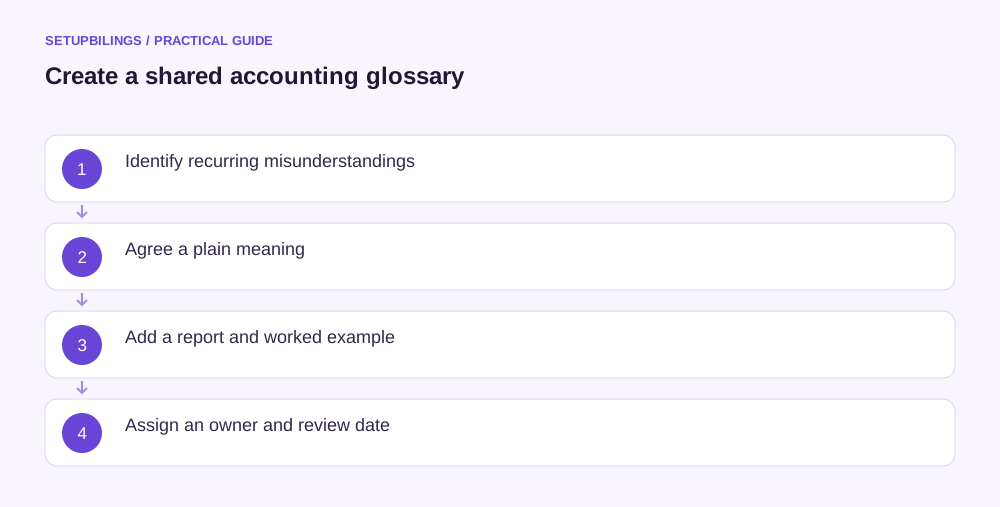
A useful accounting glossary explains the terms your team uses in the context of your own business records. It should give a plain meaning, identify the relevant report or account and show an example. Its purpose is consistent communication between sales, operations, the owner and finance, especially when responsibilities change.
A copied dictionary is only a starting point. Words such as sales, receipts, outstanding, margin and advance can mean different things to different employees. The glossary becomes valuable when it resolves those differences without replacing the applicable accounting requirements.
Start with the misunderstandings that cost time
Consider an illustrative Bikaner office equipment service firm. The sales team calls every invoice “income,” collections calls every bank credit a “sale,” and the owner asks for “net margin” without specifying which expenses are included. Monthly meetings repeatedly debate totals that cover different things.
Collect examples from recent reporting questions. Ask which terms caused a wrong action, delayed reconciliation or handover problem. Prioritise those words instead of attempting to define hundreds of unfamiliar expressions at once.
For this firm, the first entries might be billed sales, recognised revenue, customer receipt, advance, overdue invoice, gross profit, contribution and net profit. Each entry should point to a defined calculation or accounting concept and explain the difference from nearby terms.
Use a consistent entry format
Include the term, plain meaning, business application, example, source or policy reference and owner. Where a word has both a technical and an internal meaning, label the internal usage explicitly. Do not redefine a required accounting term in a way that contradicts its governing framework.
| Glossary field | Example for customer receipt |
|---|---|
| Plain meaning | Money collected from a customer |
| Business application | May settle invoices or represent an advance |
| Report reference | Receipt register and customer ledger |
| Example | ₹75,000 paid against an existing invoice |
| Common confusion | Collection is not automatically a new sale |
| Owner | Finance role responsible for allocation guidance |
Use role names where continuity matters. Naming one individual without a replacement process can make the glossary obsolete as soon as that employee leaves.
Build examples from actual workflows
Suppose, illustratively, a customer pays ₹75,000 through a payment intermediary, which deposits ₹73,500 after deducting a ₹1,500 fee. Assuming the facts support this treatment, the glossary should distinguish the customer payment, bank settlement and fee rather than call all three “receipt amount.”
The customer balance may be cleared by ₹75,000 while bank increases by ₹73,500 and the fee is recorded separately under the appropriate requirements. The example should state that a statutory withholding, disputed deduction or advance would require different analysis.
This level of detail helps the collections team explain a difference without inventing a short payment. It also helps the bookkeeper identify the supporting settlement statement and relevant invoice allocation.
Define calculations, periods and signs
For a measure such as gross margin, state the numerator and denominator used in the report. If sales are ₹1,00,000 and corresponding cost is ₹70,000, gross profit is ₹30,000 and margin on sales is 30%. Markup on cost is approximately 42.9%, which is a different measure.
For ageing, state whether days are counted from invoice date or contractual due date. For year-to-date figures, state the start date. For debit and credit balances, explain what the sign means for the account concerned rather than assuming a minus sign always indicates an error.
Include tax inclusion or exclusion where it affects the calculation. A sales dashboard and a customer payment register may use different amount bases for valid reasons, but those bases should be explicit and reconciled.
Connect terms to actions and evidence
A glossary can identify what the team should do when it sees a term. “Customer advance” may direct staff to obtain the order reference and distinguish the receipt from earned revenue. “Accrued expense” may point to the service period, estimate support and later bill-clearing process.
Keep the definition short, with links or references to the detailed policy or procedure. The glossary should not become a second uncontrolled policy manual. Material recognition decisions still require the relevant accounting basis and approval.
Use examples labelled as illustrative or adapted for training, and remove confidential details from broadly shared entries. The learning value comes from the transaction structure, not from exposing a customer’s identity or payroll information.
Maintain it through review and handover
Store the glossary where the relevant team can find the current version. Record the effective date, owner and change history. When a report definition changes, update the glossary and explain the effect on comparisons.
Test a few entries with staff outside finance. Ask them to identify the correct report, calculate a sample figure or explain what evidence is needed. If the entry produces several interpretations, revise the wording and example.
During a handover, review the glossary alongside the chart of accounts, reconciliations and unresolved-items list. It should help the incoming person understand account labels and internal measures without assuming every historical shorthand is technically correct.
Record deprecated shorthand where it is likely to recur. For example, an old report may call customer collections “cash sales.” Explain the earlier usage and point to the current term, while preserving the old report’s context. Deleting the phrase entirely can leave new staff unable to interpret historical files. A small cross-reference makes the transition easier.
A shared glossary reduces repeated clarification when it connects words with records and decisions. Begin with recurring misunderstandings, define the calculation or concept clearly and keep examples current. The whole team can then discuss the same financial event using the same meaning, making reports and handovers easier to act on.