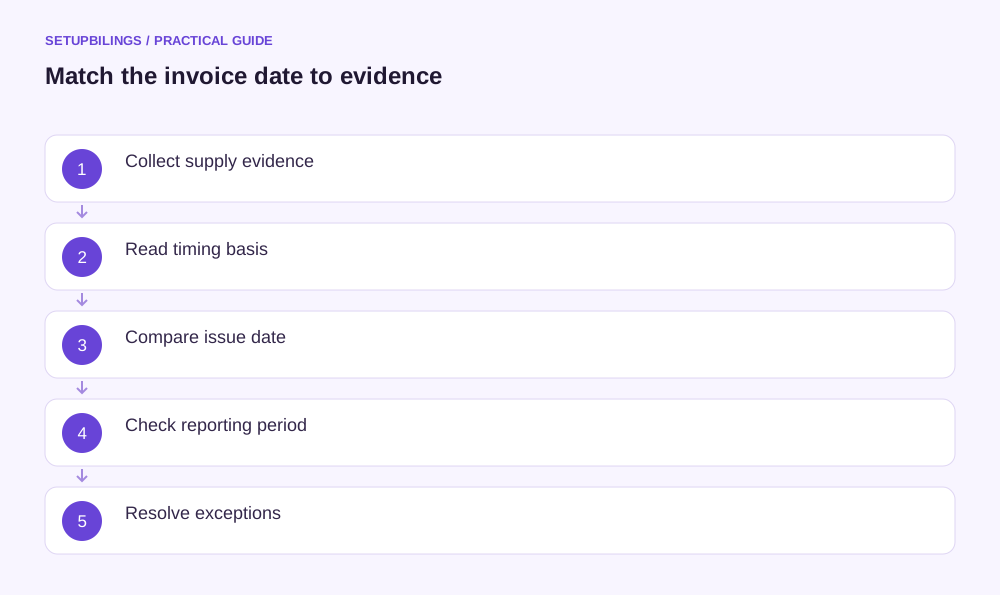
Check a GST invoice date against the event that required the invoice, rather than against the day the customer paid. For goods, section 31 generally links issue to removal where movement is involved, or delivery or making goods available in other cases. For services, the prescribed timing and special contractual rules need review. A date control works when dispatch, service delivery, invoice and payment records remain distinct.
Start with the actual supply timeline
Collect the purchase order, dispatch instruction, transporter record, delivery acknowledgment and invoice. For a service, obtain the agreement, service period, completion evidence, milestones and payment terms. List the dates in one place before deciding whether the invoice was timely.
Do not assume the ERP posting date equals the issue date. A draft may be entered on Monday and approved on Wednesday. A warehouse may dispatch on Tuesday. The accounting record needs to retain those facts, especially where an invoice number was reserved before the document was actually issued to the customer.
Review goods at removal or delivery
Where the taxable goods supply involves movement, the general section 31 rule requires the invoice before or at removal. If no movement is involved, examine delivery or when the goods are made available. Exceptions and notified categories require their own checks; a general workflow should have a way to identify them.
Consider an illustrative Pune manufacturer dispatching a machine on 28 March. Staff prepare the final invoice on 2 April because the customer promises payment after inspection. The payment arrangement does not, by itself, move the ordinary goods invoice requirement to April. The team should investigate the missed timing and reporting implications using the actual dispatch evidence, rather than changing the dispatch log to fit the invoice.
Identify the relevant service rule
Rule 47 generally provides thirty days from the date of supply of services. The rule contains a forty-five-day period for specified insurers, banking companies and financial institutions, including NBFCs, and other specified arrangements. Continuous supplies and cessation of service can require analysis under section 31 rather than a simple monthly deadline.
For a service contract, establish what the agreement says becomes due at each milestone. A ₹1,20,000 implementation assignment might have ₹40,000 due on design approval, ₹50,000 on installation and ₹30,000 on acceptance. Those milestones require a contract-based review. The fact that the customer transfers the entire ₹1,20,000 in one later payment does not erase the earlier billing events.
Keep advances on a separate track
An advance receipt date can affect time of supply and documentation even before a tax invoice is issued. Goods and services require different checks, including the relief for covered advances for goods under Notification 66/2017-Central Tax. Do not copy the service advance treatment into every goods transaction.
Maintain advance receipt references and adjustments against the final invoice. If a service customer pays ₹23,600 as a tax-inclusive advance at an assumed 18% rate, the illustrative base is ₹20,000 and tax is ₹3,600. When the final invoice is issued, ensure the same advance tax is not treated as an additional, unrelated collection or counted twice in the tax working.
Inspect year-end and rate-change dates closely
March and April deserve a focused review because a one-day date shift can affect the financial year and reporting period. Check goods staged for dispatch, services completed but not approved, invoices prepared but not released and customer requests for backdating. A requested date is not evidence that a supply occurred then.
Rate changes also require the supply, invoice and payment dates to be considered together under section 14 where applicable. Updating the rate master based only on the invoice date can produce the wrong outcome for a transaction crossing the change. Preserve the original dates and obtain a transaction-specific decision.
Turn exceptions into an actionable register
Use columns for supply reference, relevant event date, invoice date, required timing basis, amount, issue identified, owner and resolution. A register of vague “date mismatch” entries creates work without telling staff what to investigate. Distinguish missing evidence from a confirmed late invoice and from a correct special-case timeline.
Review samples across ordinary sales, milestone services, advances and month-end dispatches. An invoice worth ₹5,000 can reveal a workflow defect affecting much larger documents. Focus on why the date diverged: delayed warehouse communication, approval bottlenecks, an incorrect customer master or a misunderstanding of the contract.
A good date review preserves history and improves the next transaction. The final invoice should use a supportable issue date, and the records should explain when the supply occurred and how it was reported. That evidence is more useful than making every document date look identical after the event.
Make the next deadline visible
Once the facts are established, assign the next action to a named role. A service completion email can create a billing task with the relevant contract milestone; a confirmed dispatch can trigger a check that the invoice has been issued. Use separate pending lists for missing customer information and missing internal approval. If both are hidden under “unbilled sales,” staff may discover the problem only at month-end. A daily exception review is often more useful than a large retrospective spreadsheet.