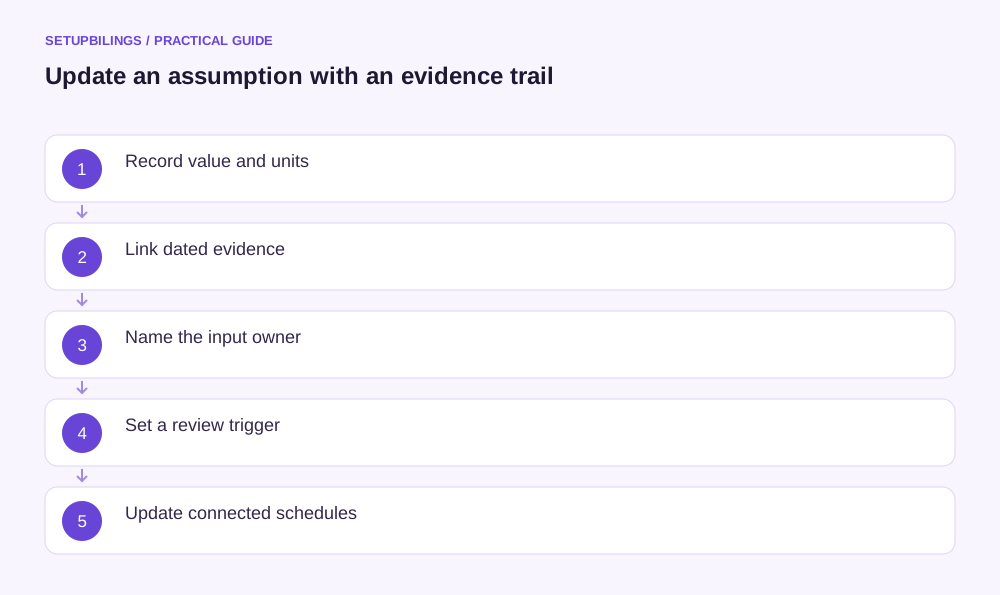
Document forecast assumptions in a short register showing the value, unit, period, evidence, owner and date for each material input. Add a review trigger and record changes without erasing the previous basis. Link each assumption to the schedules it affects so the sales, cost and cash forecasts remain consistent.
The log should explain the forecast's reasoning, not merely repeat its totals. “Revenue ₹10,00,000” is an output. “2,000 units at ₹500, supported by these orders and repeat-purchase assumptions” explains how that output was built and what could make it change.
Begin with assumptions that can alter a decision
Consider an illustrative Chennai carton distributor preparing a monthly forecast. Its key inputs are quantity, realised price, unit variable cost, customer collection time, supplier terms and replenishment lead time. It also records staffing or capacity thresholds where extra activity creates new spending.
The initial model assumes 2,000 cartons at ₹500, ₹320 variable cost each and ₹2,40,000 fixed operating costs. Revenue is ₹10,00,000, contribution ₹3,60,000 and operating profit ₹1,20,000.
ICAI's budgeting material links plans with quantified assumptions, coordination and review. The register described here is a practical management method for maintaining that evidence; it is not a prescribed statutory format.
Use fields that make the input reviewable
A useful entry includes an identifier, plain description, value and unit, applicable period, evidence source, owner, preparation date and review trigger. Confidence can be expressed in simple terms if the criteria are clear.
| Illustrative assumption | Value | Evidence and owner | Update trigger |
|---|---|---|---|
| Monthly carton quantity | 2,000 units | Orders and repeat schedule; sales | Material cancellation or new order |
| Net selling price | ₹500 per unit | Approved price and discounts; sales | New quotation or discount policy |
| Variable unit cost | ₹320 | Supplier and fulfilment estimates; purchasing | Supplier quote revision |
| Customer collections | Expected dates by invoice | Settlement evidence; accounts | Missed promise or dispute |
| Replenishment lead time | 14 days | Recent supplier deliveries; purchasing | Shipment delay or route change |
The table's short descriptions should link to evidence where the working system permits it. Keep confidential customer or supplier documents in their appropriate controlled location rather than copying unnecessary detail into a widely circulated summary.
Distinguish evidence from judgement
An accepted customer order, a current supplier quotation and a historical average provide different kinds of support. Label an input based on management judgement as such. An exact figure does not make a weak assumption certain.
For repeat demand, state the historical period and adjustments used. For a new product, identify the limited sample or customer discussions behind the estimate. Where uncertainty materially affects the decision, show a range or separate scenario.
Do not use a confidence label as a substitute for evidence. “High” should mean something understandable, such as a confirmed price for the relevant validity period, rather than the preparer's general optimism.
Record changes and their effects
Suppose a new supplier quote raises variable cost from ₹320 to ₹350. At 2,000 cartons, contribution falls from ₹3,60,000 to ₹3,00,000 and operating profit from ₹1,20,000 to ₹60,000, with other assumptions unchanged.
The log records the old value, new value, quotation date, effective period, owner and reason. It also identifies affected outputs: purchase cost, product contribution, pricing review and the supplier payment schedule. Update those connected schedules together.
A collection-date change may affect cash without changing operating profit. If a ₹2,00,000 invoice moves from week 4 to week 6, the intervening cash position weakens by ₹2,00,000. Move the receipt rather than adding it again in week 6 while leaving week 4 unchanged.
Give each input a clear owner
Sales should own demand evidence, purchasing supplier costs and lead times, and accounts expected settlement information. One person maintains the consolidated forecast and resolves conflicts where the same driver appears in several schedules.
Ownership means responsibility for obtaining and updating evidence, not a guarantee that external events will follow the estimate. A supplier delay may be outside the owner's control, while failing to update a known delay is an internal process issue.
Set a review cadence based on volatility and decision timing. A near-term customer receipt may need daily attention; a stable annual lease may need review around its renewal or a known escalation date. Reviewing every input at the same frequency wastes effort.
Preserve versions and avoid silent overrides
Retain the forecast snapshot used for each significant decision. A latest-value register helps current planning, while a change history explains why earlier expectations differed. Overwriting every old assumption makes forecast-accuracy review difficult.
Keep manual overrides visible with a reason, author and expiry or review date. A temporary assumption should not become permanent simply because nobody remembers why it was entered. Remove or replace it when its purpose ends.
Check units carefully. Monthly demand, annual rates, kilograms and finished units cannot be mixed without conversion. Include whether a cost or price basis contains particular tax amounts where that distinction affects the model.
Use the log in the forecast meeting
Review the few assumptions with new evidence, high uncertainty or a large financial effect. Ask what changed, which outputs moved and what action follows. Sensitivity analysis can help decide which unverified input deserves attention first.
An assumption log succeeds when another person can understand and update the forecast without reconstructing the preparer's memory. Keep it concise, evidence-led and connected to the working schedules. That makes forecast changes explainable and gives management a clear record of the facts and judgements behind its decisions.