Estimate the working capital needed for your next sales cycle by mapping cash tied up in raw materials, work in progress, finished stock and customer credit, then deducting supplier credit and other relevant operating funding. Add the minimum cash needed to run the cycle. Compare the requirement with resources already available and test the peak through a dated cash schedule.
The estimate should reflect the next cycle's prices, quantities and payment behaviour. A percentage copied from last year's turnover can miss a longer production lead time or a customer shift towards slower payment.
Follow the cash through the operating cycle
Consider an illustrative Rajkot pump-component manufacturer. It holds materials before production, spends time machining and assembling, stores finished components, and then waits for customers to pay. Suppliers allow some credit, reducing the period the business must fund itself.
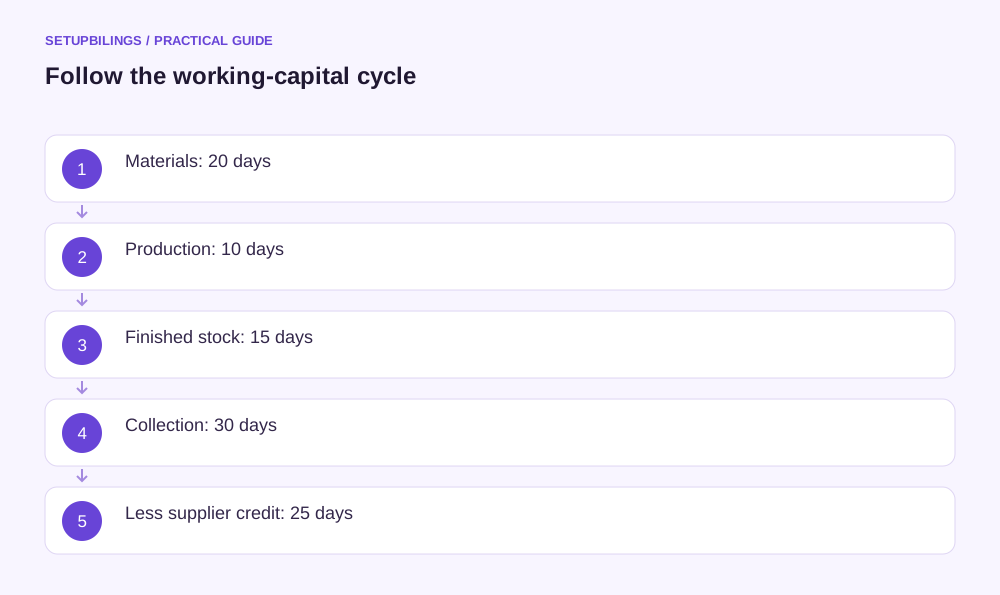
ICAI's working-capital material expresses the operating cycle as raw-material holding plus work-in-progress time plus finished-stock holding plus receivable collection time, less supplier credit time. The quantities and cost bases behind those periods still need careful estimation.
If the respective periods are 20, 10, 15 and 30 days, with 25 days supplier credit, the illustrative net cycle is 50 days. That is a useful timing indicator, not a complete cash amount by itself. Labour, materials and overhead may be paid at different points.
Choose the basis of the estimate
A balance-sheet working-capital measure can include receivables at invoice value. A managerial cash-funding estimate often focuses on the cash cost invested while waiting for collection, excluding profit not yet received. Label the basis and do not mix incompatible values silently.
For the next cycle, the manufacturer estimates customer invoices outstanding at ₹6,00,000. If the supported cash operating-cost content is 80%, the simplified cash investment represented by those receivables is ₹4,80,000. This is a planning assumption, not a replacement for the recorded receivable balance.
Keep depreciation and other noncash elements out of a cash-cost estimate. Include actual tax and payment timing separately where those amounts affect funding, using the business's applicable transaction facts.
Build a component estimate
| Illustrative funding component | Amount |
|---|---|
| Raw materials at relevant cost | ₹4,00,000 |
| Work in progress at relevant cash cost | ₹1,00,000 |
| Finished stock at relevant cash cost | ₹2,00,000 |
| Cash cost tied up in receivables | ₹4,80,000 |
| Minimum operating cash | ₹1,00,000 |
| Total funding represented | ₹12,80,000 |
| Less supplier credit | ₹3,00,000 |
| Less other operating accrual funding | ₹50,000 |
| Estimated net requirement | ₹9,30,000 |
If ₹7,00,000 of suitable funding is already available for this cycle, the estimated additional requirement is ₹2,30,000. Confirm that the ₹7,00,000 is not also committed to an equipment payment or another project.
The table assumes the component balances are reasonable for the same operating scale and period. Do not add a peak inventory balance from one month to a peak receivable balance from a different month without checking whether they occur together.
Estimate stock and production carefully
Raw-material holdings should reflect consumption, lead time and order quantities. Slow stock that cannot support the next cycle should not be treated as available funding merely because it appears in the ledger. Review usability and customer demand.
Work in progress needs a completion assumption. Material may be issued at the start while labour and conversion costs accumulate gradually. Treating every unfinished unit as fully costed can overstate one component, while ignoring it entirely understates resources already committed.
Finished-stock requirements depend on dispatch patterns and service commitments. A planned increase in sales can require more stock before revenue rises. That is why growth can increase funding needs even when margins remain satisfactory.
Use actual customer and supplier behaviour
For receivables, distinguish contractual terms from observed collection time and known disputes. A customer described as “30 days” may consistently pay later. Use a realistic expected date and test further delay for concentrated accounts.
Supplier credit should reflect agreed terms and applicable requirements, not a general assumption that payments can be postponed. If a supplier requires an advance or shortens terms, the cycle can need more cash without any change in selling price.
Accrued wages or other operating balances provide temporary funding only until their actual payment dates. Do not treat them as permanent free capital or offset liabilities unrelated to the operating cycle indiscriminately.
Include overlapping orders in the funding test
The next sales cycle may begin before customers finish paying for the current one. List outstanding supplier bills and existing receivables at the start, then add the new cycle's flows. Starting every cycle from a clean slate can understate the peak requirement when several customer orders share the same production and collection window. Use the consolidated business schedule to see the overlap rather than assuming each job funds itself independently.
Check the peak with a dated schedule
Place purchasing, production payments, dispatches and collections on a weekly timeline. The component estimate gives scale; the dated schedule reveals whether resources arrive before the largest outflow. Include opening commitments and the next cycle beginning before the current one finishes.
Stress the assumptions most likely to move the peak: material lead time, customer delay, production yield and seasonal stocking. A small shift in several drivers can matter more than a neat single percentage contingency.
Finish with a specific action for the additional ₹2,30,000 requirement: change a feasible operating driver, retain more cash or arrange suitable confirmed funding. Working-capital planning is complete when the business knows both how much cash the cycle needs and when that cash must be available.