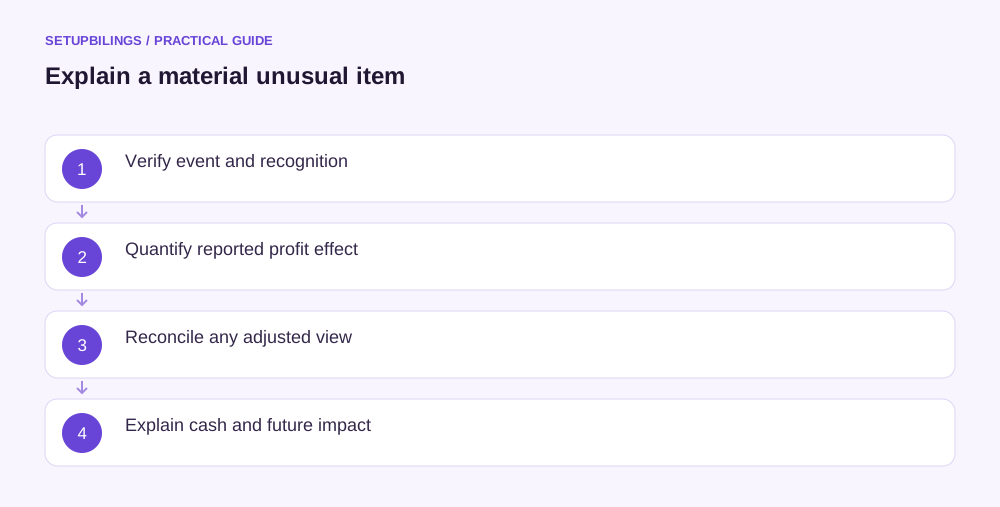
Explain an unusual gain or cost by describing what happened, how much it affected the reported result, whether cash moved and what it means for future periods. If an adjusted performance view helps, reconcile it transparently to reported profit and apply the same reasoning to favourable and unfavourable items.
The word “unusual” is a management description, not permission to bypass accounting requirements. Formal labels and treatment depend on the reporting framework and transaction. A large expense can remain part of ordinary business activity even if it occurs infrequently.
Identify the event before choosing a label
Start with documents: settlement agreements, disposal records, insurance correspondence, restructuring plans or valuation workings. Establish the period to which the event belongs and the basis for recognising the amount. A rumoured recovery or hoped-for saving should not be reported as a completed gain.
Ask whether the item reflects a new transaction, a change in estimate or an error in earlier records. These require different analysis and potentially different accounting treatment. Do not describe an omitted supplier invoice as a one-time operating cost simply to avoid explaining the correction.
For entities applying AS 5, material items within ordinary activities can require separate explanation because of their size, nature or incidence. The standard’s concepts should be applied precisely; a rare or expensive item does not automatically qualify for every formal classification someone might call “exceptional.”
Build a clear reported-to-adjusted bridge
An illustrative Hosur engineering business reports operating profit of ₹9 lakh. That includes a ₹4 lakh relocation cost and a ₹2 lakh gain from disposing of equipment. Management wants to discuss performance before both events.
| Reconciliation | Amount |
|---|---|
| Reported operating profit | ₹9 lakh |
| Add back relocation cost for the stated management view | +₹4 lakh |
| Remove equipment-disposal gain | −₹2 lakh |
| Adjusted operating result | ₹11 lakh |
The adjusted figure is an analytical measure, not a replacement for reported profit. Explain whether the relocation cost is truly outside the activity being assessed and why both adjustments are relevant to the comparison.
If relocation spending continues next year, disclose that expectation. A cost can be unusual relative to past periods while still creating future cash commitments. Calling it non-recurring without checking the remaining plan would mislead the reader.
Explain the components, not only the total
Break the ₹4 lakh relocation cost into items such as removal, temporary rent, staff travel and production disruption where reliable records exist. Identify costs expensed now, qualifying assets recognised separately and commitments not yet incurred. Do not treat all payments connected with a project as identical accounting expenses.
For the equipment gain, show sale proceeds, carrying amount and any directly relevant disposal costs. A ₹2 lakh gain might arise from ₹5 lakh proceeds against a ₹3 lakh carrying amount. The cash receipt and profit effect differ.
Avoid excessive netting. If a disruption causes a ₹6 lakh loss and a ₹4 lakh recovery, showing only a ₹2 lakh net cost may conceal collection uncertainty or timing. Present gross components when they matter to understanding the event, subject to the applicable accounting requirements.
Keep cash timing visible
An expense may be accrued before payment, and a recovery may be recognised before receipt. Show amounts paid, collected, outstanding and expected to settle. Tie these to the balance sheet and cash-flow schedules.
Suppose ₹2.5 lakh of relocation cost has been paid and ₹1.5 lakh remains payable. Removing all ₹4 lakh from an adjusted profit view does not make the unpaid ₹1.5 lakh disappear from the cash forecast.
Likewise, an asset-sale gain does not mean the full sale proceeds are operating cash. ICAI AS 3 classifies cash flows by activity and excludes non-cash investing or financing transactions from cash movements. Use the transaction’s nature rather than its profit-statement location to assess cash classification.
Challenge repeated adjustments
Review at least two or three years of adjustments. If legal disputes, reorganisation costs or stock losses appear every year, assess whether they are part of the business’s recurring risk and cost structure. Different individual events can still create a repeated economic burden.
Distinguish completed events from expected future efficiencies. A planned saving from combining warehouses is a forecast assumption, not automatically an addition to historical earnings. Show when the saving begins, what costs remain and what evidence supports the amount.
Owner-related adjustments also need discipline. A proposed replacement salary or market rent can help a transaction discussion, but it is an explicitly assumed economic view. Keep it separate from the accounting result and state how the estimate was obtained.
Keep supporting analysis for the alternatives considered. If management concludes that a cost will not recur, note the completed event and remaining commitments supporting that judgement. This gives the next reviewer a basis for checking whether the conclusion still holds.
Write commentary that can be checked
A useful note might say: “Reported operating profit was ₹9 lakh, including ₹4 lakh relocation expense and a ₹2 lakh disposal gain. The stated adjusted view is ₹11 lakh. ₹1.5 lakh relocation cost remains payable, and the new site is expected to begin normal production in November.”
Each sentence identifies an amount, status or assumption. Avoid calling the adjusted figure “true profit,” because the reported costs and gains are real parts of the period’s result even when a second view is informative.
Finish with the effect on future operations, remaining commitments and the next review date. A good unusual-item explanation allows the owner to understand both the period’s reported outcome and the evidence supporting any view of continuing performance.