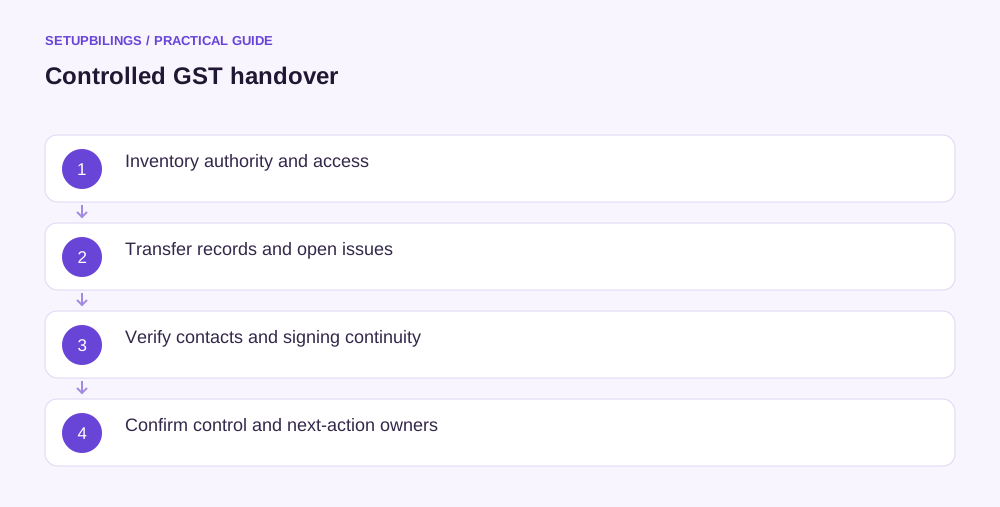
Hand over the work as well as the login
A GST handover is incomplete if the new preparer receives only a username and password. The business also needs its registration history, filing records, reconciliations, notices, pending applications and authority arrangements. Begin with a clear scope: who prepares, who reviews, who signs and who monitors the account after the transition.
Keep the registrant's control distinct from the preparer's convenience. An accountant may help with routine filings, but the proprietor, partners or company should know which GSTINs exist, whose contact details are registered and who can authorise submissions. This is particularly important when a long-standing external engagement ends.
Make an access and authority inventory
List every GSTIN and special registration, the legal person, username, primary authorised signatory, registered email and mobile, signing method and responsible preparer. Do not place the actual passwords in an openly circulated inventory. Store secrets through a controlled business method and share only the access required for the agreed role.
Review signatory appointments and any GST practitioner or authorised representative arrangements shown in the account. These roles are not identical. Someone preparing data should not be added as a director or partner merely to make access easier. Use the correct appointment and portal process for the actual authority being granted.
GSTN's registration and profile guidance identifies the relevant signatory and representative fields. Check what the live system provides rather than assuming it offers unlimited separate user logins or a particular permission feature. Where software or a service provider is connected, review its actual permissions and engagement arrangements separately.
Secure continuing contact access
Confirm that registered email and mobile channels are active and controlled through a reliable business arrangement. A former employee's personal number can become an access and notice problem even where the password is known. Plan contact changes before the old channel disappears, using the appropriate GSTN verification workflow.
Where the promoter or partner and signatory are the same person, GSTN describes linked contact updates through the relevant promoter or partner section. Where the signatory changes, prepare the new authority and update primary status rather than merely replacing an old person's phone field with a different employee's number.
Verify the resulting profile after submission. Receiving one forwarded OTP does not establish that the new contact is now recorded. Confirm who receives subsequent acknowledgements and notices and document who is responsible for checking them. A monitored inbox is useful only if someone knows how to escalate the messages.
Protect the signing arrangement
Review the DSC requirements and the appointed individual's valid certificate where DSC is used. GSTN's registration guidance makes DSC signing mandatory for companies and LLPs. A departing person's certificate should not become a shared device used indefinitely by the replacement team, because the signature is associated with the individual and authority.
Keep the certificate device, PIN and private signing credentials under appropriate control. Preparation of a return can be delegated while the authorised signatory reviews and completes signing through the permitted process. Do not treat a request for faster filing as authority to submit declarations the signatory has not understood or approved.
Plan continuity for absence, expiry and replacement. Record the renewal date and who can complete the required official setup. Test the permitted signing process before a deadline rather than changing credentials and discovering at the final submission screen that the authorised person's certificate is unavailable.
Transfer a complete open-item file
Prepare a register of filed periods, missing periods, payments, notices, replies, refunds, amendments and saved drafts. Include references, due dates, status and next action. Label a saved draft clearly so the incoming team does not mistake it for a filed return or an approved amendment.
Illustratively, a Coimbatore manufacturer changes preparers with two GSTINs and an unresolved ₹85,000 ledger difference. The handover should explain the source of that difference, what was filed and which documents remain missing. A folder containing only return PDFs would leave the new preparer unable to distinguish an accounting mismatch from an outstanding tax task.
Transfer the underlying sales and purchase workings, credit reconciliations, stock schedules and electronic ledger evidence relevant to the open periods. Retain a copy in the business's own records. An adviser-controlled folder that the business loses when the engagement ends does not provide durable access to its filing history.
Ask the new team to explain one recent reconciliation and one pending application using the handed-over records. That exercise tests whether the file is understandable, not just whether a folder can be downloaded. If the explanation depends on missing notes held by the outgoing preparer, add them to the handover while the relevant people are still available to clarify the history.
Verify the handover with a controlled test
Have the incoming responsible person confirm access to the correct GSTINs, current profile, notices and submitted applications. Test the actual permitted workflow without filing an unnecessary form merely to prove access. Compare the open-item register with the portal so omissions are found while the outgoing team can still explain them.
Review and change passwords through the proper process where the transition requires it, and remove obsolete access or permissions where applicable. Communicate secrets through a controlled channel rather than placing them in an ordinary handover email with the entire registration file. Keep a record of who now holds the operational responsibilities.
Finish with a dated internal sign-off listing completed access checks and unresolved work, each with an owner. The business should be able to receive messages, authorise submissions and retrieve its records independently of any former preparer. That is the practical test of a GST handover that preserves control.