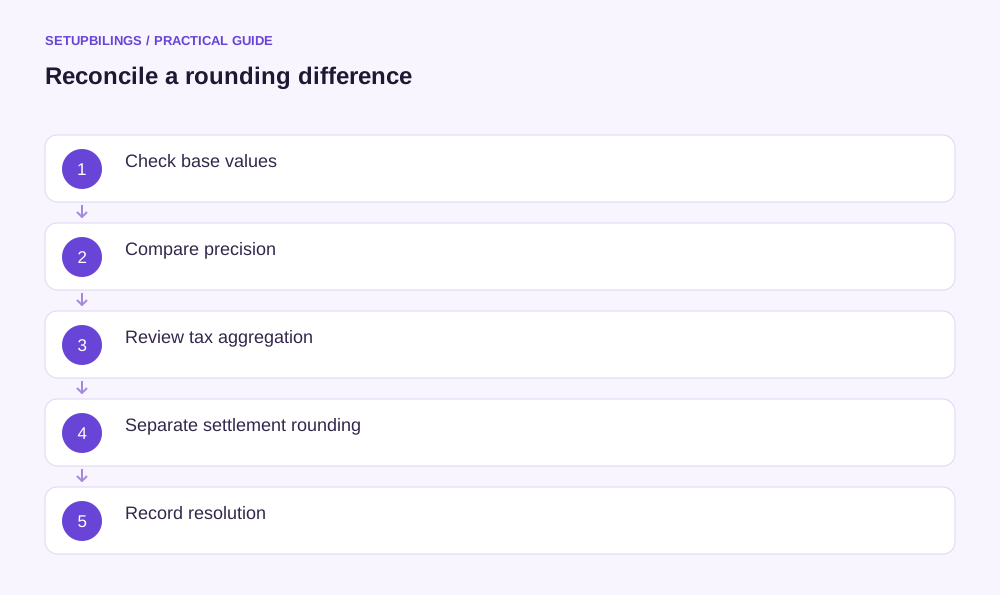
Manage GST rounding by defining calculation precision, aggregation and display rules consistently across the invoice, ledger and reporting data. Section 170 provides rounding for amounts payable or due under the Act, but it should not be read as permission to round every unit price or intermediate calculation arbitrarily. Identify the legally relevant amount and keep customer settlement rounding distinct from taxable-value and tax calculations.
Separate four different numbers
An invoice can contain an unrounded calculation, a displayed line amount, a tax total and a rounded customer payable. These are not necessarily identical stages. Document which precision is retained internally and where the final output rounds. Otherwise two systems can use the same rate and base but produce slightly different totals.
Keep tax heads separate as well. CGST and SGST calculated at their respective rates can produce different intermediate rounding behaviour from one IGST calculation at the aggregate rate. The correct heads come from the transaction analysis; staff should not switch heads merely to remove a decimal difference.
Understand a realistic one-paise difference
Assume three independently displayed lines, each with taxable value ₹101.03 and an illustrative confirmed IGST rate of 18%. Each unrounded tax is ₹18.1854. Rounding each displayed tax to two decimals gives ₹18.19, and three lines total ₹54.57.
If the system instead aggregates the base to ₹303.09 and applies 18%, tax is ₹54.5562, displayed as ₹54.56. The one-paise difference comes from calculation sequence. It is not evidence that the rate changed or that ₹0.01 of taxable goods is missing. Choose a supportable consistent method and ensure the invoice and downstream records follow it.
Keep precision until the approved stage
Avoid rounding quantity conversions, discounts and taxable bases repeatedly before applying tax. A price per kilogram converted to small packs can generate decimals that become material over many units. Retain enough precision in the working to reproduce the final amount.
For example, a ₹1,250 price for a ten-unit carton implies ₹125 per unit, but other conversions may not divide evenly. If staff round a derived per-unit price before multiplying back to hundreds of units, the result can diverge from the agreed carton price. Check the contractual unit and conversion before calling the difference a tax-rounding issue.
Apply section 170 in its proper context
The section addresses nearest-rupee rounding for specified amounts payable and due under the Act, with fifty paise as the upward threshold. Review that requirement at the relevant legal and reporting stage. Do not use it to alter a commercial rate, conceal a pricing error or round each item upward independently without a basis.
An illustrative amount of ₹1,234.49 becomes ₹1,234 under that nearest-rupee rule, while ₹1,234.50 becomes ₹1,235. This statutory rounding question is separate from whether invoice values are displayed with two decimals and how a customer settles a final bill. Keep those policies explicit rather than mixing them in one adjustment account.
Show customer settlement round-off separately
Suppose the approved document values total ₹357.65 and the business's agreed settlement practice rounds the payable to ₹358.00. The ₹0.35 should be identifiable as a settlement round-off, with the accounting and tax treatment reviewed appropriately. Do not silently increase a goods line to make the payable match.
A bank receipt of ₹358 does not prove the underlying tax calculation was ₹358 less an arbitrary base. Preserve the invoice's tax amounts and the separate settlement entry. The same principle applies when a customer pays a rupee less or more: identify whether it is rounding, a short payment or another agreed adjustment.
Reconcile by layer
Compare item quantities and values first, discounts and charges second, taxes by rate and head third, and final settlement last. This order helps distinguish a rounding issue from a missing line or incorrect rate. A ₹360 difference on included freight is unlikely to be explained by a one-paise aggregation effect.
Use a small working that shows the source values, unrounded tax, displayed tax and any round-off entry. Record which system generated each amount. When a PDF and an accounting export differ, compare their calculation settings rather than repeatedly editing the last line until both totals look equal.
Test mixed rates and credit notes
Mixed-rate invoices need consistent aggregation within each approved rate and tax-head group. Returns and credit notes should preserve traceability to the original values and the actual adjustment. Recalculating an old transaction using today's rounding setup can produce unexplained residual balances.
Test an inclusive-price invoice, a quantity conversion, a multi-rate bill and a partial return when changing software or settings. Check structured invoice data where applicable as well as the customer PDF. A correctly displayed total can coexist with a different tax amount in the transmitted record.
Investigate recurring differences
Track recurring paise differences by source and method. A consistent known aggregation difference can be addressed through an approved reconciliation policy; unexplained or growing differences need investigation. Restrict manual round-off entries that change tax or taxable value without review.
Reliable rounding preserves the arithmetic path. Define precision, apply the relevant legal requirement at the correct stage, show settlement adjustments clearly and reconcile the same figures across outputs. That gives the accounts team a reproducible explanation instead of a collection of balancing entries.