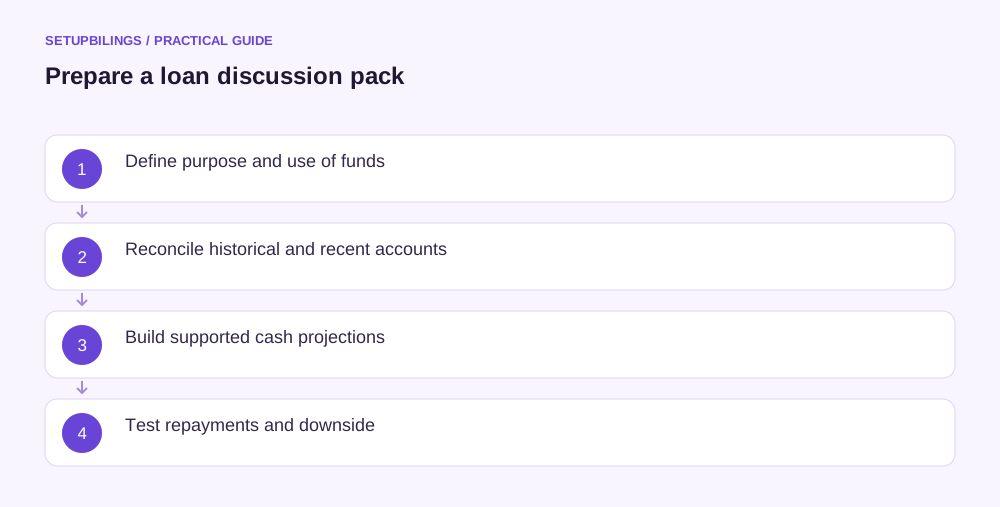
Organise financial statements for a business loan discussion around three questions: what the business has earned, why it needs funding and how cash will support repayment. Assemble consistent historical accounts, recent management results, working-capital and debt schedules, and supported projections. Reconcile the pack before presenting it so differences do not distract from the actual proposal.
Obtain the lender’s current checklist for the specific facility and borrower. Requirements vary by product, entity, loan size and circumstances. SBI’s commercial-loan FAQ, for example, lists historical balance sheets, projections, existing banking details and business information among relevant documents; that is not a universal checklist for every lender.
State the purpose and amount clearly
Distinguish a working-capital requirement from a term investment. Buying equipment, funding seasonal stock and replacing an existing loan create different repayment patterns. Explain the use of funds with quotations, operating schedules or other evidence.
An illustrative Coimbatore components manufacturer proposes a ₹30 lakh machine purchase. The owner expects to contribute ₹10 lakh and seeks a ₹20 lakh term loan. The pack should also show installation, commissioning and additional working-capital needs rather than assuming the machine price is the entire funding requirement.
Identify when payments are due and when the asset can begin generating receipts. A project can require cash well before its first sale. Keep the funding source for that interval explicit.
Assemble the historical financial statements
Include the relevant completed balance sheets, profit and loss statements, notes and cash-flow statements where prepared or required. Preserve signed or final versions and clearly identify any unaudited management reports. Do not describe a report as audited without the corresponding audit evidence.
Use a consistent period and explain material accounting-policy, classification or business-scope changes. Reconcile opening balances to the previous final accounts. Keep tax returns and other statutory records consistent with the financial story, with a documented explanation for legitimate differences.
Historical statements show the starting position, not the whole credit case. A profitable past year can coexist with current overdue customers or a major order cancellation, so recent information matters.
Add current management results and schedules
Provide recent year-to-date profit and loss, balance sheet and cash information with the reporting date and outstanding adjustments. Include comparative periods or budget where they help explain performance.
Support the main balances with receivable ageing, inventory details, supplier ageing, bank reconciliations and a borrowing schedule. Identify disputed invoices, slow stock, restricted deposits and overdue obligations. A lender needs the quality of the balances, not only their totals.
| Schedule | Main question it helps answer |
|---|---|
| Receivables and subsequent receipts | When customer cash may arrive |
| Inventory ageing and stock records | What funds are tied up and saleable |
| Supplier dues | What must be paid and when |
| Existing debt | Principal, interest and maturity commitments |
| Fixed assets and quotations | What the investment creates and costs |
Reconcile these schedules to the financial statements. If a stock statement previously supplied to a lender differs from the books, explain and resolve the difference rather than circulating inconsistent versions.
Build projections from operating assumptions
Forecast sales from capacity, orders, prices and a realistic utilisation ramp. Show material, labour, overhead, maintenance and financing assumptions. Separate confirmed orders from prospects and identify customer concentration.
For the manufacturer, assume incremental annual sales of ₹40 lakh at a 35% contribution margin after relevant variable costs. That produces ₹14 lakh contribution. If additional fixed cash operating costs are ₹4 lakh, the illustrative incremental operating cash contribution before working-capital changes, tax and finance is ₹10 lakh.
That is not automatically cash available for loan repayment. Add inventory and customer-credit needs, payment timing, taxes and essential capital expenditure. A first-year ramp may produce less than the full-year contribution assumption.
Show the repayment calendar and stress case
Suppose illustrative annual principal repayments are ₹5 lakh and interest payments ₹2 lakh. Combined debt payments are ₹7 lakh before considering existing loans. Compare these payments with a complete cash forecast, not only the ₹10 lakh contribution subtotal.
Model lower utilisation or a collection delay. If contribution falls to ₹9.8 lakh because incremental sales are 30% below the ₹40 lakh assumption, the same ₹4 lakh fixed operating cost leaves ₹5.8 lakh before the other cash demands. That would not cover the stated ₹7 lakh debt payments by itself.
Actual rates, repayment terms, taxes and eligibility depend on the lender and transaction. Use proposed or sanctioned terms when available and label illustrative assumptions clearly. Agreement-specific ratio definitions should be followed for any covenant calculation.
Separate the base business cash forecast from the incremental machine case, then reconcile them. Existing customers, wages and loan instalments continue while the new asset ramps up. A project that appears affordable in isolation can still strain the combined business if old receivables are delayed or current facilities are already fully used. Show the opening liquidity buffer and any conditions attached to additional funding.
Make the pack easy to review
Create an index with dates, units, report status and filenames. Keep the proposal amount, source-and-use table, forecasts and debt schedule consistent. Include a short explanation of unusual gains, losses or recent changes that affect repayment capacity.
Prepare supporting ownership, registration, security and business documents requested by the lender, with appropriate verification of their actual requirements. Do not assume a financial pack alone establishes approval or eligibility.
Before the meeting, have another reviewer trace the key projected receipts and payments to assumptions. The strongest pack is a coherent, evidence-based account of the business and its funding need, allowing a practical discussion of amount, timing, repayment and remaining uncertainty.