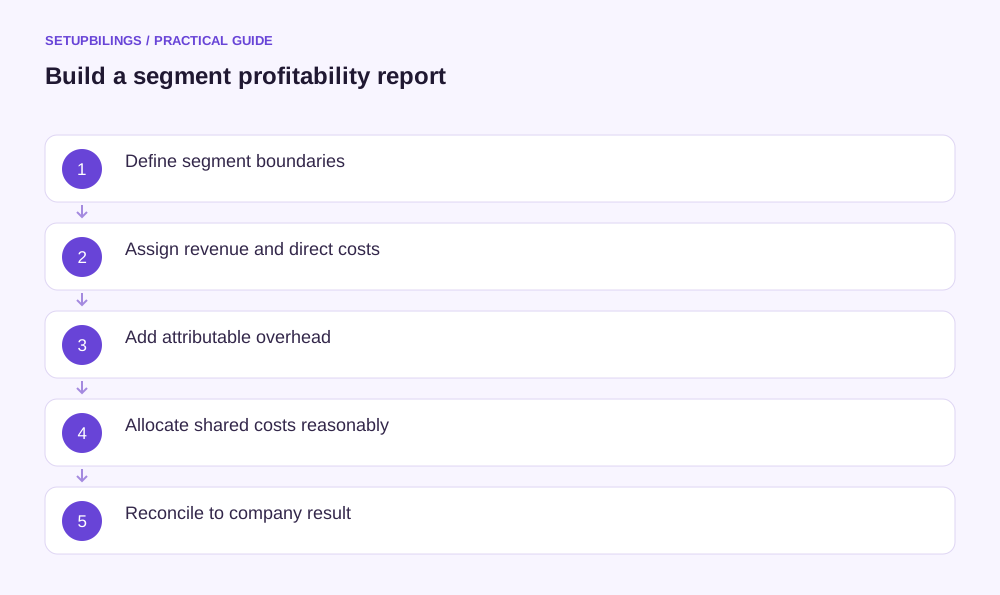
Prepare a segment profitability report by defining meaningful business activities, assigning their revenue and direct costs, allocating shared operating costs on a defensible basis and reconciling the total to the company result. Keep unallocated corporate costs visible. A segment report should explain economics, not manufacture winners and losers through arbitrary allocations.
This is a management-reporting workflow. Formal segment disclosures depend on the applicable accounting framework and entity requirements. ICAI AS 17 provides relevant principles under AS reporting where applicable, but an internal report is not automatically a substitute for those disclosures.
Define segments around real decisions
Choose groups with distinguishable products, services, customers, operating processes or risks. A business selling machines, installing them and providing maintenance may need separate activity views. An unrelated grouping by invoice number would offer little management insight.
Assign a segment owner and document the boundary. Define how bundled contracts, shared staff and customers buying multiple services are handled. Keep the classification stable enough to compare periods, and explain changes when the business reorganises.
Avoid excessive detail that the records cannot support. A reliable report for three major activities is more useful than ten apparently precise results built on guessed cost assignments. Improve transaction coding before expanding the report.
Start with direct revenue and costs
Reconcile segment revenue to recognised revenue in the profit and loss statement. Assign returns, discounts and credit notes to the relevant segment. Customer collections and order backlog should be reported separately rather than added to revenue.
Direct costs are those attributable to the segment’s activity, such as goods sold, project subcontractors, dedicated labour or identifiable delivery costs. Apply the same cost definition across segments. Track direct costs from source records instead of allocating them merely because direct coding is inconvenient.
Consider an illustrative Pune industrial-services business with equipment sales, installation and maintenance. Its monthly revenue and direct costs are:
| Segment | Revenue | Direct costs | Contribution before shared costs |
|---|---|---|---|
| Equipment | ₹30 lakh | ₹24 lakh | ₹6 lakh |
| Installation | ₹12 lakh | ₹7 lakh | ₹5 lakh |
| Maintenance | ₹8 lakh | ₹3 lakh | ₹5 lakh |
| Total | ₹50 lakh | ₹34 lakh | ₹16 lakh |
The equal ₹5 lakh contribution from installation and maintenance arises from very different sales volumes and margins. Both the amount and rate help explain the business.
Show directly attributable overhead separately
Add expenses that belong to a segment but are not included in the chosen direct-cost subtotal. These might include a dedicated supervisor, exclusive premises, segment-specific software or depreciation on assets used only by that activity.
Suppose equipment has ₹1.5 lakh dedicated overhead, installation ₹1 lakh and maintenance ₹1 lakh. Segment results before shared costs become ₹4.5 lakh, ₹4 lakh and ₹4 lakh respectively. Keep the subtotal labels explicit so readers know what has been deducted.
A manager may control some of these expenses but not all. If the report supports performance evaluation, distinguish controllable costs from centrally decided commitments. Commercial profitability and manager accountability are related but different purposes.
Allocate shared costs using a causal basis
Shared costs require a reasonable, documented driver. Warehouse costs may follow space or handling activity; IT support may follow users; scheduling staff may follow jobs; shared technicians may follow recorded hours. Revenue can be a practical fallback, but it may poorly represent resource consumption.
Assume shared operating costs total ₹3 lakh and reliable activity records allocate ₹1.2 lakh to equipment, ₹1 lakh to installation and ₹0.8 lakh to maintenance. Segment profit after these allocations is ₹3.3 lakh, ₹3 lakh and ₹3.2 lakh, totalling ₹9.5 lakh.
Record the driver, data source and review date. If a new allocation changes the segment ranking, show the effect. Do not interpret a method change as an operational improvement or deterioration.
Keep corporate and internal items visible
Suppose corporate administration of ₹2 lakh cannot be meaningfully attributed for this decision. Show it below the segment total, producing company operating profit of ₹7.5 lakh. Finance costs, taxes and other items can then reconcile to the final company result as relevant.
Internal transactions need elimination in the total business view. Installation may use equipment supplied by another segment, but internal revenue should not inflate external company revenue. Show any internal transfer basis and reconcile revenue and profit after eliminations.
Inventory held within the business can also contain internal profit that is not yet earned from an external customer. The treatment depends on the entity and reporting purpose; do not assume that adding branch or segment ledgers automatically produces a correct company result.
Test what a loss-making segment means
A negative allocated result does not prove that closing a segment improves total profit. Some shared costs continue after closure, and the segment may support equipment sales or customer retention elsewhere. Analyse avoidable costs, lost contribution and cross-segment effects separately.
Conversely, positive contribution does not justify indefinite losses after necessary capacity costs. Consider investment required, demand, pricing and the time needed to reach a sustainable result. Keep any turnaround assumptions measurable.
Add operating drivers such as jobs completed, technician hours, repeat visits, customer retention and asset use. These explain why two segments with similar revenue can consume different resources.
Release a reconciled decision report
Check that every external revenue and material expense is assigned or visibly unallocated once. Reconcile to the general ledger and explain pending adjustments. Compare with budget and prior periods using consistent definitions.
Conclude with the cause of each material change and the decision it supports. The segment report is useful when the owner can see direct economics, shared-resource demands and company reconciliation together, then decide where pricing, capacity or investment should change.