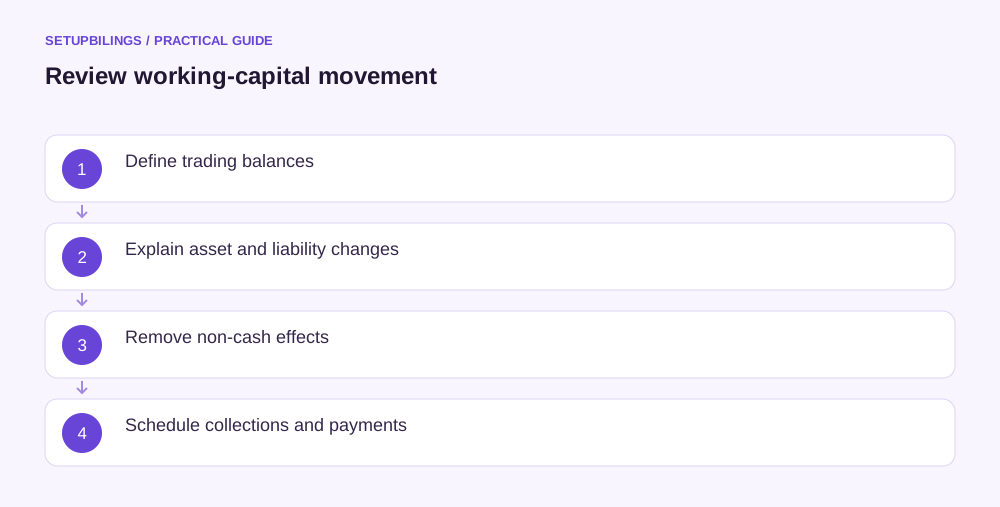
Working capital commonly means current assets minus current liabilities. Read a change in that total by examining the individual balances behind it. A higher figure can represent more cash available, more stock waiting to sell or more unpaid customer invoices. Those situations have different implications for the business.
For management decisions, also calculate operating working capital using a clearly defined set of trading balances, often inventory plus trade receivables minus trade payables. That narrower view helps explain funding tied up in the operating cycle. It is different from the broad balance-sheet definition and should be labelled accordingly.
Start with classifications and definitions
Use the same current and non-current classifications in both periods. For companies, the applicable Schedule III requirements consider the normal operating cycle and other conditions. A simplistic “everything collectible within twelve months” rule can miss the operating-cycle element or relevant restrictions.
Identify the contents of each line. Other current assets can include prepayments, tax balances and advances that do not behave like cash. Current liabilities can include borrowing, instalments, customer advances, taxes and accrued expenses as well as suppliers.
Document which balances you include in operating working capital. Some businesses also include other operating receivables, advances and accruals. The purpose is to show the trading funding requirement consistently, not to select whichever definition gives the most reassuring answer.
Build a two-date movement table
Consider an illustrative Hyderabad stationery distributor:
| Balance | Opening | Closing | Movement |
|---|---|---|---|
| Inventory | ₹10 lakh | ₹14 lakh | +₹4 lakh |
| Trade receivables | ₹12 lakh | ₹18 lakh | +₹6 lakh |
| Cash | ₹3 lakh | ₹2 lakh | −₹1 lakh |
| Total current assets | ₹25 lakh | ₹34 lakh | +₹9 lakh |
| Trade payables | ₹8 lakh | ₹11 lakh | +₹3 lakh |
| Short-term borrowing | ₹5 lakh | ₹9 lakh | +₹4 lakh |
| Total current liabilities | ₹13 lakh | ₹20 lakh | +₹7 lakh |
| Net working capital | ₹12 lakh | ₹14 lakh | +₹2 lakh |
The broad measure improved by ₹2 lakh. But operating working capital, defined here as inventory + receivables − payables, rose from ₹14 lakh to ₹21 lakh. An additional ₹7 lakh became tied up in trading balances.
The cash decline and borrowing increase help explain how that need was funded alongside other business movements. The broad net working-capital increase alone would not reveal the additional reliance on short-term finance.
Explain inventory before assuming growth is healthy
A stock increase can support a planned seasonal sales peak, protect against long supply lead times or reflect weak demand. Break it down by product, age and stage of production. Compare quantities as well as rupee values, because purchase-price inflation can lift inventory without increasing physical stock.
Review whether damaged and slow-moving goods are appropriately valued. ICAI AS 2’s lower-of-cost-and-net-realisable-value principle applies to inventories within its scope. A write-down can reduce reported working capital without creating a cash outflow at the time of the adjustment.
That is why the change in inventory is not always identical to cash invested during the period. Non-cash valuation changes, reclassifications and acquisitions need separate treatment in a cash-flow bridge.
Read receivables through customer behaviour
In the example, receivables grew ₹6 lakh. Compare this with credit-sales growth, invoice dates, contractual terms and ageing. A large March dispatch can temporarily raise the closing balance, while an unresolved six-month dispute indicates a different risk.
Check subsequent receipts and concentration with major customers. Separate unbilled work, customer advances and tax components where relevant. Use consistent bases when comparing receivable days with sales; a tax-inclusive balance divided by tax-exclusive revenue can overstate the apparent collection period.
A reduction in receivables can also mislead. It may arise from collections, but it may also reflect write-offs, credit notes or transfers. Identify the cause before celebrating faster cash conversion.
Test supplier credit and other obligations
Higher payables provide funding only within the actual commercial and legal terms. Distinguish agreed credit from overdue amounts, disputes and invoices awaiting recording. Payment delays can improve a month-end cash position while damaging supply reliability or creating additional obligations.
Borrowing is another important distinction. Taking a short-term loan increases cash and current liabilities together, leaving broad net working capital unchanged at that moment. It can improve immediate liquidity without strengthening the underlying net working-capital position.
Customer advances similarly provide cash while carrying delivery or refund obligations. Do not treat them as free profit or assume their presence means future work is already funded after considering the associated costs.
Use monthly balances when the business is seasonal. Two year-end dates can miss the peak amount needed to buy and hold goods before customers pay. A peak-funding view can therefore reveal pressure that a modest annual working-capital movement conceals. Compare the peak with the timing of facility renewals and owner commitments, rather than assuming year-end funding remains available throughout the cycle.
Keep the operating-balance definition attached to every comparison so later reviewers can reproduce it.
Translate the change into an action plan
Prepare a bridge showing the movement in inventory, receivables, operating payables and other material balances. Reconcile non-cash changes before calling the result a cash effect. Compare the operating requirement with available funding and a weekly cash forecast.
For the distributor, the immediate questions are whether the ₹4 lakh stock build matches demand and whether the ₹6 lakh receivable increase will collect on schedule. Assign specific reviews to purchasing and collections, while checking the ₹4 lakh borrowing increase against facility terms.
Working capital is most useful as a map of where funds are committed and when they can return. Read the total, inspect its composition and connect each movement to a realistic collection or payment date.