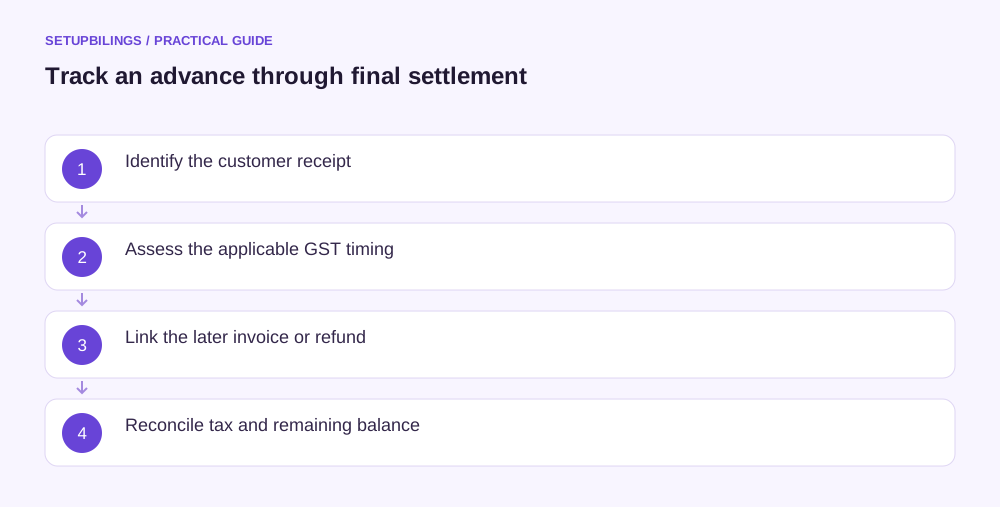
Reconcile advances by tracing each customer receipt from its original purpose through the applicable GST timing, later invoice adjustment or refund. Do not treat every advance as immediate accounting revenue or assume that all goods and services follow the same GST rule.
For specified registered persons outside composition, Notification 66/2017-Central Tax provides the relevant goods time-of-supply relief. Ordinary taxable service advances can create a different timing result under the applicable provisions. Establish the supply, taxpayer status and current rule before deciding whether an advance-related tax amount belongs in the return.
Identify genuine advances in the bank data
Consider an illustrative Pune event-services business receiving deposits before functions are completed. A bank receipt may be a customer advance, payment against an existing invoice, refundable security or an unrelated transfer. The receipt description alone is not enough.
Record customer, contract or order, date, gross amount, purpose, expected supply, place of supply, tax treatment and supporting document. Link the receipt to any earlier invoice so an old receivable collection is not misclassified as a new advance.
A refundable deposit needs its own analysis, including whether it is applied as consideration. Do not classify every amount called a deposit identically. Retain the agreement and subsequent application or refund history.
Separate goods from services
Notification 66/2017 identifies registered persons who have not opted for composition and addresses outward supplies of goods by reference to the specified invoice-based time-of-supply provision. Its scope should not be expanded automatically to all taxpayers, services or reverse-charge arrangements.
For a mixed business, maintain separate categories and review whether the contract constitutes a composite or mixed supply or another arrangement requiring analysis. A ledger name such as “customer deposits” does not establish the legal supply classification.
The event-services business should assess its advance under the applicable service rules. A separate trader receiving money for future goods should assess the goods relief and its conditions. Their accounting advances may look similar while their GST timing differs.
Work through a taxed advance example
Assume, illustratively, the service contract validly attracts 18% GST and an advance of ₹1,18,000 is tax-inclusive. The corresponding taxable amount is ₹1,00,000 and tax is ₹18,000. These are worked assumptions, not a rate conclusion for every event service.
Suppose the final invoice is ₹2,36,000 inclusive of ₹36,000 GST on ₹2,00,000 taxable value. If ₹18,000 tax was correctly accounted for on the earlier advance, the later reporting needs the appropriate adjustment so the same advance tax is not counted twice.
| Stage | Commercial record | Tax reconciliation focus |
|---|---|---|
| Advance received | ₹1,18,000 customer receipt | Whether and when ₹18,000 liability arises |
| Final invoice | ₹2,36,000 invoice | Full supply value and tax treatment |
| Advance applied | ₹1,18,000 against invoice | Supported adjustment of earlier taxed advance |
| Remaining collection | ₹1,18,000 | Settlement of the remaining customer balance |
The final amount collected is a settlement question. It does not by itself determine how the advance and invoice appear across return periods.
Use the relevant advance tables carefully
GSTN’s GSTR-1 manual provides advance-related liability reporting where time of supply arises without an invoice in the same period, and an adjustment section for amounts previously reported and later invoiced. Match the actual facts to that workflow.
If the advance and invoice occur in the same period, review how the invoice already captures the supply before adding a separate advance liability. The goal is complete reporting without duplication, not entering every receipt in every available table.
Maintain rate-wise and place-of-supply information required for the relevant summaries. One customer can pay advances for more than one supply type or location. A single unanalysed advance total can produce incorrect tax heads.
Reconcile opening and closing balances
For each advance, show opening balance, new receipts, invoice applications, refunds, transfers supported by the agreement and closing balance. Track tax already reported separately from commercial amounts still held.
At month end, compare the advance register with the customer ledger and bank receipts. Investigate old balances that remain after a project was completed. They may reflect unallocated receipts, missing invoices or a genuine continuing obligation.
A closing advance balance is not always evidence of GST still unpaid. The tax may already have been accounted for while the service remains outstanding. Conversely, a cleared accounting advance does not prove that the return adjustment was made correctly.
Reconcile advances customer by customer rather than only as a closing ledger total. One over-adjusted receipt and another unadjusted receipt can offset numerically while leaving different contracts wrong. Check the remaining amount, related invoice and tax already reported for each material receipt. The combined total becomes reliable only after its individual components have a supportable history.
Review cancellations and refunds
If an event is cancelled, examine the contract, amount retained, refund and applicable GST document and adjustment rules. A bank refund should be linked to the original receipt and tax history. Do not simply reduce current sales by the refunded cash without analysis.
Where an advance is moved to another order, retain customer instructions and assess whether the supply, rate, location or timing changes. An internal transfer entry cannot decide those questions by itself.
Keep a pending list for receipts whose purpose remains unclear and resolve it promptly with the customer-facing team. Unidentified money should not be posted automatically as taxable sales or left indefinitely outside review.
A useful advance reconciliation links cash, supply and tax across time. Establish the correct rule, track the original liability and connect it with the later invoice or refund. That gives the owner a clear view of both customer money still held and the GST treatment already reported.