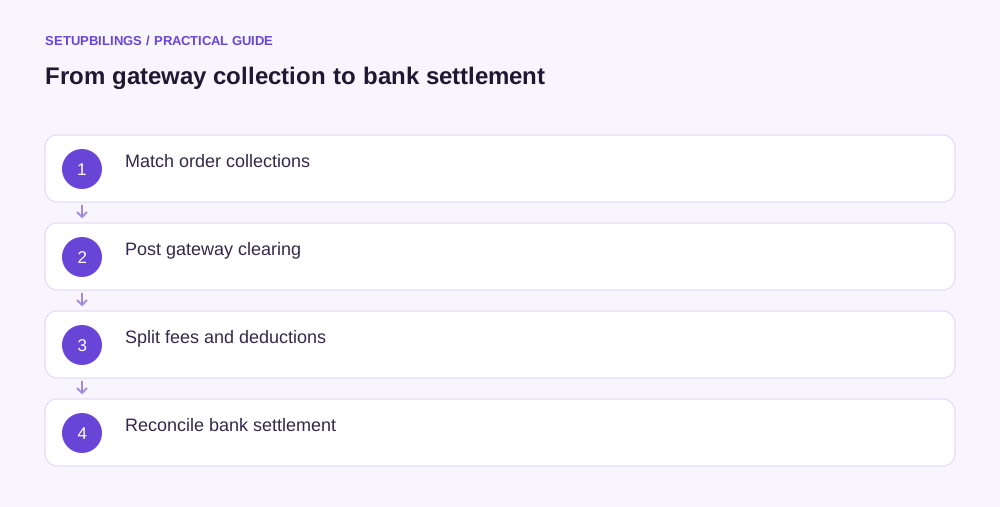
Use a payment-gateway clearing account to connect gross customer collections with the smaller amount deposited into bank after fees and other adjustments. Record sales from the underlying transactions, then record the gateway’s fee and settlement separately. Treating the net bank deposit as sales can understate both revenue and payment-processing costs.
Understand what the gateway statement measures
A gateway settlement report may include customer collections, refunds, chargebacks, service fees, tax on fees and amounts held back. Its deposit is a settlement of those components, not a substitute for sales invoices.
First establish the business’s role. A seller collecting its own sales generally has different revenue from a platform acting as an agent for another seller. ICAI AS 9 distinguishes revenue in an agency relationship from the gross cash passing through it. The example below concerns a business selling its own goods.
Retain the order-level collection report and the settlement identifier. They allow a reviewer to connect individual invoices with the consolidated bank receipt.
Illustrative collection and settlement
A Chennai online seller records completed sales with an illustrative base value of ₹1,00,000 and output GST of ₹18,000. Customers pay ₹1,18,000 through a gateway. Assume supported gateway fees are ₹2,000 plus recoverable input GST ₹360, leaving ₹1,15,640 deposited.
| Event | Account | Debit ₹ | Credit ₹ |
|---|---|---|---|
| Customer collections | Gateway clearing | 1,18,000 | — |
| Customer collections | Sales | — | 1,00,000 |
| Customer collections | Output GST | — | 18,000 |
| Settlement | Bank | 1,15,640 | — |
| Settlement | Gateway fees | 2,000 | — |
| Settlement | Recoverable input GST | 360 | — |
| Settlement | Gateway clearing | — | 1,18,000 |
Both events balance independently. The clearing account returns to zero for this batch. Sales remains at ₹1,00,000 and the fee appears as a separate cost. The illustrative tax figures assume the respective invoice and eligibility requirements are satisfied.
If customer invoices already created receivables, first debit Gateway clearing and credit those customer receivables for the collections. Do not credit sales again when recording the gateway payment.
Reconcile the clearing balance
Use a movement schedule: opening unsettled balance, plus collections, less refunds, fees, chargebacks and bank settlements, with separately identified holdbacks and other adjustments. Its closing figure should match the unsettled amount supported by gateway reports.
A settlement arriving after month end does not automatically mean the related sales belong in the next month. Revenue recognition, collection and bank settlement can occur on different dates. Keep those dates distinct in the records.
Investigate negative balances and settlements older than expected. They can indicate duplicate imports, missing refunds, incorrect batch matching or a reserve held by the processor.
Fees need supporting invoices
A report showing “fee ₹2,360” is useful for settlement reconciliation, but the tax split needs the relevant documentation and eligibility assessment. Do not calculate input GST backward from every difference between gross collections and bank receipts.
If the fee invoice is issued monthly while settlements are daily, record the expense and tax through a controlled process that avoids duplication. Reconcile the monthly invoice to the fees already deducted and clear any related accrual or payable.
The CGST Act’s input-credit conditions apply to the actual service and recipient. Fees paid from settlement proceeds are not automatically eligible or ineligible solely because no separate bank payment was made.
Refunds and chargebacks are different events
A customer refund following a valid sales return may reduce customer balances and revenue through the appropriate credit-note process, then reduce the gateway clearing asset when funded. Connect both stages to the original order.
A chargeback may initially be a disputed recovery by the payment network. Determine whether it represents a cancelled sale, fraud loss, temporary disputed amount or another supported event. Posting every chargeback directly to sales returns can hide losses and unresolved claims.
Record any additional chargeback fee separately. A ₹1,000 customer refund plus a ₹100 processing charge should not be described as a ₹1,100 refund of the original sale.
Reserves and withheld amounts need visibility
Suppose an illustrative settlement holds back ₹5,000 that remains recoverable under the gateway agreement. Identify it separately from fees, either within a clearly analysed clearing balance or an appropriate reserve receivable account. It is not an expense merely because it was not deposited today.
When the reserve is released, debit Bank and credit the corresponding recoverable balance. Do not recognise sales again. If recoverability later becomes uncertain, assess that issue under the applicable accounting framework with the underlying agreement and correspondence.
Make the batch close reproducible
Store the settlement report, fee invoice, order allocation and bank reference together. Reconcile transaction counts as well as rupee totals; two missing orders can sometimes offset an unrelated duplicate amount.
Reconcile refunds requested but not yet processed
A customer-service team may approve a refund before the gateway actually deducts it. Maintain the approved refund obligation separately from the settlement movement so the timing difference is visible. An approval email is not evidence that bank or gateway funds have already moved.
When the refund is processed, match its gateway reference to the approved amount and original order. If the process fails, keep the liability open rather than treating the customer as refunded. Failed and retried refunds deserve particular attention because duplicate attempts can otherwise produce two deductions for one return.
Preserve each report’s settlement timezone and cut-off when comparing daily totals. An order paid near midnight may appear on a different reporting day from the related bank settlement.
The gateway clearing ledger should explain every step between customers paying and the business receiving money. A net deposit is the end of that trail, not the starting point for measuring sales.