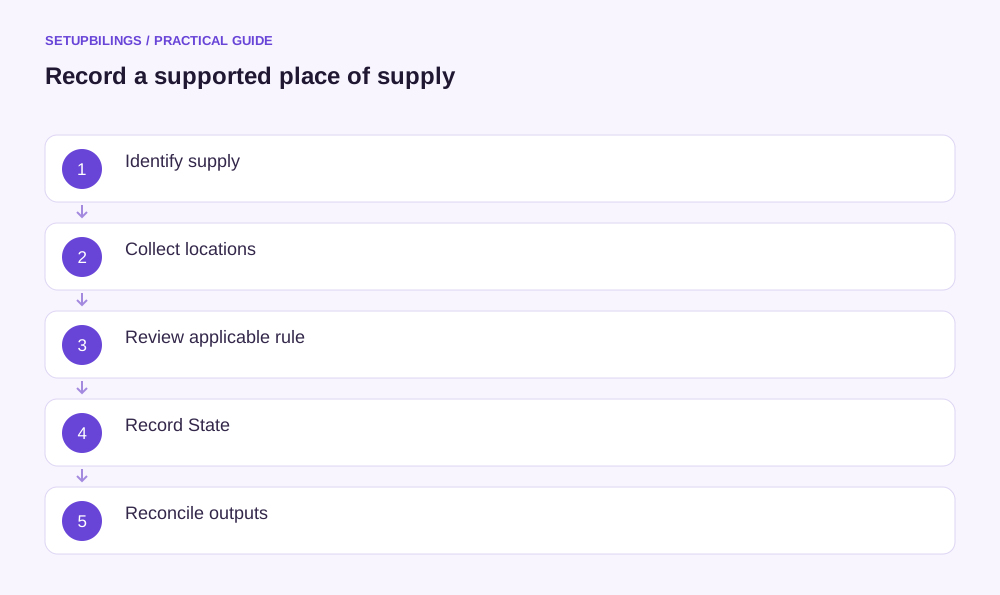
Record place of supply as the location determined under the applicable IGST Act provision, with clear State identification where required. Do not populate it automatically from the delivery address or customer GSTIN without checking the transaction. Rule 46 requires place of supply with the State name for inter-State supplies. The invoice field should communicate a decision already supported by the order and supply facts.
Decide whether you are analysing goods or services
Goods and services use different place-of-supply frameworks. For domestic goods, section 10 addresses movement, delivery on another person's direction, installation and other situations. For services where supplier and recipient are in India, section 12 contains a general rule and specified categories with different treatment. Cross-border services require a separate review under section 13.
This first distinction prevents a common shortcut: applying a goods delivery rule to a service merely because the technician travels. Write a one-line supply description for the review, such as “sale of equipment for installation at customer site” or “monthly bookkeeping support.” Then identify the provision relevant to that description and the contract.
Capture the locations that matter
Keep supplier location, purchasing registration, billing address, delivery address and service-related location as separate information. For services, also identify the establishment involved where that affects the analysis. A company's registered office or payment centre may not be the only relevant location.
The invoice should not display an unexplained two-letter abbreviation where a State name is needed. Use a consistent State name and code mapping across the customer master, print format and reporting data. Internal location codes such as “South Zone” can help operations, but they should not replace statutory geographic details.
Ordinary goods example
Consider an illustrative sale by a registered Maharashtra supplier to a registered Karnataka buyer. Goods move to Bengaluru for delivery, and no special bill-to/ship-to, installation or other rule changes the result. The place of supply is Karnataka under the ordinary movement rule. On ₹60,000 taxable value at an assumed confirmed aggregate rate of 18%, IGST is ₹10,800 and total payable ₹70,800.
The invoice can state “Place of supply: Karnataka” and use the corresponding State code in structured data. Retain the order and delivery instruction. If the customer instead directs delivery on behalf of another purchaser, re-examine the arrangement before copying this conclusion; the same destination does not prove identical legal facts.
Handle unregistered goods customers deliberately
Section 10(1)(ca) requires a specific approach for goods supplied to unregistered persons. CBIC Circular 209/3/2024-GST explains the treatment where their billing and delivery addresses differ: place of supply follows the delivery address recorded on the invoice in the case covered by that clarification.
For an unregistered buyer billed at a Rajasthan address but receiving goods in Gujarat, do not mechanically choose Rajasthan from a customer account default. Collect the delivery instruction and review the circular. Where address information is absent, the statutory fallback also matters. The right operational response is to collect reliable data before issue, not manipulate fields to obtain a preferred tax result.
Test service categories before using a default
For many ordinary domestic B2B services, the registered recipient's location is central to the general rule. But specified categories, including certain property-related, event, transport and other services, require their own checks. An item master labelled “services” does not resolve these distinctions.
Suppose an interior contractor's invoice concerns work on premises in Chennai while the customer's finance office is in Mumbai. Before selecting Maharashtra, inspect the scope, property connection and relevant place-of-supply provision. The bill's payment address can remain Mumbai even when the legal place-of-supply analysis points elsewhere. Record enough facts that a reviewer can understand the conclusion without interviewing the project manager.
Connect place of supply to tax type
After determining place of supply, compare it with the supplier location and check the IGST Act's inter-State and intra-State rules, including specific exceptions. SEZ supplies require particular attention because ordinary same-State logic is insufficient. Only then select IGST or the relevant central and State or Union territory components.
A useful review table has four columns: supply facts, provision checked, concluded place of supply and tax-head outcome. Use it for exceptions rather than attaching a lengthy legal note to every customer invoice. Keep the approved conclusion accessible to billing staff for repeat transactions with the same facts.
Use exceptions to improve the location master. If staff repeatedly select a district, city or internal sales territory where a State field is expected, change the entry guidance and approved list. A readable State name on the PDF should correspond to the same State in the structured record, rather than being a separately typed note that can drift.
Prevent stale defaults and unexplained overrides
Review place-of-supply defaults when a customer changes registration, delivery arrangements or service scope. Limit manual overrides and ask for a short reason. “Customer requested” is incomplete; the reason should identify the actual transaction fact and rule considered.
Before releasing the document, compare the PDF field with the sales register and applicable electronic reporting data. If the document says Karnataka while the structured record uses Maharashtra, correct the source of the mismatch. A clear place-of-supply field is valuable because it makes the tax decision visible, but its reliability comes from a complete factual review before the invoice is generated.