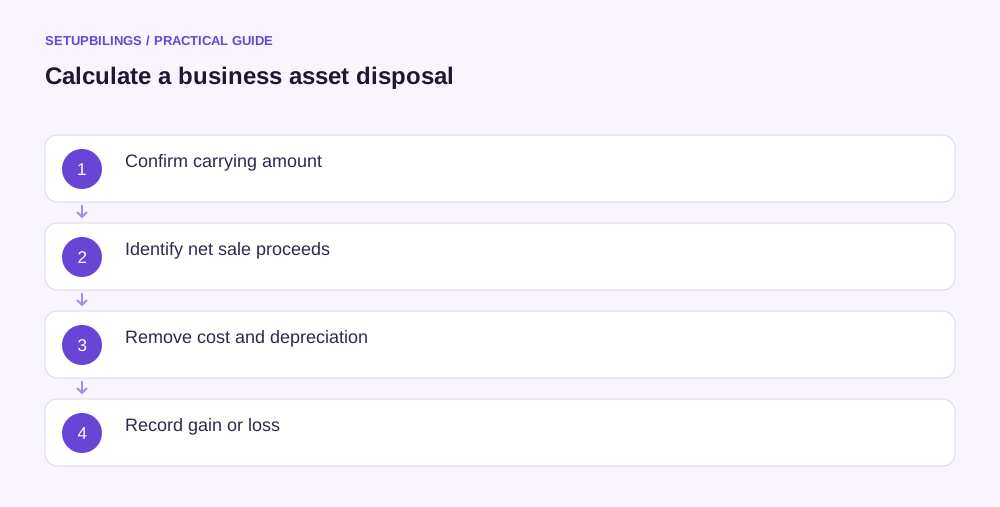
When a business asset is sold, remove its recorded cost and related accumulated depreciation, recognise the sale proceeds and record the resulting gain or loss. Separate any output tax from the amount used to measure the disposal result. Crediting ordinary sales for the full bank receipt can conceal both the asset removal and its carrying amount.
Establish the asset being disposed of
Use the asset register to identify the item, cost, accumulated depreciation, impairment and location. Confirm that the asset sold matches the item removed; similar machines can have different acquisition dates and carrying values.
Bring depreciation up to the relevant disposal date under the applicable policy. An old register extract may understate accumulated depreciation and distort the calculated gain.
ICAI AS 10 addresses derecognition and generally measures the disposal result as net disposal proceeds less carrying amount. Its ordinary fixed-asset disposal guidance distinguishes the gain from revenue, while providing specific treatment for some routine disposals of rental assets. The example concerns an ordinary operating machine.
Illustrative sale with a gain
A Ghaziabad manufacturer sells a machine with recorded cost of ₹5,00,000 and accumulated depreciation of ₹3,00,000. Assume no impairment. Carrying amount is ₹2,00,000. The agreed pre-tax selling price is ₹2,40,000, with illustrative GST of ₹43,200, all received into bank.
| Account | Debit ₹ | Credit ₹ |
|---|---|---|
| Bank | 2,83,200 | — |
| Accumulated depreciation | 3,00,000 | — |
| Machinery cost | — | 5,00,000 |
| Output GST | — | 43,200 |
| Gain on asset disposal | — | 40,000 |
| Total | 5,83,200 | 5,83,200 |
The ₹40,000 gain equals ₹2,40,000 proceeds before tax less ₹2,00,000 carrying amount. The ₹43,200 tax is not part of that gain. The tax rate is assumed solely for the illustration and does not determine an actual asset’s tax treatment.
After posting, both the machine’s cost and its related accumulated depreciation are removed. Leaving either behind makes the asset ledger incomplete.
What changes when the sale makes a loss?
If the same machine instead sells for an illustrative ₹1,70,000 before tax, the disposal loss is ₹30,000 before considering supported selling costs. Debit the loss account rather than inserting a negative gain credit without clear presentation.
The asset’s original cost does not determine the result alone. Comparing ₹1,70,000 with ₹5,00,000 would ignore depreciation already recognised and overstate the new loss.
Likewise, a fully depreciated asset can still produce proceeds. Its remaining carrying amount and relevant disposal costs must be considered before concluding what gain arises.
Selling costs and unpaid proceeds
A broker fee or removal cost connected with disposal needs its own supporting document and treatment. Where such costs form part of net disposal proceeds under the applicable framework, include them in the gain-or-loss working without hiding the related payable or bank movement.
If the buyer has not paid, debit an appropriate disposal receivable instead of bank. Later collection debits Bank and credits that receivable. Do not recognise the disposal gain again when the money arrives.
A deposit received before the sale is completed should be tracked according to its actual terms. Receipt of money does not by itself establish that the asset has been disposed of.
GST needs a separate working
The sale of a business asset can have GST consequences depending on registration, asset history and transaction facts. Where input credit was availed on capital goods, specific provisions may affect the amount payable. The illustrative output-tax calculation is not a complete tax determination.
Review the original purchase and credit records, sale documents and applicable requirements before issuing the invoice. Do not assume that an accounting loss means no GST is due or that a book gain is the taxable value.
Retain the tax working beside the disposal working. They answer different questions and may use different measures.
Part disposals and trade-ins need detail
Selling one component of a larger asset requires a supported carrying amount for the part removed. Do not derecognise the entire machine merely because the component shares its asset code.
For a trade-in, identify the disposal of the old item and acquisition of the new one, with the contractual and accounting measurement assessed appropriately. A net supplier payment can obscure two separate economic events.
Keep the old asset’s disposal references linked to the new purchase where relevant. That makes the cash difference understandable without merging the two asset histories.
Close operational records as well as the ledger
Obtain the authorised sale approval, invoice, handover evidence and buyer details. Update insurance, maintenance and location records so the business does not continue paying costs for an item it no longer controls.
Review assets held for disposal but not yet sold under the applicable measurement requirements. An intention to sell is different from a completed disposal, and the ledger should reflect the actual stage.
Check payment received before physical collection
A buyer may pay before collecting the machine. Establish the actual disposal date from the contract, control and relevant recognition requirements rather than choosing whichever of payment or collection is convenient.
Keep the asset’s location and custody clear while it awaits handover. An invoice and bank receipt can coexist with goods still on the seller’s premises, but the accounting conclusion needs the supported transfer facts. The depreciation and disposal working should use that same conclusion consistently.
The completed entry should explain the money or receivable created, the carrying amount removed and the resulting gain or loss. A reconciled asset register makes each part of that result reviewable.