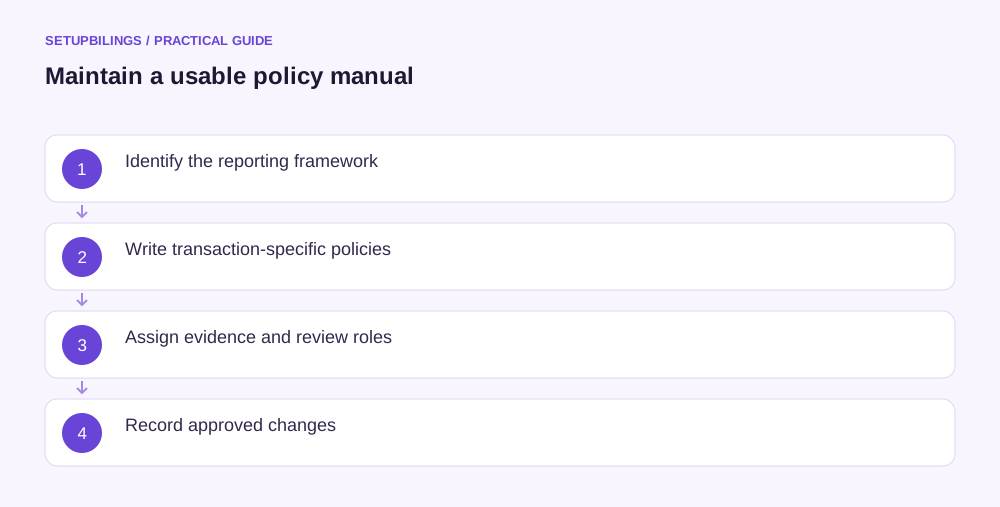
A simple accounting policy manual records the principles and methods the business uses to prepare its accounts. It should identify the reporting framework, explain material accounting treatments and show how staff apply them to recurring transactions. Its purpose is consistent, supportable decisions rather than a long document nobody consults.
Start with the business’s actual activity. A service firm needs clear rules for project fees, advances and subcontract costs. A trader needs inventory and return policies. A manufacturer needs production-cost guidance. Generic text copied from another entity may describe choices the business has never made or cannot support.
Establish scope and authority
Consider an illustrative Raipur industrial supplies firm preparing a manual for its finance team and external preparer. The first page identifies the entity, reporting framework, financial year, accounting basis, effective date and person responsible for approving changes.
Distinguish accounting policies from procedures. A policy explains the treatment, such as the relevant inventory cost formula. A procedure explains who collects bills or runs the stock report. Both can be linked, but staff should understand whether they are applying a recognition rule or completing an administrative task.
ICAI’s AS 1 addresses disclosure of significant accounting policies and recognises that policy selection requires judgment. An internal manual supports application, while the financial statements still need the disclosures required by the applicable framework. The manual is not itself a substitute for those notes.
Select the sections that matter
A practical starting structure includes revenue, purchases and expenses, inventory, equipment, employee costs, cash and bank, funding, estimates and the month-end close. Add other areas when actual transactions require them.
| Section | Questions the manual should answer |
|---|---|
| Revenue | What evidence supports recognition and how are advances handled? |
| Expenses | How are service periods, accruals and prepayments reviewed? |
| Inventory | What costs and formula apply, and how is value reviewed? |
| Equipment | What qualifies, when does depreciation begin and who reviews estimates? |
| Funding | How are owner contributions, loans and repayments identified? |
| Estimates | What evidence, approval and review are required? |
Do not invent policies for hypothetical complex arrangements merely to make the manual look comprehensive. Instead, include an escalation rule for unfamiliar transactions so the team obtains an assessment before posting.
Write application rules using real examples
For the supplies firm, a prepayment section might explain that qualifying future service payments are recorded with coverage dates and released as benefits are consumed. An illustrative ₹24,000 twelve-month service contract would produce ₹2,000 monthly expense if an even allocation fits the service pattern.
The section should state where the schedule is maintained, who reviews it and how changes or cancellations are handled. Avoid a blanket instruction to spread all payments above ₹24,000 over a year. The amount does not establish a future benefit or an appropriate period.
For equipment, explain the recognition criteria and directly attributable cost principles under the relevant standard, with examples of routine servicing versus qualifying replacement. State how useful life and residual value are supported. A company-specific materiality policy needs a reasoned basis rather than an imported tax threshold.
Define the evidence and approval trail
Every material policy area should identify the records that support application. Revenue may require contracts, delivery and completion evidence. Inventory needs quantities, cost records and condition review. Estimated obligations need scope, evidence and calculations.
Specify who prepares, reviews and approves unusual entries. For example, a bookkeeper may apply the documented monthly insurance release, while a new revenue arrangement requires accounting review. The division of work should match staff competence and the business’s actual resources.
Include a short exception log. If a transaction cannot be resolved before a reporting deadline, record the issue, provisional treatment where appropriate, financial effect and responsible person. Do not allow “ask the owner” to become an undocumented permanent policy.
Keep choices separate from estimates
A policy describes principles and methods. An estimate uses judgment to measure an amount within the relevant treatment. A change in useful life based on new evidence is different from changing a policy for a class of transactions, and both differ from correcting a posting error.
Record those distinctions because they can affect accounting and disclosure. The manual should direct staff to the applicable standard and review process rather than give one general instruction to “adjust this year.”
Avoid contradicting the framework. Disclosure of a chosen policy does not cure an inappropriate accounting treatment. If a manual rule conflicts with a required standard, update the manual and assess the accounts accordingly.
Make maintenance part of the close
Use version numbers, effective dates and a change log. Record the reason for each material update and its approval. Keep earlier versions available where they explain past reporting. Tell staff what changed and whether comparative reports need attention.
Review the manual when new products, locations, funding arrangements or reporting requirements arise. At least periodically, compare the written policies with actual ledger practice. A beautifully worded manual is ineffective if the team consistently posts differently.
Test the document by asking a new staff member to classify several real transactions and identify the necessary evidence. Where they struggle, improve the explanation rather than add more abstract terminology.
Provide a short worked entry where it prevents a recurring mistake, but explain the assumptions that make the entry appropriate. Staff should not copy an example into a different legal entity or contract without checking its relevance. Mark examples as illustrations and connect them to the underlying policy and escalation rule.
A useful accounting manual is concise, specific and maintained. It gives routine transactions a consistent path, gives unusual transactions a clear escalation route and preserves the reasoning behind material choices. That reduces dependence on memory and makes both monthly reports and staff handovers more reliable.