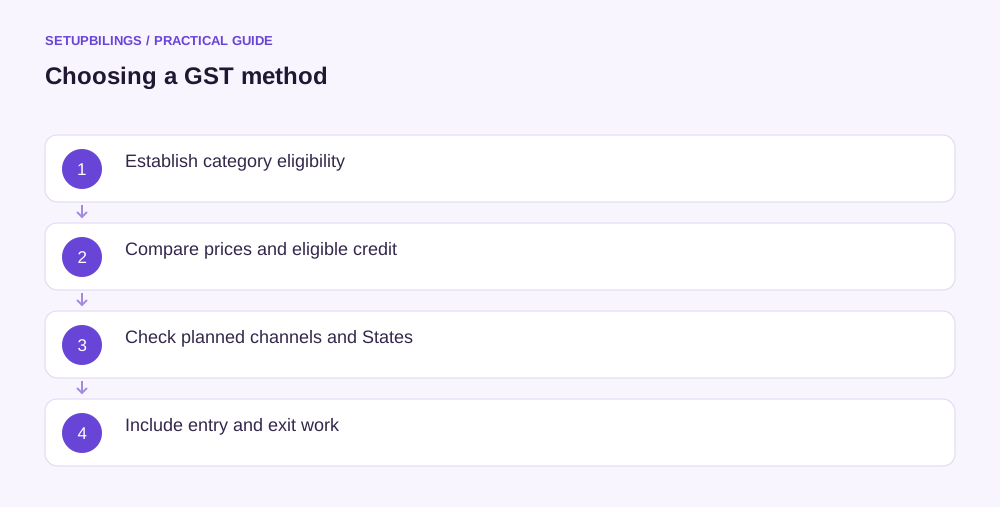
Eligibility comes before the cost comparison
The composition scheme is an optional GST method for eligible registered persons. It does not mean an unregistered business can simply pay a small percentage of sales without following the registration and scheme rules. First establish whether registration is required or chosen, then identify which composition category, if any, fits the business.
For the main section 10(1) route, Notification 14/2019 sets a preceding-year aggregate-turnover ceiling of ₹1.5 crore, with ₹75 lakh for the eight States specified in that notification. A separate section 10(2A) route has a ₹50 lakh preceding-year limit for qualifying persons outside the main route. These figures are eligibility limits with other conditions, not a universal promise that every business below them qualifies.
Understand the main operating difference
Under normal taxation, the business charges GST where applicable, issues the appropriate tax invoice and may claim input tax credit subject to statutory conditions and restrictions. Its net cash tax is not simply the tax rate multiplied by sales; eligible credit and other adjustments affect the position.
A composition taxpayer cannot collect tax from customers and is not entitled to input tax credit under the scheme. It issues a bill of supply with the prescribed particulars and bears the composition payment within its commercial economics. Do not compare a tax-exclusive normal price with a composition final price and call the difference pure tax savings.
The applicable composition rate and tax base depend on the category. Check both the central and corresponding State treatment before modelling a combined payment. Restaurant, manufacturer, trader and other qualifying service-related categories should not all be assigned one rate solely because each is called composition.
Test the customer and purchase mix
A consumer-facing business may be able to quote one final price without customers expecting credit. A business supplying registered customers may face different procurement and pricing expectations. Ask what buyers actually require and how much of the demand depends on a tax invoice supporting their own potential credit claim.
Review purchases too. If a business buys substantial taxable stock or equipment, loss of eligible credit under composition can matter. Some purchases would not qualify for credit even under normal taxation, so do not treat all GST appearing on bills as a benefit the regular option automatically provides.
Illustratively, a local retailer expects ₹8 lakh of monthly sales and ₹5 lakh of taxable purchases before considering tax. Compare the two routes using verified rates, actual purchase-credit eligibility, final customer prices and operating costs. A low composition percentage can still yield a weaker margin if purchase tax becomes cost and selling prices cannot increase.
Check the channels and geographic plans
Composition restricts inter-State outward supplies under the applicable section 10 conditions. A business planning sales from one State to customers in others must review that constraint before opting in. Buying goods from another State is a different question and should not be confused with making inter-State outward supplies.
Avoid the outdated statement that every composition taxpayer is barred from selling goods through e-commerce operators. Notification 36/2023 provides an operator procedure for composition goods supplies from 1 October 2023, including no inter-State goods supplies through that route and TCS reporting. Service supplies through relevant operators have a different restriction and must be checked separately.
An online store's settings should therefore be part of the decision. If the model requires nationwide goods delivery or a service marketplace arrangement incompatible with the selected category, a small preceding-year turnover does not cure the problem. A future sales plan can make normal taxation operationally more suitable even where composition is currently available.
Compare records and ongoing work honestly
Composition has its own payment, return and recordkeeping obligations; it is not a record-free option. The business still needs reliable turnover, purchases, stock and eligibility monitoring. Check the current forms and filing calendar for the actual category instead of using an old article's due dates as permanent rules.
Normal taxation may involve more transaction-level reporting, credit reconciliation and invoice controls. Assess the real effort using a trial month. A business with a few complex contracts may need more attention than a shop with many routine sales, so count the work rather than assuming invoice volume alone measures compliance effort.
Use a comparison table covering customer price, purchase tax cost, payment amount, expected credit, sales restrictions and staff or professional effort. Explain assumptions and run a second case with higher turnover or a changed customer mix. This reveals whether the chosen option remains useful as the business grows.
Include entry and exit costs
A normal taxpayer moving into composition must review the special credit reversal and stock-related requirements. A composition taxpayer moving out may have a separate conditional stock and capital-goods credit entitlement. Neither transition is achieved merely by changing a tax-rate setting in invoice software.
The scheme choice also interacts with other registrations under the same PAN. Review the statutory common-PAN conditions before choosing composition for one shop while assuming another registration can continue under normal taxation. The business needs a consistent legal decision across the relevant registrations, not independent choices made by different branch bookkeepers.
Choose the option that fits both the current facts and the intended operating model. Keep a dated decision file with eligibility evidence, a numerical comparison and review triggers such as a new State, channel or turnover level. That file makes the choice explainable and gives the business a clear reason to reassess it when its facts change.