Netting receivables against payables means showing only the difference between amounts due to the business and amounts it owes. That can hide useful information about collection exposure, payment obligations and cash timing. The fact that a net number is easy to calculate does not establish that offsetting is permitted in the accounts.
The applicable accounting framework determines when balances may be offset. For entities applying Ind AS, the relevant financial-instrument rules include specific conditions concerning enforceable rights and settlement intention. Other entities also need to assess their governing requirements rather than assume that common ownership or a shared counterparty name is enough.
See what the net number conceals
Consider an illustrative Vapi packaging business that sells cartons to a customer and also buys material from that same legal entity. The customer owes ₹1,50,000 for cartons, while the packaging business owes ₹90,000 for materials. A net figure is ₹60,000 receivable.
However, the ₹90,000 supplier payment is due in seven days and the ₹1,50,000 customer invoice is due in sixty days. Unless an appropriate settlement arrangement exists, the business may need to pay ₹90,000 well before collecting anything. A net receivable of ₹60,000 does not explain that funding gap.
The gross balances also show the amount exposed to customer collection risk and the full supplier obligation. Reducing both to one number can make receivables ageing, supplier due-date reviews and working-capital analysis less informative.
Distinguish matching from offsetting
Applying a customer receipt against the customer’s invoice is settlement of a receivable. Applying a supplier credit note against a valid supplier bill can adjust the relevant payable. These are different from taking two separate asset and liability balances and presenting only their difference.
Similarly, correcting a payment posted to the wrong customer is a classification or allocation correction, not a reason to net unrelated accounts. Start by understanding the transaction and document that produced each balance.
| Situation | Question before adjustment |
|---|---|
| Same entity is customer and supplier | Are the required offsetting conditions actually met? |
| Different companies in one group | Does any valid arrangement cover the separate legal parties? |
| Customer advance and unpaid invoices | What obligation and allocation does the customer intend? |
| Supplier deposit and unpaid bill | Is the deposit refundable separately or validly applied? |
| Misallocated receipt | Which invoice or party should the payment settle? |
A spreadsheet formula can combine balances that the business has no right to settle together. The accounting review must precede the netting instruction.
Check rights and settlement intention
Ind AS 32 requires, for the relevant financial assets and liabilities, both a currently enforceable legal set-off right over the recognised amounts and an intention to settle net or realise and settle simultaneously. Having only a hoped-for agreement or only an intention to net is insufficient.
The enforceability and timing of rights can be complex, particularly across jurisdictions or where a right operates only on default. Obtain and assess the actual agreement with appropriate expertise where needed. Do not turn an informal telephone understanding into an assumed legal conclusion.
Even where the conditions support net presentation, underlying transaction detail remains important for reconciliation and any required disclosure. Net presentation should not mean deleting invoices, bills or settlement evidence from supporting records.
Keep legal entities and balances identifiable
Two companies with a similar name or common owner are not automatically the same counterparty. A receivable from one group company cannot casually clear a payable to another. Any multi-party arrangement needs its own documented analysis and accounting treatment.
For the Vapi business, record the full customer and supplier references, legal names, invoice numbers, dates and terms. If the parties agree a valid adjustment, retain the agreement, authorisation and confirmation of which amounts were settled.
Where the transaction changes or extinguishes rights and obligations, assess the recognition or derecognition consequences separately. Presentation by netting is not the same question as whether an obligation has actually been settled.
Protect operational reports
Maintain receivables ageing and payable due-date schedules on a clearly defined basis. A credit in one customer’s account should not automatically reduce the overdue balance of another customer. A deposit should not disappear into ordinary payables without explanation.
Reconcile gross supporting detail to the ledger and any permitted net presentation. Record the adjustment separately so a reviewer can reconstruct the original balances. Otherwise, a reported reduction in old receivables may look like cash collection when it was only an accounting adjustment.
Cash forecasts should reflect the settlement arrangement that is actually enforceable and intended. Until it is established, do not assume a gross supplier payment can be avoided. Distinguish confirmed net settlements from proposed adjustments still awaiting agreement.
Check whether the adjustment affects different periods or currencies. Even where counterparties discuss settlement, exchange differences, invoice disputes and timing can leave amounts unmatched. Retain the original balances and the calculation of any valid adjustment, including the date used. Do not clear a residual difference to discount or miscellaneous income merely because the parties expected the net figure to be round. Investigate what the remaining amount represents.
Use a short review note
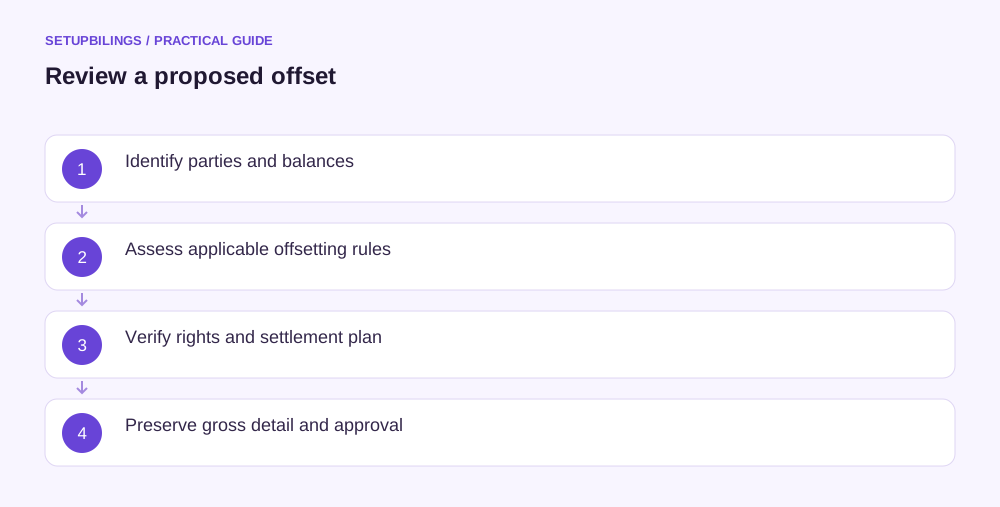
For each material proposed offset, document the parties, amounts, source transactions, relevant framework, rights, settlement plan and approval. Explain the resulting presentation and retain the reconciliation. Reject unexplained “square-off” journals that only make old balances disappear.
Gross information often tells the owner what must be collected and what must be paid more clearly than a single net figure. Apply offsetting only when the applicable conditions are met, preserve the underlying records and keep cash timing visible. That gives the business a clearer view of both exposure and obligations.