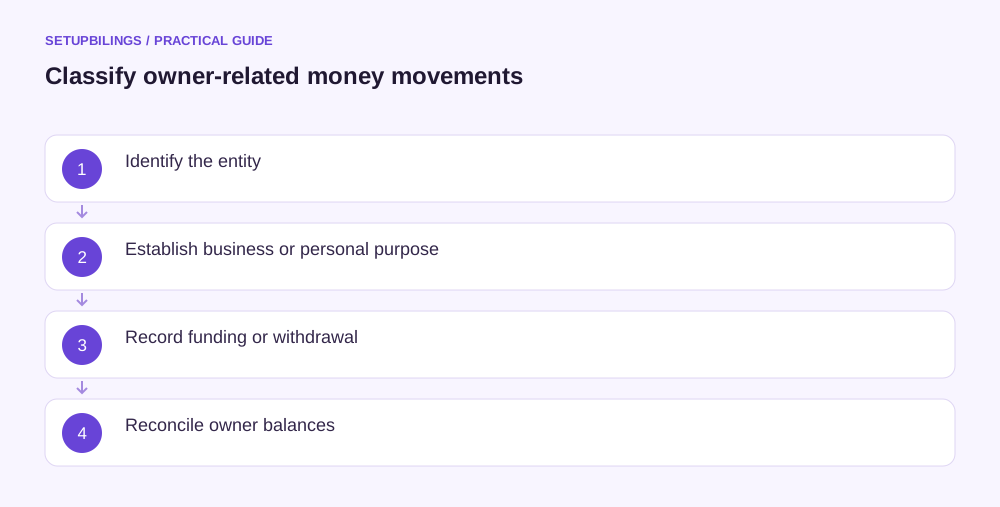
Business accounts should describe the business's resources, obligations, income and expenses separately from the owner's personal finances. This is the business entity concept. It applies to the accounting view even when the business is a sole proprietorship and the legal relationship differs from that of a separate company.
The practical benefit is straightforward: you can tell whether the business earns money and how much the owner has introduced or taken out. Mixing personal purchases, family transfers and customer receipts in one unexplained stream makes those answers harder to establish.
Start with the purpose of each payment
Consider an illustrative Indore proprietor running an appliance repair service. The business bank account pays ₹12,000 for workshop rent and ₹8,000 for the proprietor's family groceries. Both payments reduce the bank balance. Only the workshop rent is a business expense on those facts.
The groceries are drawings: a withdrawal for personal use that reduces the owner's capital. If both amounts are charged as expenses, business costs are overstated by ₹8,000 and reported profit is understated by the same amount. The bank reconciliation could still agree perfectly.
Now suppose the proprietor pays a ₹6,500 supplier bill using a personal card. Ignoring tax for this illustration, the business purchase or expense still needs recording. The counterpart reflects money owed to or contributed by the owner according to the arrangement. Leaving it out because it bypassed the business bank understates business activity.
Distinguish funding from turnover
When an owner transfers ₹75,000 of savings into the business, that receipt is not customer revenue. The books must identify whether it is a capital contribution, a genuine loan or another correctly documented balance. The label should follow the facts and the entity's legal structure.
A company requires particular care. Money transferred by a director or shareholder is not automatically share capital, and personal withdrawals cannot simply be treated as proprietorial drawings. Corporate approvals, documentation and applicable restrictions require separate analysis. Using a proprietor's bookkeeping shortcut for a company can obscure the actual relationship.
The reverse error also occurs: a customer pays into the owner's personal account and the sale disappears from the books. The business must record the sale and explain the amount collected or held by the owner. The destination of money does not change what generated it.
Establish simple payment boundaries
Use a dedicated business bank account and business payment identifiers where available and appropriate. Route customer receipts consistently. Pay suppliers from the business account when possible. These practices reduce the number of explanations required, although they do not replace correct accounting.
Create a short process for exceptions. An owner who pays a business cost personally should submit the invoice, purpose and payment proof. An accidental personal payment from the business account should be identified promptly and posted to the appropriate owner balance rather than hidden in an expense category.
For a mixed-use item, identify the business portion using a reasonable basis and supporting facts. A telephone used for customer calls and personal conversations may need an allocation. Do not assume the full payment is a business expense merely because the account is in the owner's name, or reject all business use merely because the bill is personal.
Make the owner's account explainable
| Movement | What the records should establish |
|---|---|
| Owner puts money in | Source, date and whether capital or a loan |
| Owner pays a supplier | Business invoice and settlement evidence |
| Business pays a personal bill | Amount withdrawn and correct owner account |
| Customer pays the owner directly | Sale recorded and money traced |
Review these movements monthly. A capital or owner-current-account schedule should reconcile opening balance, introductions, withdrawals and other relevant adjustments. Large or repeated unexplained transfers deserve investigation while memories and documents are available.
Avoid a miscellaneous account that absorbs every uncertain movement. It may postpone the classification problem while making profit unreliable. Temporary holding accounts should have named owners, supporting lists and a deadline for clearing items.
Separation improves decisions as well as records
Suppose the repair service reports ₹40,000 monthly profit and the proprietor withdraws ₹55,000. Drawings do not normally reduce the proprietor's reported operating profit, but they do reduce cash and capital. The business may be profitable while the withdrawal pattern is financially unsustainable.
Seeing profit and drawings separately makes that issue visible. The owner can set a planned withdrawal, keep a buffer for bills and review whether personal needs require stronger margins or a different budget. Calling the withdrawal a salary would not solve the cash problem and would distort the accounting explanation.
Similarly, owner funding can temporarily conceal weak operations. A bank balance supported by repeated personal transfers does not demonstrate that customer activity generates enough cash. Reporting introductions separately helps the owner measure the business on its own performance.
When several family members help the business, name the person associated with each transfer. A payment from a relative may be reimbursement, funding or settlement of a specific customer receipt. Combining those movements under the proprietor’s name can make later repayment and ownership discussions unnecessarily difficult. Clear identification at entry is usually easier than reconstruction at year end.
Build the boundary into everyday habits
Tell employees which account to use, where receipts belong and how reimbursements are approved. Keep personal documents out of routine supplier processing while retaining evidence for any genuine business allocation. Ask the bookkeeper to flag owner transactions instead of deciding uncertain items silently.
A clean boundary will never eliminate every exception. Its purpose is to make exceptions visible and explainable. When business income, expenses, owner funding and personal withdrawals each have a clear place, the accounts can answer the central question: what has the business itself earned and retained?