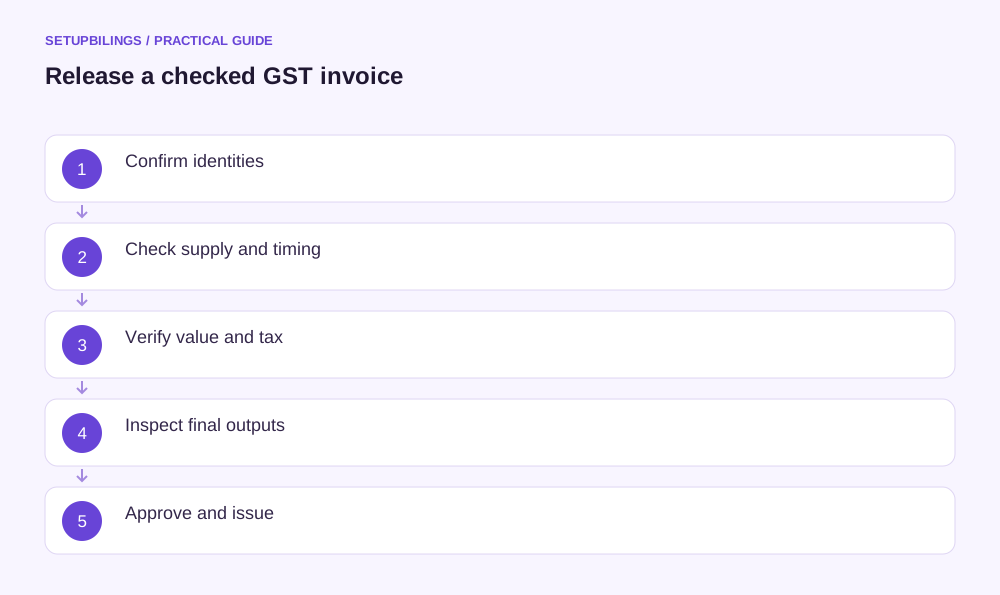
A pre-issue GST invoice check should confirm that the document represents the agreed supply, identifies the correct parties and calculates tax from supported facts. Sales staff do not need to resolve every complex legal question themselves. They do need to recognise missing information and route exceptions before release. Use the checklist as a sequence from order to final customer copy, with clear ownership for unresolved items.
Confirm the supplying and purchasing registrations
Check which GSTIN supplies the goods or services and which customer registration purchases them. Compare the accepted order, customer instruction and master data. Where a GSTIN is provided, verify it against the official GST Portal details and read the returned identity rather than treating a format check as sufficient.
Keep billing and delivery addresses separate. A branch, warehouse or customer contact can receive goods without becoming the contracting purchaser. Confirm unregistered status rather than assuming it because the GSTIN field is blank. The selected document and place-of-supply analysis depend on the actual facts.
Select the right document and date
Check whether the transaction needs a tax invoice, bill of supply, permitted combined document or another prescribed record. Taxability, supplier status and recipient facts matter. Do not choose a document because its layout looks familiar or the customer casually asks for a “GST bill.”
Compare the intended issue date with dispatch, delivery, service completion or contract milestone records. Section 31 and the applicable rules govern invoice timing, including special cases. An expected payment date is not a universal substitute. Review advances separately and preserve their receipt references.
Match items to approved descriptions and classifications
Confirm the SKU or service scope, description, quantity and unit. Use approved HSN or SAC and current rate references. If a new product or service does not fit the master, obtain the missing technical or contractual facts before selecting a convenient existing item.
Flag bundles, installation projects and contracts involving immovable property for the relevant analysis. Separate invoice lines do not automatically establish independent supplies. Likewise, a package name does not decide composite or mixed-supply treatment. The sales order should describe the arrangement accurately enough for review.
Rebuild the taxable value
Check quantity multiplied by agreed price, qualifying invoice discounts and charges requiring inclusion. Distinguish tax-inclusive from exclusive prices. Packing, freight and miscellaneous recoveries need the approved valuation treatment; separate rows do not automatically put them outside the base.
Keep advances, retention, withholding and payment deductions distinct from discounts. If a customer has already paid money, apply it to the receivable with a clear reference rather than reducing taxable value automatically. Where related persons, non-cash consideration or special valuation arises, obtain the appropriate approval.
Work a complete illustrative release example
Assume twenty units at ₹2,500 each, a qualifying ₹2,000 invoice discount and ₹1,000 included delivery under the approved arrangement. Taxable value is ₹49,000. At a confirmed assumed aggregate rate of 18%, GST is ₹8,820 and invoice total ₹57,820.
If ₹10,000 was already received and properly linked, the remaining amount collectible is ₹47,820. For an ordinary intra-State supply in a State, the assumed tax components are ₹4,410 CGST and ₹4,410 SGST. For an ordinary inter-State supply at the same rate, IGST is ₹8,820. The correct heads still require the location and nature-of-supply review.
Check place of supply and special routes
Determine place of supply using the rule covering the goods or service, then compare supplier location and statutory exceptions to select tax heads. Do not use customer GSTIN State or delivery destination as a universal answer. Unregistered goods buyers, bill-to/ship-to arrangements, specified services and SEZ supplies can require specific checks.
For exports or SEZ supplies, verify eligibility, route, supporting records and the current prescribed endorsement. For reverse charge, confirm the applicable liability and document indication. A short note saying “tax free” cannot replace the analysis or correct an inconsistent tax amount.
Check numbering and electronic requirements
Confirm the final invoice number follows the approved consecutive series, character limit and financial-year uniqueness requirements. Do not reuse a cancelled number or replace the invoice identity with a quotation reference. Preserve the issued document's history.
Where e-invoicing applies, complete the prescribed IRN process and required QR information before treating an ordinary PDF as the finished invoice. Review applicability and current system conditions for the actual supplier and document category. Electronic requirements should be controlled by approved facts, not by whether staff happen to see a button in the billing screen.
Inspect the customer copy and reporting values
Read the saved PDF or printout. Check names, GSTINs, addresses, descriptions, date, totals, tax heads and notes. Ensure long text does not hide required fields and that old template wording or placeholders are removed. Payment instructions should agree with the approved customer balance and bank record.
Compare key figures with the ledger and applicable structured data. A correct PDF can coexist with an incorrect tax amount or recipient in an export file. Use an independent arithmetic check for unusual invoices and new master settings rather than reviewing only the grand total.
Resolve exceptions before release
Record the specific issue, evidence needed, owner and decision. “Awaiting customer registration confirmation” or “delivery charge valuation review” is more useful than “invoice pending.” Keep approvals with the order and preserve the final issued version.
The checklist is complete when sales, dispatch and accounts can explain the same transaction from the same records. Correct identities, supported value, appropriate tax treatment and a readable customer copy make the invoice ready for collection and reporting, while giving unusual supplies a clear review path before issue.