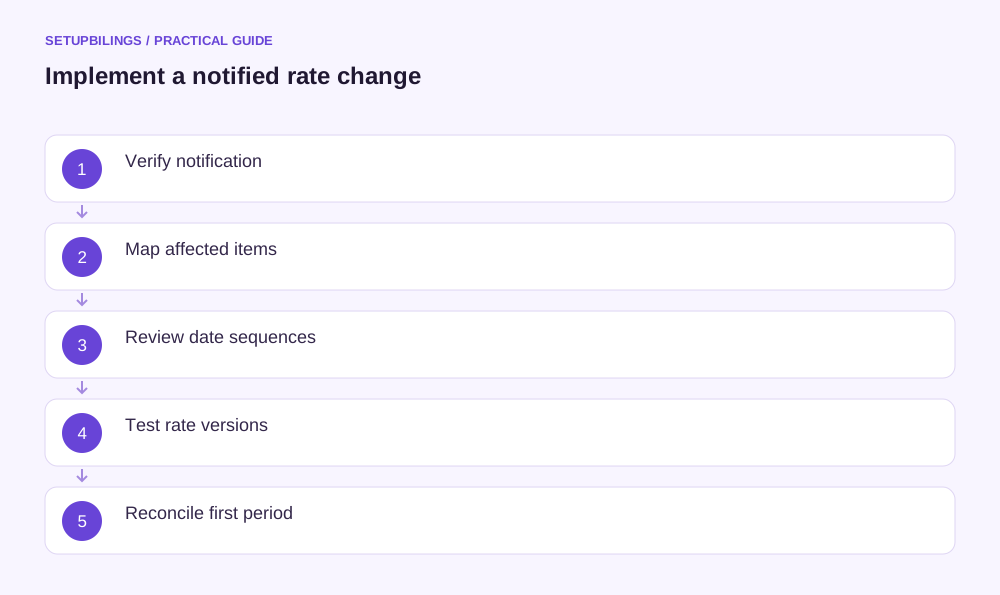
Update billing records for a GST rate change by creating a supported effective-dated rate version and reviewing transactions that cross the change. Verify the notification, goods or service description, conditions and commencement date before changing live billing. A Council recommendation can signal a future update, but the operative legal instrument determines when the new treatment applies. Preserve old rates for historical documents and corrections.
Identify exactly what changed
Read the actual notification and amendments. Determine whether the change concerns a percentage, exemption, description, classification condition, cess or valuation mechanism. A headline saying rates were simplified does not establish treatment for every item in a catalogue.
Map affected entries to specific SKUs and service scopes. Keep potentially affected items in a review list where descriptions or conditions need technical confirmation. Do not update every item sharing a broad keyword. A small variant difference can matter where the notification uses a precise description or condition.
Record the legal and operational dates
Store notification date, effective date, internal approval date and implementation date separately. They can differ. A future-dated entry should remain inactive until the correct period, while the old version stays available for transactions that legally retain the earlier treatment.
Keep the source document and a concise decision note. Identify who approved the item mapping and any assumptions, such as packaging, recipient or end-use conditions. The billing team needs enough guidance to apply the change without researching the entire notification during each sale.
Review section 14 for transitional transactions
Section 14 of the CGST Act addresses changes in tax rate using the relationship between supply, invoice and payment dates. Do not choose the rate solely from when the customer pays or when staff enter the invoice. Assemble the actual timeline first.
For example, where supply occurs before the rate change but both invoice and payment occur after it, section 14 provides a specific outcome using the later-side invoice or payment timing. Where the invoice is before the change and payment afterwards, the rule differs. Use the statutory matrix for the actual sequence rather than a universal “old order equals old rate” shortcut.
Illustrative timing and amount review
Assume a purely hypothetical rate changes from 5% to 18% on 1 November for a covered supply. On ₹1,00,000 taxable value, the arithmetic is ₹5,000 at the old rate and ₹18,000 at the new rate. The ₹13,000 difference makes the date analysis material.
If supply, invoice and payment all occur after the effective date and no special provision changes the outcome, the new reviewed rate applies. For a transaction spanning October and November, record each date and apply section 14 and any relevant special procedure. The quotation date alone does not resolve which percentage belongs on the tax document.
Review open commercial commitments
List accepted quotations, unfulfilled orders, advances, dispatched goods awaiting review, service milestones and recurring bills. Identify whether prices are inclusive or exclusive of GST and whether contracts address tax changes. The tax conclusion and who bears the commercial difference are related but separate matters.
For a fixed inclusive ₹1,18,000 price at an assumed new 18% rate, the extracted base is ₹1,00,000. An exclusive ₹1,18,000 base would instead produce ₹21,240 GST. Confirm the actual bargain before sending revised totals. Do not silently change the commercial price because a master percentage changed.
Keep historical invoices intact
Create a new rate version rather than recalculating previously issued invoices from the current item master. Preserve the rate, description and tax heads captured when the original document was approved. A later credit or debit note needs review of the underlying supply and applicable timing, not an automatic application of today's rate.
If the earlier master was wrong rather than legally superseded, treat that as a correction project with its own affected-document list. A prospective rate update should not conceal historical errors. Record the distinction so staff understand which invoices need investigation and which merely retain valid older treatment.
Test every billing route
Generate drafts for an old-period transaction, a straightforward new-period transaction and a rate-change exception. Check discounts, included freight or packing, multiple rates and inclusive prices. Compare the PDF, ledger and applicable structured reporting values.
Review manual screens, spreadsheet imports, integrations and scheduled recurring invoices. A new central master can coexist with stale copied templates. Confirm that users cannot bypass the change through an old item code without review, and that historic-date access does not permit uncontrolled backdating.
The main section 14 sequences can be summarised as follows, subject to its payment-date definition and any relevant special provision:
| Supply position | Invoice and payment positions | Section 14 timing result |
|---|---|---|
| Before change | Both after change | Earlier of invoice or payment |
| Before change | Invoice before, payment after | Invoice date |
| Before change | Payment before, invoice after | Payment date |
| After change | Invoice before, payment after | Payment date |
| After change | Both before change | Earlier of invoice or payment |
| After change | Payment before, invoice after | Invoice date |
Check the special bank-credit proviso where credit occurs after four working days from the rate change. Keep book-entry and bank-credit evidence so the payment-date conclusion is supportable.
Reconcile the first reporting period
After implementation, compare sales by rate and date against the approved mapping. Investigate old-rate invoices after the effective date and new-rate invoices before it, while allowing correctly documented transitional outcomes. An exception report should request the supply/invoice/payment timeline, not merely flag every date mismatch as wrong.
Keep customer communications factual and specific to accepted orders. Explain revised totals where the contract requires them without promising a particular tax saving. The final evidence should show the notification, item decision, timing analysis, tested setup and actual invoices.
A rate change is complete when the business can reproduce both the old and new treatment and explain the boundary between them. Effective-dated records and section 14 reviews keep the update accurate without rewriting historical invoices or relying on a single convenient date.