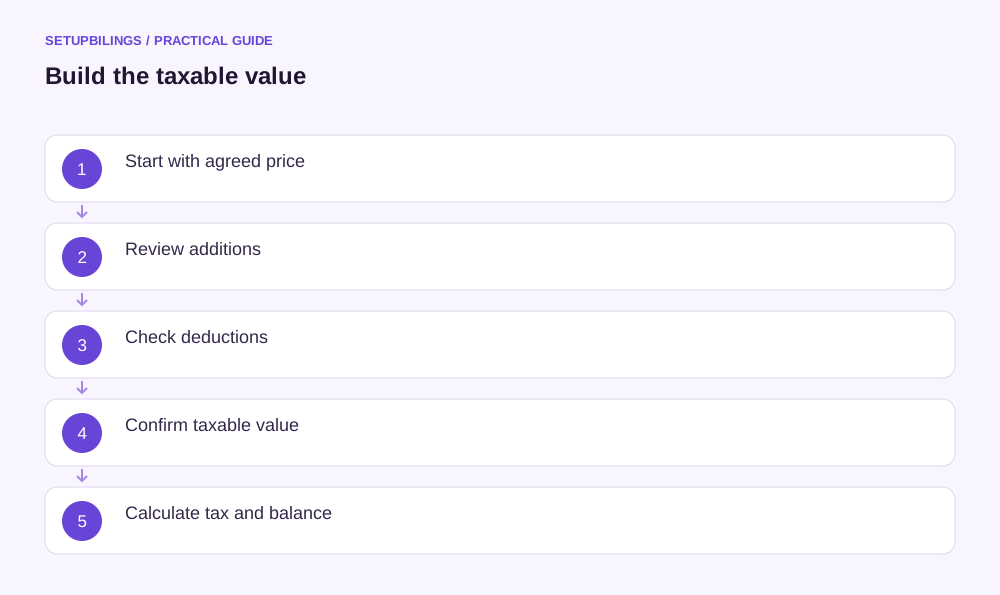
GST transaction value generally starts with the price actually paid or payable where supplier and recipient are not related and price is the sole consideration. Section 15 of the CGST Act then requires specified additions and permits qualifying discounts. Build the taxable value from the contract and commercial records rather than assuming that the amount received in the bank is the taxable base.
Confirm that the ordinary transaction-value test fits
Identify the contracting parties, their relationship and all forms of consideration. If the buyer provides goods, services or another benefit in addition to money, the price may not be the sole consideration. Related-party or distinct-person supplies also require valuation-rule review rather than automatic acceptance of the amount entered on the invoice.
Check whether a special valuation provision applies to the particular category. Section 15 contains a framework for prescribed and notified valuation, so the ordinary price method is not universal. Record the reason a routine sale qualifies for transaction value and flag exceptions early. An invoice total created by the sales team is an input to the review, not its conclusion.
Reconcile the base price with the agreement
Start with quantity multiplied by the agreed unit price or the service contract amount. Link that figure to the purchase order, accepted quotation and amendments. Resolve differences between the price list and the specific agreement before calculating tax.
For example, twenty units quoted at ₹3,000 each produce a ₹60,000 starting price. If the accepted order changes the specification and unit price to ₹3,200, the base becomes ₹64,000. The fact that staff copied an older quotation does not make the lower value correct. Retain the accepted change rather than using a balancing adjustment at the end of the invoice.
Review the statutory additions
Section 15 addresses certain non-GST taxes and charges, amounts the supplier is liable to pay but the recipient incurs, incidental expenses and amounts charged for relevant work before delivery or supply. It also covers interest, late fee or penalty for delayed consideration and directly price-linked subsidies other than specified government subsidies.
Read these categories against actual records. A charge called “reimbursement” is not automatically excluded. A customer payment to a third party may need inclusion if it discharges the supplier's liability. Conversely, do not add every cost in the supplier's accounts: the review concerns the statutory valuation conditions, not a universal cost-plus method for ordinary unrelated sales.
Illustrative value bridge
Assume an ordinary unrelated goods sale with money as sole consideration. The agreed item price is ₹60,000, a qualifying invoice discount is ₹3,000, packing charged by the supplier is ₹1,200 and delivery charged by the supplier is ₹1,800. Assume the reviewed arrangement requires those charges in the same taxable supply and the confirmed aggregate rate is 18%.
| Value component | Amount |
|---|---|
| Agreed item price | ₹60,000 |
| Qualifying invoice discount | Minus ₹3,000 |
| Included packing | ₹1,200 |
| Included delivery | ₹1,800 |
| Taxable value | ₹60,000 |
| GST at assumed 18% | ₹10,800 |
| Invoice total | ₹70,800 |
The coincidence that additions equal the discount does not remove the need to show the bridge. Each component has a different commercial source and must be supportable on its own.
Check discounts by timing and conditions
A discount given before or at supply can be excluded when duly recorded on the invoice under section 15(3)(a). Post-supply discounts require a separate review of the law applicable to the period, credit-note conditions and recipient-credit consequences. Do not reduce taxable value merely because a customer deducts an amount from payment.
A short payment may represent an agreed discount, a disputed quality claim, withholding, retention or an error. Identify which it is and obtain evidence. The bank receipt establishes cash collected; it does not automatically establish a revised value of supply. Keep collection adjustments and GST valuation decisions separately traceable.
Distinguish deposits and settlement entries
A refundable deposit, advance or security amount should be understood from the agreement and its actual application. Do not treat every incoming amount as the price of a completed supply. Likewise, an advance adjusted against a final invoice should not be added to the taxable value a second time.
Suppose a customer pays ₹20,000 in advance against a later invoice totalling ₹70,800. The remaining receivable is ₹50,800. That collection calculation does not change the illustrative invoice's ₹60,000 taxable value and ₹10,800 tax. Review any advance-related tax and documentation separately according to the supply and applicable provisions.
Retain a reviewable working
Keep the order, price amendments, discount authorisation, packing and freight terms, third-party payment evidence and any valuation note. Use a bridge that reconciles the commercial amount to the taxable amount, then to tax and the final receivable. Assign unresolved additions or deductions to a named reviewer before issue.
Reconcile unusual invoices with the ledger and relevant reporting data after approval. If a separate charge is posted directly to a recovery account, confirm that its GST treatment still agrees with the valuation decision. A correct customer-facing total can coexist with an omitted taxable charge in the accounts.
Transaction value becomes manageable when every adjustment has a source and a reason. Begin with the agreed price, test whether the ordinary method applies, include the required elements and deduct only supported discounts. The resulting invoice should explain both what the customer owes and how the taxable base was built.