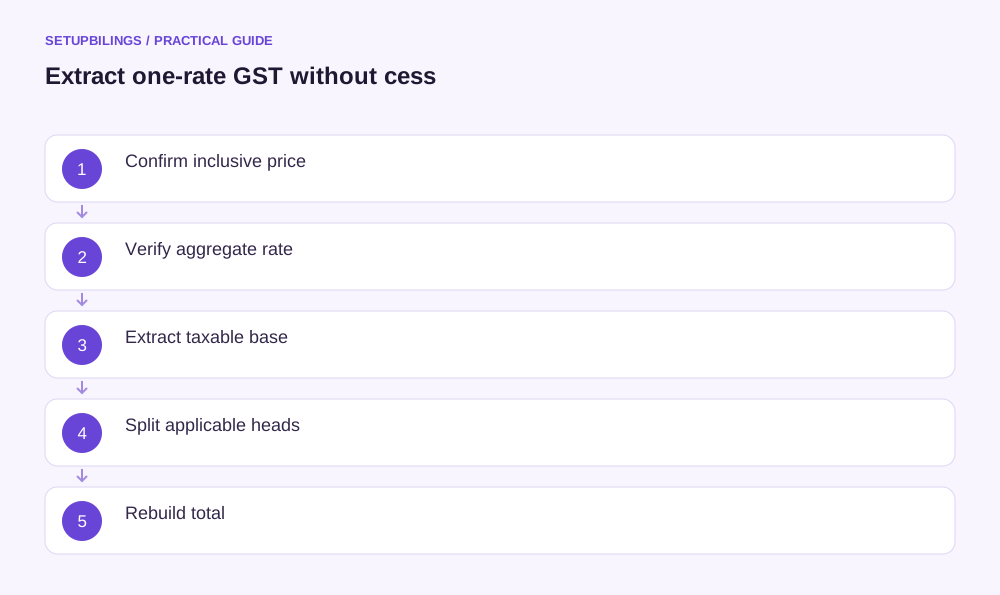
To extract GST from a tax-inclusive price, divide the inclusive amount by one plus the aggregate GST rate expressed as a decimal. Equivalently, taxable value equals inclusive price multiplied by 100 and divided by 100 plus the aggregate rate. The tax is the difference between inclusive price and taxable value. Rule 35 of the CGST Rules provides the inclusive-tax calculation framework. Confirm the applicable rate and included taxes before using the formula.
Understand what the inclusive amount contains
Read the offer and invoice terms. Does the displayed amount include GST only, or does it also contain delivery, packing, cess or another charge? The simple formula assumes one taxable value and one aggregate GST rate. A basket containing exempt items or several rates needs a component calculation.
Confirm whether the supplier can charge GST on the particular document. A composition supplier's bill of supply should not be turned into a regular tax invoice by extracting a notional tax component from its selling price. Document status and taxability must be settled before arithmetic.
Apply the formula to a straightforward example
Assume a taxable sale has a confirmed aggregate GST rate of 18%, no cess and a tax-inclusive price of ₹11,800. Taxable value is ₹11,800 × 100 ÷ 118, which equals ₹10,000. Total GST is ₹1,800. For an ordinary intra-State supply in a State, the corresponding assumed components are CGST ₹900 and SGST ₹900.
For an ordinary inter-State supply at the same rate, IGST is ₹1,800. The inclusive price remains ₹11,800. Determine the correct tax heads through the place-of-supply and nature-of-supply analysis; the inclusive formula calculates the amount but does not select the jurisdictional treatment.
Avoid subtracting the percentage from the total
A common mistake is to subtract 18% of ₹11,800. That gives tax of ₹2,124 and a supposed base of ₹9,676. It is wrong because 18% applies to the taxable base, not to the price that already includes tax. Multiplying ₹9,676 by 18% does not recreate the claimed tax component.
Use a reversal check: calculated base plus the applicable tax should return the agreed inclusive price. In the correct example, ₹10,000 plus ₹1,800 equals ₹11,800. This check is quick enough for a salesperson to perform on a calculator when reviewing an unusual quote.
Calculate local components using the combined denominator
Where the aggregate rate is 18% split as 9% CGST and 9% SGST, calculate each head using the same denominator of 118. On ₹11,800, CGST is ₹11,800 × 9 ÷ 118 = ₹900, and SGST is also ₹900. Do not use 109 as the denominator for each component independently.
For a covered intra-territory supply, substitute the appropriate UTGST component where applicable. The structure remains a single inclusive value with the relevant sum of tax rates. Keep the source rate and component mapping in the working so a reviewer can see how the total was divided.
Handle a tax-inclusive discount explicitly
Suppose a customer receives an agreed ₹590 discount from an inclusive price of ₹11,800 before issue, leaving ₹11,210. Assuming the discount qualifies for valuation exclusion and the same 18% rate applies, taxable value becomes ₹11,210 ÷ 1.18 = ₹9,500. GST is ₹1,710.
The ₹590 reduction comprises ₹500 taxable value and ₹90 tax in this example. Do not deduct the full ₹590 from the ₹10,000 base and then calculate tax unless that is what the commercial offer actually means. State whether discounts are quoted on inclusive or exclusive amounts to avoid a mismatch between sales and accounts.
Separate multiple rates and other levies
An inclusive basket price of ₹15,000 does not provide enough information to calculate GST if it contains supplies at different rates and exempt lines without an allocation. Obtain the agreed line prices or a supportable allocation that reflects the offer. Do not apply an average rate merely to make the invoice total agree.
Where compensation cess or another levy applies for the relevant transaction period, verify its legal basis and computation separately. Some levies can use a different base or a quantity-based formula. The simple GST-only example should not be extended to them without checking the actual rule.
Retain precision until the appropriate stage
An inclusive price can produce a taxable base with recurring decimals. Keep adequate calculation precision and follow a consistent approved rounding method for the invoice and reporting outputs. Repeatedly rounding the base, each component and the total at different stages can create small discrepancies.
For example, ₹999 inclusive at an assumed 18% produces an unrounded base of approximately ₹846.610169 and tax of approximately ₹152.389831. A two-decimal presentation can show ₹846.61 and ₹152.39, totalling ₹999.00. Check the selected tax heads and the way the accounting system aggregates lines before treating a one-paise difference as an unexplained write-off.
Close with a reconstruction check
Keep the agreed inclusive price, confirmed rate, extracted base, tax components and any discount allocation together. Recalculate a sample independently after a rate-master change or new price offer. Compare the customer copy with the ledger and structured invoice values where applicable.
The reliable method starts with a clear commercial price and a verified tax treatment. Once those inputs are correct, the extraction is a transparent calculation that recreates the agreed total and leaves the taxable value and tax heads separately traceable.