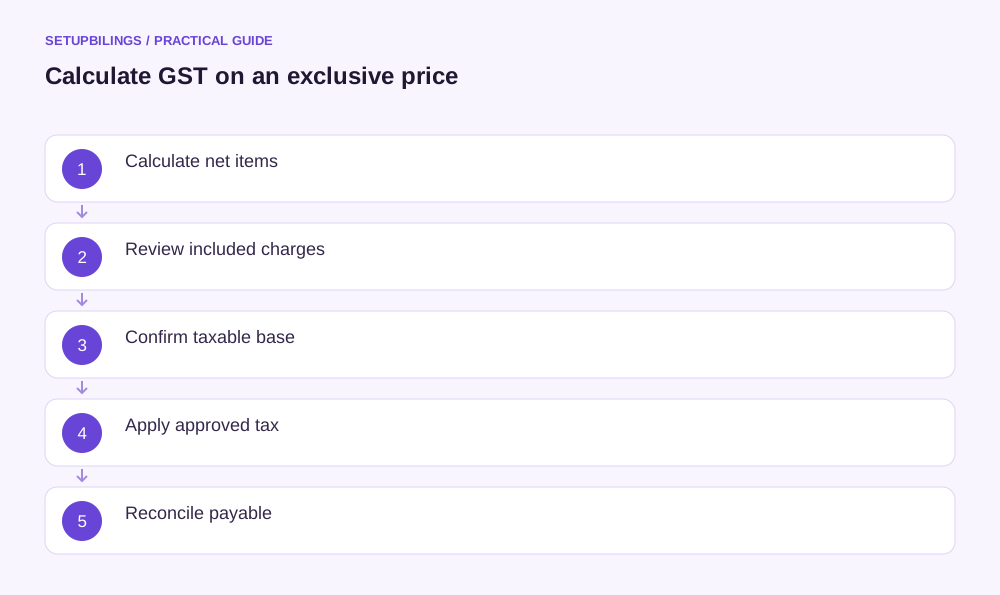
To add GST to a tax-exclusive price, first establish the taxable value, then multiply that value by the applicable rate and add the tax. The familiar formula works only after discounts, included charges and special valuation questions have been resolved. Section 15 of the CGST Act governs the value review, while the relevant classification and rate provisions determine the percentage. Make the commercial quotation explicit about what its exclusive price covers.
Confirm that the quote is genuinely tax-exclusive
Read the accepted quotation and purchase order. “₹50,000 plus GST” is different from “₹50,000 all inclusive.” If the customer accepts a fixed total, adding GST afterwards may create a commercial dispute even when the mathematical calculation is correct. Resolve the agreed pricing basis before generating the final document.
List any extra charges the customer has accepted, such as packing or delivery. A quote that says “freight extra” leaves another amount to determine; it does not establish whether that charge is outside taxable value. Review the actual supply arrangement and statutory valuation rules before calculating the final base.
Calculate the net item amount
Multiply quantity by the agreed unit price, then apply any qualifying invoice discount. Check whether the discount is a percentage of the item value, a fixed amount per unit or an overall order concession. Confirm the sequence where the offer contains several discounts.
For example, thirty units at ₹1,200 each produce ₹36,000. A 5% discount is ₹1,800, leaving ₹34,200. If the commercial terms instead provide ₹50 off each unit, the discount is ₹1,500 and the remaining value is ₹34,500. These are different offers; a software dropdown should not decide which one the customer agreed to.
Build the taxable base before calculating GST
Assume the first offer applies, the invoice discount qualifies for exclusion and the supplier charges ₹800 packing plus ₹1,000 delivery. Assume the reviewed arrangement requires both charges in the same taxable supply. The resulting taxable value is ₹34,200 + ₹800 + ₹1,000 = ₹36,000.
With a confirmed illustrative aggregate GST rate of 18%, total tax is ₹6,480. The invoice total is ₹42,480. The coincidence that taxable value equals the original gross item amount does not mean discounts and charges can be omitted from the working. Their separate records explain how the value was derived.
Split the tax under the correct heads
For an ordinary intra-State supply in a State at the assumed 18% aggregate rate, CGST at 9% is ₹3,240 and SGST at 9% is ₹3,240. For an ordinary inter-State supply at the same rate, IGST is ₹6,480. If UTGST is the relevant local component, use that treatment where the territory and supply rules require it.
| Illustrative component | Amount |
|---|---|
| Net items after discount | ₹34,200 |
| Included packing and delivery | ₹1,800 |
| Taxable value | ₹36,000 |
| Aggregate GST at 18% | ₹6,480 |
| Total payable | ₹42,480 |
The tax-head decision comes from supplier location, place of supply and statutory exceptions. A matching total does not establish that the right heads were used.
Keep multiple rates separate
If a single invoice contains independently treated supplies at different rates, calculate the taxable value and tax for each rate group. Allocate overall discounts and common charges on a supportable basis that reflects the agreement and the legal treatment. Do not apply the first line's rate to the entire invoice by default.
If the commercial arrangement is a composite or mixed supply, analyse that before treating components independently. Separate invoice lines cannot override the bundle's legal character. The calculation method should follow the approved supply analysis, not create it after the total has been negotiated.
State payment adjustments separately from value
An advance already received reduces the amount still collectible, but it does not automatically reduce the taxable value of the final supply. In the illustrative ₹42,480 invoice, a ₹10,000 advance leaves ₹32,480 to collect. Keep the advance reference and any applicable advance-tax adjustment separate from the price and output-tax calculation.
Similarly, withholding, retention and a disputed deduction are not automatically invoice discounts. Record the commercial nature of each adjustment. A customer paying less than the invoice total does not itself authorise the supplier to reduce the GST base. Investigate the reason and choose the appropriate documentation route.
Verify the arithmetic in both directions
Check quantity times unit price, discount, included charges, taxable value, tax by head and total. Then subtract total tax from the invoice total to see whether it returns the approved base, excluding any separately treated amounts. Compare the result with the order and customer acceptance.
Keep enough precision for the calculation and apply a consistent rounding policy in the final outputs. Test the first invoice after a rate or price-master change. A correct formula can still use an outdated rate or the wrong unit conversion, so verify the inputs as carefully as the multiplication.
Make the exclusive offer easy to understand
Show the taxable amount and tax components clearly on the invoice, with agreed freight or packing identified. The customer should be able to connect the final total to the accepted quote without asking which hidden amount was added.
Adding GST is straightforward once the commercial and tax bases are settled. A reliable process establishes the net price, reviews valuation adjustments, verifies the rate and tax heads, then calculates the payable amount. That sequence gives both the seller and customer a transparent number to approve and reconcile.