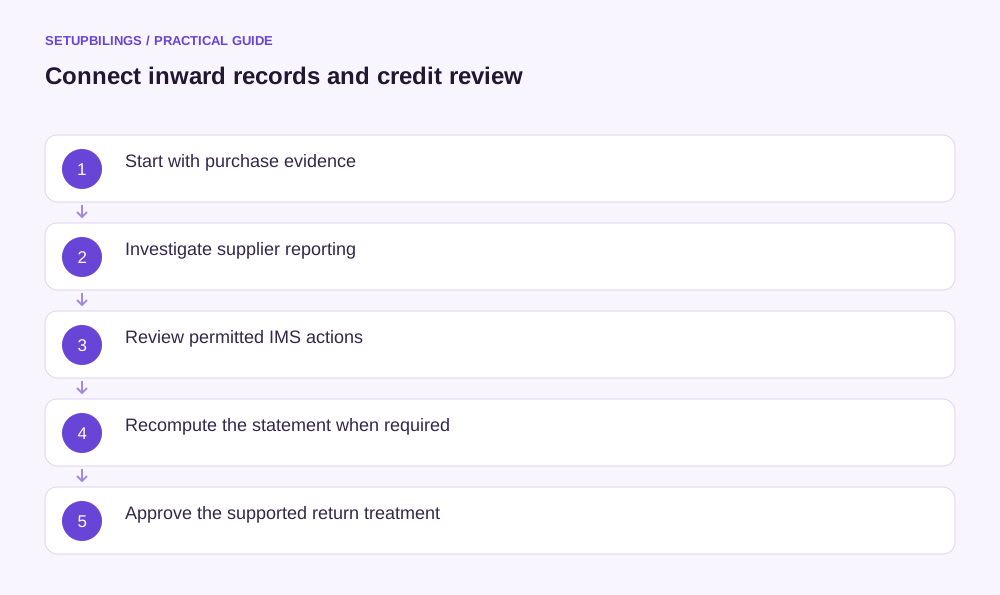
GSTR-2A and GSTR-2B are generated inward-supply statements with different roles in reconciliation. GSTR-2A is a dynamic view of relevant counterparty reporting. GSTR-2B organises credit-related information for a tax period and supports GSTR-3B preparation. Neither is a substitute for purchase records or a complete legal input tax credit assessment.
A critical current distinction is that GSTR-2B should not be described as permanently unchangeable immediately after initial generation. Under IMS workflows, relevant recipient actions and recomputation can affect it before the connected GSTR-3B is filed. Preserve the version actually used for the return.
Begin with what you are trying to answer
Consider an illustrative Surat packaging trader who cannot find a supplier invoice in the month’s credit reconciliation. The business needs to know whether the supplier reported it, which GSTIN was used, whether the source return was filed and which statement period contains the record.
GSTR-2A can help investigate evolving supplier reporting and amendments. The relevant GSTR-2B helps establish the period’s generated credit information, taking account of the applicable source-return and IMS process. The purchase register establishes what the recipient actually booked and the documents it holds.
Keep those questions separate. A supplier saying “uploaded” may mean saved data rather than a filed source return. A record visible in a dashboard may not yet have the same status or period effect as a filed document in the relevant statement.
Compare the roles rather than memorising slogans
| Record | Practical use | Important limit |
|---|---|---|
| Purchase register | Establish booked transactions and source evidence | Does not prove supplier reporting or all credit conditions |
| GSTR-2A | Investigate dynamic counterparty data and changes | Not a stand-alone authority to claim every visible amount |
| GSTR-2B | Reconcile the relevant period’s generated credit information | Version and IMS changes can matter before filing |
| IMS | Review permitted document actions and their effects | Acceptance does not replace legal eligibility checks |
| GSTR-3B | Report the reviewed credit treatment | Summary requires supporting schedules |
The familiar “2A dynamic, 2B static” shorthand reflects their original design but can mislead if it suggests that current IMS recomputation is impossible. Explain the actual workflow instead of relying on the old slogan alone.
Follow a supplier timing example
Suppose the trader books an illustrative ₹1,00,000 purchase with ₹18,000 tax, using an assumed valid 18% rate solely for this arithmetic example. The supplier reports the document later than expected. The invoice date, supplier reporting period and recipient statement period may therefore differ.
The recipient should trace the source-return status and relevant statement rather than changing its invoice date to force a match. Preserve the original invoice and record when the supplier’s document becomes available through the applicable process.
The ₹18,000 is not automatically claimable solely because a statement later displays it. The recipient must still assess the applicable credit conditions, restrictions, receipt, documentation and time limits. Conversely, the timing issue should not be mistaken for proof that the underlying purchase never occurred.
Incorporate current IMS handling
GSTN’s guidance describes accepted, rejected, pending and default treatment for relevant records, with recomputation where actions change after initial statement generation. Later October 2025 updates introduced additional handling for specified credit notes and related documents, including limited pending options and credit-reduction controls.
Do not apply the original 2024 pending restrictions as though no later changes occurred. Equally, do not assume all document types can be held pending forever or rejected through identical processes. Review the current document-specific guidance and the options available for the period.
If an action changes, recompute the related statement where required and review the resulting summary before filing. Keep the action history and final download together. A reconciliation against an earlier version may no longer explain the credit actually reported.
Treat imports and reverse charge separately
GSTN introduced an Import of Goods section in IMS from the October 2025 period for relevant Bills of Entry, including specified SEZ imports. That is a customs-document workflow, not a domestic supplier invoice with a supplier GSTIN key in every case.
Retain Bill of Entry identifiers and supporting import records. Review amendments and statement information according to the permitted action process. Import services and inward reverse-charge liabilities have distinct legal and reporting considerations and should not simply be classified as ordinary missing B2B invoices.
A reconciliation design should therefore identify domestic invoices, notes, imports, reverse charge and other relevant categories before matching. One combined total can conceal several different reasons for a difference.
Do not erase an earlier statement download when recomputing. Keep it with a clear superseded label and record which actions changed the result. If the total moves by ₹6,000, the reviewer should be able to trace that movement to identified documents rather than assume every difference is a new purchase. The version trail is especially useful when the preparer and approver work at different times or when a supplier changes a record during the review.
Keep a period and version trail
Save the GSTIN, statement period, download date, recomputation status and connected GSTR-3B period. Match documents using supplier or customs identifiers, document type, number, date and values, while preserving original fields.
Track differences as missing, extra, amended, duplicated, value-related, date-related or eligibility-related. Assign an owner and next action. Supplier follow-up should name the invoice and defect rather than ask vaguely for “2B correction.”
As at 25 October 2026, proposed future return reforms do not replace the live process. Base the current reconciliation on implemented guidance and applicable law. Used together, the purchase register, dynamic supplier view, relevant GSTR-2B and IMS history explain both where a document sits and what credit treatment the business has supportably adopted.
Sources and references
- GSTN: Revised advisory on Invoice Management System
- GST Council October 2025 newsletter: IMS updates
- GSTN: Import of Goods in IMS, advisory dated 30 October 2025
- GSTN: GSTR-3B FAQs
- GST Council: Recommendations of the 57th meeting, 8 October 2026
- CBIC CGST Rules, Part B forms: GSTR-2A dynamic-statement instructions, read with later IMS updates