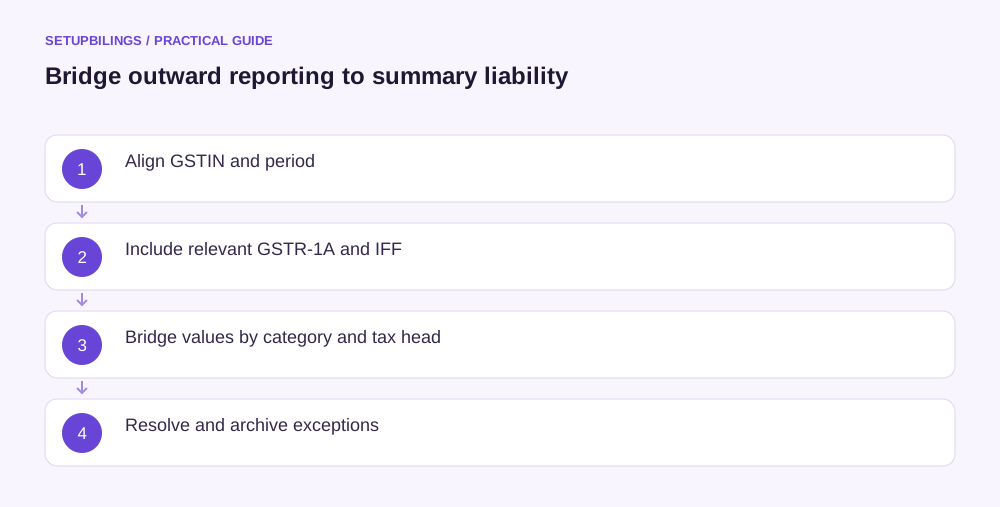
GSTR-1 reports outward supply details, while GSTR-3B is the summary return through which relevant liabilities and credit are declared and tax is discharged. The outward information relevant to liability should reconcile between them. “Agree” means the relationship is supported and explainable, not that every total in both forms must be identical without considering scope.
GSTR-3B includes matters that are not simply copies of sales invoices, including reverse-charge inward liabilities and credit reporting. Start by matching comparable outward-liability components, then explain legitimate differences and correct errors through the applicable process.
Define the comparison before calculating a difference
Consider an illustrative Jaipur industrial fasteners supplier. Its outward register contains taxable invoices, credit notes, exempt supplies and an export transaction. A single comparison of total invoice value with total GSTR-3B liability mixes taxable value, tax and categories that serve different purposes.
Compare the same GSTIN, period, supply category and tax head. Separate taxable value from GST amounts and use consistent signs for notes and amendments. If GSTR-1A has been filed for the period, include its relevant effects rather than treating the original GSTR-1 as the final outward position.
For QRMP, reconcile the quarter using the combination of IFF records and quarterly GSTR-1 as applicable. Invoices already furnished through IFF should not be counted again as new quarterly records merely because the reconciliation covers three months.
Build a transaction-backed bridge
Suppose, illustratively, reviewed outward invoices create ₹2,16,000 tax. Valid credit notes reduce relevant tax by ₹9,000 and a separately supported advance adjustment increases the comparable liability by ₹3,000. The expected outward-liability figure is ₹2,10,000 before other identified items.
If the corresponding GSTR-3B figure is ₹2,04,000, investigate ₹6,000. Do not add ₹6,000 to an arbitrary category just to close the spreadsheet. Identify which invoice, note, adjustment or mapping produced the difference.
| Bridge component | Evidence to examine |
|---|---|
| Current outward invoices | Sales register and filed outward records |
| Credit and debit notes | Valid documents, reasons and tax treatment |
| Amendments | Original record, revised record and differential effect |
| Advances and adjustments | Time-of-supply analysis and advance register |
| Other identified differences | Period, category and correction explanation |
Every bridge line should identify its direction and whether it affects taxable value, a tax head or both. An accounting-only adjustment may not alter tax in the same way as a valid GST note.
Investigate timing without using it as a catch-all
A late-entered invoice, prior-period amendment or same-period GSTR-1A correction can change which records appear in each extraction. Preserve invoice date, original reporting period, correction period and return filing status.
Timing explains a difference only when the amount can be followed into the appropriate return treatment. A line labelled “next month” without a document list, owner and follow-up date merely postpones investigation. Confirm the later treatment and close the item when evidence supports it.
Also distinguish accounting revenue timing from GST liability timing. A customer advance may create a tax question before revenue is recognised, depending on the supply and applicable rules. A bank collection of an old invoice does not create a second outward supply.
Check classification and tax heads
An invoice can be included in both forms but placed under different categories or tax heads. Interstate and intrastate treatment depends on the relevant supplier-location and place-of-supply rules, not merely a customer’s mailing address.
A correct total of ₹18,000 tax does not resolve an incorrect split between IGST and CGST plus SGST. Review the underlying transaction and use the proper correction or payment mechanism where required. Do not net unlike tax-head differences to zero and declare reconciliation complete.
Exempt, nil-rated, zero-rated and non-GST categories also need separate review. Their labels describe different treatments. Misclassification can affect reports and recipient data even where the immediate cash liability looks unchanged.
Use GSTR-1A within its actual role
The current GSTR-1A facility is optional and addresses eligible same-period outward details after GSTR-1 and before that period’s GSTR-3B, subject to its availability conditions. It can be filed only once for a period under GSTN’s described workflow.
This makes the review between outward filing and summary filing important. Gather all identified same-period corrections before using the facility. If GSTR-3B is already filed, do not assume GSTR-1A can reopen it or correct any historical period.
Keep the amendment analysis distinct from the Council’s October 2026 recommendations for a future alternative correction mechanism. The press release proposes an April 2027 start; it does not itself replace the live October 2026 process.
Review differences by document count as well as amount. One omitted ₹50,000 taxable invoice and one duplicated ₹50,000 invoice can leave total taxable value unchanged while reporting two customers incorrectly. A value-only bridge would miss that problem. Compare identities, categories and tax heads before concluding that a zero arithmetic difference means the returns agree. Preserve the evidence for the matched population, not just the residual exceptions.
Preserve the final reconciliation
Retain filed GSTR-1, any GSTR-1A, the relevant IFF data, GSTR-3B, portal summaries and the approved bridge. Record unresolved matters, their impact and the action taken. If additional payment or another process is required, keep its evidence linked to the original issue.
Review differences before filing whenever possible and monitor later corrections until closure. A mismatch log should distinguish errors corrected, legitimate scope differences and matters awaiting evidence. That prevents the same explanation from being recycled every month.
The two forms support different parts of one tax reporting chain. Reconcile comparable outward components, explain scope and timing, and investigate transaction-level exceptions. The result should let another reviewer trace the business’s outward records into the liability actually reported and discharged.