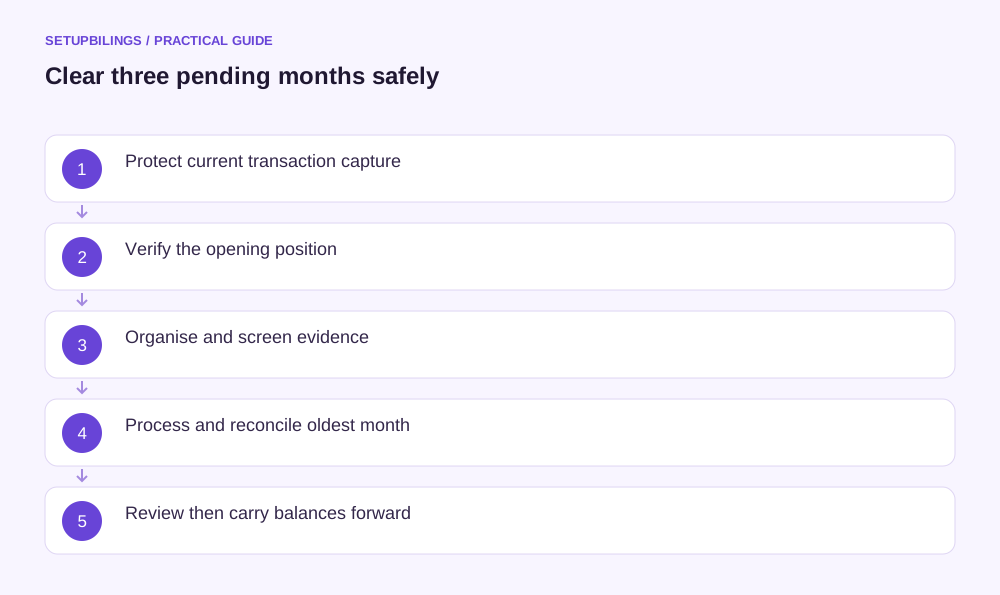
Clear three months of pending bookkeeping by protecting current capture, verifying the opening position, organising sources and processing the oldest incomplete period first. Reconcile and review each period before relying on its closing balances. This controlled sequence reduces duplicate entries and prevents errors from being carried into every later month.
Do not begin by uploading every bank line and accepting suggested categories without understanding existing records. The backlog may contain partly posted invoices, unallocated payments, missing credit sales and unresolved prior balances. Speed comes from controlling these relationships, not merely increasing entry volume.
Keep current activity from joining the backlog
Assign a person or time slot to capture new sales, bills, receipts and payments while cleanup proceeds. Current documents should use the same reference and filing rules as older work, with a clear boundary between periods.
An illustrative Surat equipment trader is behind for July, August and September. It begins cleanup in October but reserves one hour daily for October capture. Without that protected routine, the assignment could become four months behind before the first old month is reviewed.
Track current completeness separately from backlog progress. Posting many July transactions does not compensate for losing this week’s cash receipts or supplier bills.
Freeze and understand the starting records
Preserve an export or recoverable copy of existing ledgers, documents and reports. Identify the last reliable opening balances and obtain supporting bank, cash, customer, supplier, stock and loan information.
Check what has already been entered. An invoice recorded in July with payment unallocated in August requires settlement matching, not another purchase entry. Mark the status of each source or batch before processing it.
If opening balances are unsupported, resolve material uncertainties or document the approved approach before carrying them forward. An unexplained opening suspense balance can make three months of later reconciliation appear complete while preserving the original problem.
Organise evidence and remove duplicate copies
Create a source register with date coverage, owner, document reference and current processing status. Link supplier invoices, goods receipts, payments and credit notes. Keep additional copies under one underlying record.
Check supplier, invoice number, date and amount before posting. Identical amounts alone do not prove duplication, while minor formatting differences can hide the same invoice sent by several people.
For the trader, a ₹47,200 bill arrives as a paper scan and an emailed PDF. Treating both as purchases overstates the liability by ₹47,200. The clearer copy should improve evidence without creating another transaction.
Process the oldest incomplete month
Complete July sales and purchase records, cash movements, bank entries and known non-cash transactions using their actual facts and appropriate periods. Allocate receipts and payments against customer and supplier balances.
Use a controlled query queue for missing purpose, unreadable documents or unmatched amounts. Assign the question to the person who can answer. Do not park everything in miscellaneous expense simply to increase the completed-entry count.
| Stage | July completion test |
|---|---|
| Capture | Named sources received or gaps identified |
| Entry | Supported activity recorded once |
| Allocation | Customer and supplier settlements matched |
| Reconciliation | Bank, cash and key controls explained |
| Review | Adjustments and material queries assessed |
The exact completion standard should suit the business, but it must include more than the presence of entries.
Reconcile before moving balances forward
Reconcile July bank accounts, cash and settlement providers. Review customer and supplier lists against control accounts and statements. Check stock and other schedules needed for reliable reporting.
ICAI’s bank-reconciliation material distinguishes timing items and errors that explain differences. Retain the evidence for each outstanding item instead of forcing agreement through a balancing journal.
Suppose July’s bank ledger is ₹12,000 above the statement. Investigation finds a payment entered twice and an unrecorded bank charge with offsetting effects. The correct treatment follows those facts; one net adjustment would conceal both causes.
Complete monthly adjustments with review
Assess accruals, prepayments, depreciation, interest and other relevant closing items. The actual entries depend on the entity and applicable accounting framework. Support each journal with a calculation, period and approval.
Review late documents for the correct period. A September payment may settle an August expense, while a July advance may relate to goods received later. Submission or payment date alone does not determine the accounting result.
Do not reopen externally filed or signed records informally. If cleanup affects such information, identify the matter for the appropriate professional process rather than assuming a revised internal workbook replaces the earlier record.
Repeat for August and September
Carry approved July balances into August and repeat the controlled sequence. Track issues that cross months, such as advances, partial payments and credit notes. The evidence reference should remain stable while the balance changes.
Reconcile each month’s opening to the preceding reviewed close. This catches adjustments made in one report but omitted from the ledger or later period. Keep a change log for material revisions.
Use defined batches and checkpoints. For example, review all bank and cash work for a month before releasing its report, while a separate person collects missing September bills. Parallel collection can help, but dependent balances still need a controlled sequence.
Close the cleanup with a handover
Report completed periods, reconciled accounts, unresolved matters, assumptions and any later action required. Preserve the reviewed report versions and supporting schedules. A backlog is not fully controlled if only the original preparer knows which balances remain uncertain.
Compare actual effort with the initial estimate and identify why the backlog developed. Fix recurring intake, staffing or review failures so the next quarter does not require the same reconstruction.
The finished result should be three supported monthly positions and a working current routine. That gives the owner a reliable starting point for decisions, rather than a large number of entries whose completeness nobody can demonstrate.