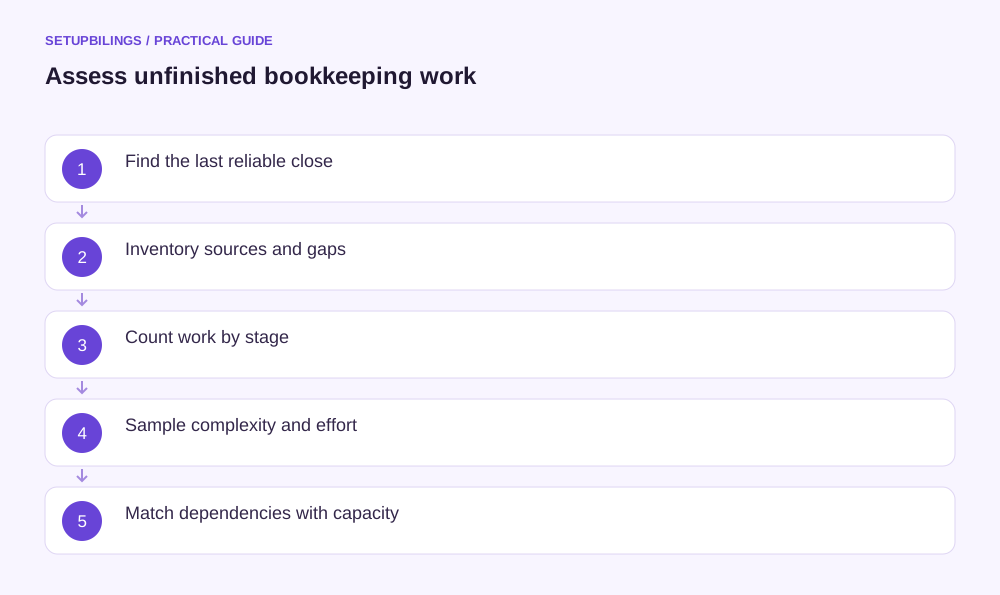
Measure a bookkeeping backlog by identifying the periods affected, counting unprocessed work by source and stage, assessing complexity and estimating the review effort required. A bank-statement line count alone is not a complete backlog measure. It can miss unpaid bills, credit sales, payroll, stock adjustments and unresolved opening balances.
Separate evidence collection, entry, reconciliation and review. A month with every transaction entered can still have a substantial backlog if bank accounts are unreconciled or customer receipts are unallocated. Define what “complete” means before promising a finish date.
Establish the last reliable point
Find the latest period with supported opening balances, reconciliations and reviewed reports. Identify later corrections or data migrations that may affect it. A report marked final is useful evidence of status, but inspect what review actually occurred.
Record which entities, branches, bank accounts, cash locations and sales channels are in scope. An omitted payment account can make a three-month estimate incomplete even if the main bank file is current.
Preserve existing data before assessment. Avoid entering a sample into live books until you understand what has already been posted, otherwise the estimate itself can create duplicates.
Inventory sources and missing periods
List available bank statements, sales records, supplier bills, employee claims, payroll reports, stock records and prior closing schedules. Mark date coverage, format, completeness and owner for each source.
An illustrative Jaipur packaging business has three months pending. It holds 600 bank lines, 180 supplier documents, 90 employee receipts and 300 sales invoices. These are source counts, not automatically 1,170 separate accounting transactions, because some documents relate to payments already represented in bank lines.
Create cross-links or sample matching to understand overlap. An invoice and its payment may require linked records, while two copies of one invoice should not increase the count of underlying transactions.
Count work by processing stage
Use statuses such as not collected, collected but unentered, entered but unreconciled, queried and ready for review. Give each item or batch one current status for workload counting, with related evidence linked separately.
| Work category | Example measure |
|---|---|
| Capture gap | Missing statements or document batches |
| Entry gap | Supported transactions not yet posted |
| Allocation gap | Receipts or payments not matched to balances |
| Reconciliation gap | Accounts or periods not reconciled |
| Review gap | Journals, schedules or reports awaiting checks |
This prevents a large entry count from hiding incomplete reconciliations. It also makes dependencies visible: a missing opening bank balance may block later checks even when many documents are ready.
Sample complexity before estimating time
Review a representative sample from each source. Include ordinary and difficult items, not only the clearest invoices. Measure time for document checking, duplicate search, classification, posting, allocation and necessary review.
Suppose 200 routine entries are estimated at four minutes each, 60 complex allocations at ten minutes and 25 queries at twelve minutes of active effort. Estimated active time is 800 + 600 + 300 = 1,700 minutes, about 28.3 hours.
Add separate reconciliation and review work. If those require another 12 hours, the estimated active total is about 40.3 hours. Query waiting time can extend calendar duration without adding the same amount of active processing effort.
Distinguish capacity from calendar availability
A bookkeeper working six hours a day may have only two hours available for backlog after current work and meetings. At two focused hours daily, 40.3 hours represents about 21 working days before allowing for unresolved dependencies and new discoveries.
Do not divide by nominal office hours and promise a one-week cleanup. Estimate actual productive capacity and reserve time for current transactions so the backlog does not rebuild while older work is cleared.
Use a range where evidence is uncertain. State assumptions about document quality, owner response and missing records. Refine the estimate after the first controlled batch rather than defending an unsupported initial date.
Rank risk and dependencies
Prioritise unsupported opening balances, cash differences, material customer or supplier issues and imminent reporting or payment decisions. Determine current external deadlines separately for the business’s facts; the oldest document is not always the most urgent task.
Some work must follow sequence. Later bank reconciliations depend on correct earlier balances. A customer allocation may require the sales register first. Map these dependencies before assigning parallel batches.
ICAI’s error-rectification material explains why balanced books can still contain omissions and wrong classifications. Include review effort for these risks instead of treating data entry as the entire assignment.
Build a baseline and progress measure
Record the assessed date, source inventory, workload counts, missing inputs, estimated hours and completion definition. A useful baseline might state that March is complete only when all named accounts reconcile, material queries are resolved or assessed, and the reviewed report is issued.
Track work completed by stage, queries waiting and newly discovered items. A reduction of 100 bank lines is progress, but not necessarily 100 fully completed transactions. Avoid measuring success solely through posting volume.
Explain scope changes as they arise. Discovering another business account or an unrecorded credit-sales book should update the estimate transparently rather than being hidden inside slower progress.
Keep the assessment date visible. New source documents, corrected opening balances or discovered accounts can change the workload, so the estimate should remain a traceable baseline rather than an unchanging promise.
Agree the cleanup plan from evidence
Assign responsibilities for supplying missing information, processing batches and reviewing results. Set realistic checkpoints and record what could delay them.
A good backlog assessment leaves the owner with a credible workload, dependencies and capacity plan. It replaces “three months behind” with a specific account of what remains, what blocks completion and how progress will be verified.