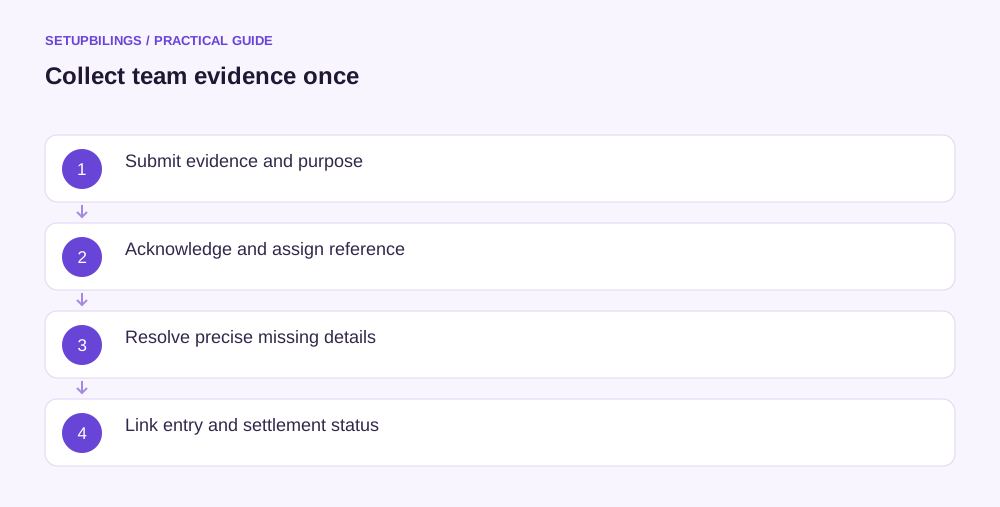
Collect bills and receipts through one clearly owned intake route with a short list of required details, an acknowledgement and a visible exception process. Tell staff what counts as complete and where to check status. Repeated reminders usually arise because the handoff is vague, not because the business needs a longer checklist.
Design the process around how employees actually work. A field technician may need to submit a photograph from a phone, while purchasing may receive supplier PDFs by email. Different capture methods can feed one controlled register without requiring everyone to use the same device.
Define a complete submission
Ask for the readable bill or receipt, transaction date, supplier, amount, business purpose, branch or project where relevant, payment method and whether the employee needs reimbursement. Add an internal reference after receipt.
Require all pages and relevant attachments. A cropped total may omit the supplier or tax details. Payment proof can support settlement, but it may not explain what was purchased or establish the contents of the invoice.
Keep the required fields short and purposeful. If the business never uses a requested tag, remove it or explain its role. Excessive form filling can push employees back to informal messages that accounts cannot track reliably.
Give each source a standard route
An illustrative Bengaluru maintenance company has eight field technicians, a purchasing assistant and a bookkeeper. Technicians use an approved expense intake form, purchasing forwards supplier documents to a designated inbox, and the bookkeeper registers both in one queue.
The rule is one submission per underlying transaction, with later documents attached to its reference. A technician should not resend the same bill through several channels merely because no acknowledgement arrived. The process must therefore confirm receipt promptly.
Specify a fallback for poor connectivity or system outages. Staff can hold a temporary local record with a date and reference, then submit it through the normal route when available. The fallback should feed the same register rather than create a permanent second inbox.
Separate acknowledgement from approval
Acknowledge that the document was received and assign a tracking reference. This does not mean the expense is approved, posted or ready for reimbursement. Use separate statuses so employees know what is still required.
| Status | Meaning |
|---|---|
| Received | Submission has entered the register |
| Needs information | A specific field or document is missing |
| Ready for entry | Required evidence and context are available |
| Entered | Recorded with an accounting reference |
| Payment or reimbursement review | Awaiting the relevant decision |
These labels can be adapted to the business. Their value comes from shared meaning, not the software used to display them.
Make follow-up specific and assigned
For an incomplete submission, ask for the exact missing item and give it an owner. “Please submit all documents” is less useful than “Reference EXP-0142 needs the supplier name and service-job number.”
The bookkeeper should track the request date and target response date. A supervisor can resolve repeated delays from a team member, while accounting handles technical classification questions. Do not ask employees to decide tax eligibility or accounting policy without appropriate guidance.
Use a recurring summary of outstanding items instead of sending separate repeated messages for each one. Urgent or high-value matters can still be escalated individually where a payment or closing decision depends on them.
Prevent common duplicate routes
A bill can arrive from the employee, supplier and purchase team. Search the register before creating another record, using supplier, invoice number, date and amount. Mark additional copies as linked evidence rather than entering a second expense.
Suppose a technician submits a ₹3,540 parts invoice and purchasing later forwards the supplier’s PDF. If both relate to the same purchase, there is one underlying transaction. The clearer copy should improve the evidence without doubling the cost or reimbursement.
Also distinguish an employee-paid bill from a company-paid bill. The same evidence should not trigger both supplier payment and employee reimbursement. Capture who paid and link the actual settlement record.
Set a practical submission rhythm
Use a daily or next-working-day internal target suited to the activity, with special arrangements for travel and weekends. Explain that the target supports current records and timely reimbursement; it does not change the transaction date or any external requirement.
At month-end, issue a defined final collection request and identify late items separately. If work occurred before the close but the bill arrives later, the reviewer must assess its accounting period rather than automatically recording it when submitted.
Review the oldest open submissions and missing-document rate by source. If 20 of 100 submissions lack job codes, the process may need a clearer field or supervisor check rather than more general reminders.
Protect originals and access
Preserve original files and maintain readable links from the intake register to the entry. If documents are enhanced or renamed, keep the original evidence retrievable. Do not delete paper originals solely because a photograph exists; retention requirements and practical evidence needs should be assessed for the actual documents.
Restrict access to employee, customer and bank information according to the task. Staff should be able to submit and view their own status without automatically seeing the entire accounts archive.
Improve the process using recurring questions
Ask why the same details are missing. A short example of a complete submission, a clearer acknowledgement or a required project selection can remove repeated effort at its source.
The system works when an employee can submit once, confirm receipt and answer a precise query if needed. Accounts then spends more time recording supported transactions and less time reconstructing where documents were sent and who was supposed to provide them.