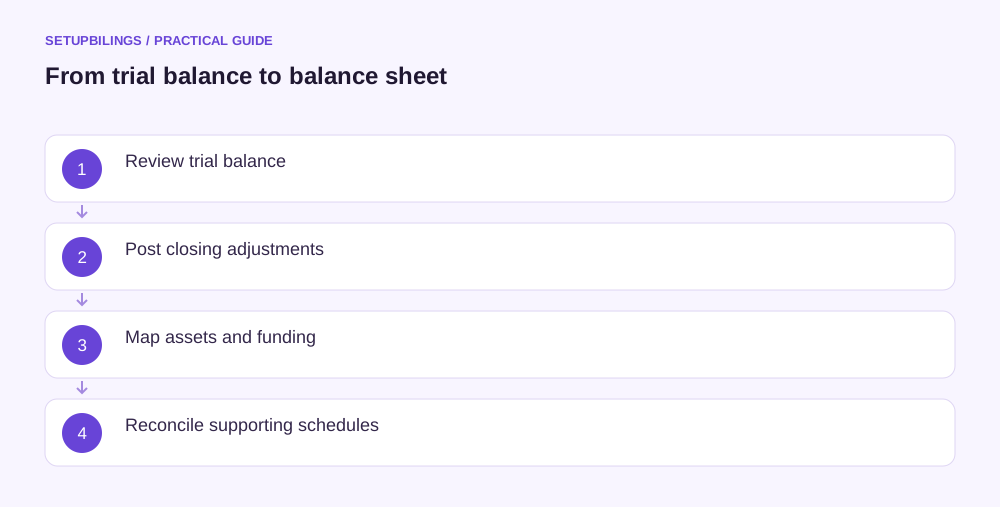
Prepare a balance sheet from a trial balance by completing closing adjustments, separating income and expense balances from assets and liabilities, and mapping the remaining balances into appropriate presentation groups. Then bring the period result into the owners’ section and reconcile every material figure to a supporting schedule. A trial balance is the starting record, not a finished financial statement.
Choose the reporting format before building the report. Companies must consider the Schedule III division and accounting framework that apply to them. Partnerships, LLPs and proprietorships have different presentation considerations. An internal management balance sheet can be simpler, but its classifications and accounting basis should still be clear.
Freeze a reliable trial balance
Export the trial balance with ledger codes, names, opening amounts, period movements and closing debits or credits. Record the reporting date and export version. Check that total debits equal total credits; if they do not, resolve the extraction or posting problem before preparing statements.
Agreement does not establish completeness. A missing purchase invoice can leave a trial balance perfectly balanced because neither the expense or asset nor its payable was recorded. Obtain bank reconciliations, stock records, receivable and payable lists, loan statements and fixed-asset schedules alongside the export.
Also identify unusual signs. A customer with a credit balance might represent an advance or overpayment. A supplier debit might be an advance or claim. Do not automatically net these against unrelated balances simply because the software groups them under one control account.
Complete adjustments before mapping
Typical closing work includes accrued expenses, prepayments, depreciation, inventory valuation, customer balance impairment or allowances where appropriate, interest accruals and tax entries. Each adjustment needs an explanation, date, calculation and supporting document. Keep a journal register so that reviewers can distinguish original ledger balances from closing changes.
Check whether closing stock is already inside the trial balance. Some systems post inventory and cost of goods sold throughout the period; others require a closing adjustment. Recording the same closing inventory twice overstates assets and profit. Use the system’s actual ledger mechanics rather than applying a memorised entry blindly.
For inventories within ICAI AS 2, measurement considers the lower of cost and net realisable value. A physical count alone does not answer the valuation question. Damaged stock may exist but require a lower carrying amount.
Create a ledger-to-report map
Assign every adjusted ledger to exactly one reporting group, with separate tags when a balance must be split. Typical groups include property and equipment, inventory, receivables, bank balances, other assets, borrowings, trade payables, provisions and owner funds.
Current and non-current classification requires attention to the operating cycle and the applicable rules. It is not merely a choice between familiar ledger names. For example, a term-loan account can contain both instalments payable soon and amounts due later. Split the balance using the repayment schedule.
Keep the original ledger code beside its report mapping. This makes it possible to trace the final report back to entries and to repeat the process consistently next month or year.
Work through a small example
Assume an illustrative Mysuru furniture workshop has the following adjusted balances after closing income and expenses. All figures are in lakh rupees, and taxes are omitted from this teaching example.
| Assets | Amount | Funding and obligations | Amount |
|---|---|---|---|
| Equipment, net | 12 | Owner capital before current profit | 11 |
| Inventory | 7 | Current-period profit | 4 |
| Trade receivables | 6 | Term borrowing due later | 8 |
| Bank and cash | 3 | Borrowing due within current period classification | 2 |
| Prepayments | 1 | Trade payables | 3 |
| Accrued expenses | 1 | ||
| Total | 29 | Total | 29 |
The owner funds section totals ₹15 lakh. Liabilities total ₹14 lakh, and assets total ₹29 lakh. The resulting balance sheet balances without adding any suspense figure.
Suppose the equipment cost account is ₹18 lakh and accumulated depreciation is ₹6 lakh. Their net presentation is ₹12 lakh, supported by the asset schedule. The underlying accounts remain separately traceable; deleting accumulated depreciation to make the face of the report shorter would damage the records.
Build supporting schedules and notes
For receivables, reconcile invoice-level balances to the control account and assess disputes, ageing and subsequent receipts. For suppliers, reconcile statements and investigate unmatched goods receipts or invoices. For loans, match principal and accrued interest to lender records and explain differences.
Show the significant accounting policies relevant to the statements. ICAI AS 1 emphasises the importance of policy disclosure for understanding financial position and performance. Where the required report includes comparative figures or detailed disclosures, do not stop after producing the main face of the balance sheet.
Maintain a separate list of estimates and unresolved matters, including the person responsible for each. If a receivable allowance or inventory valuation is still under review, show its potential effect to the reviewer rather than hiding uncertainty inside a final-looking total. Resolve material open items before release.
Review the finished statement
Run a completeness check: every trial-balance ledger must appear in the profit statement, balance sheet or a documented elimination or adjustment. Reconcile the profit transferred to capital or reserves with the final profit and loss statement. Review owner contributions and withdrawals separately.
Compare movements with the previous period. A large increase in stock, a new negative supplier balance or a sudden drop in borrowings should have a commercial explanation. Check arithmetic, units, dates and report status before sign-off.
The final deliverable should include the balance sheet, mapping, adjustment register and reconciled schedules. That package turns a balanced export into a report another person can verify and use for decisions.