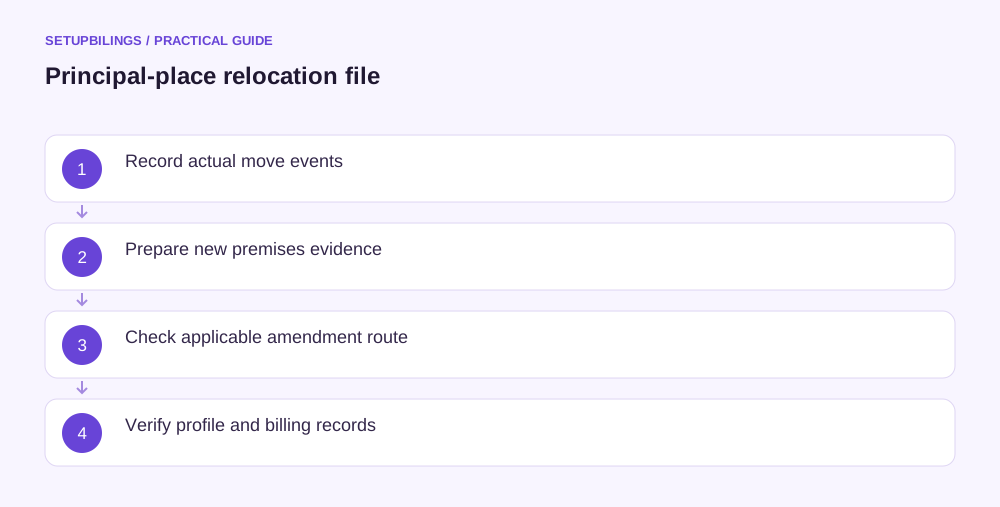
Establish what is changing
A change in principal place of business is more than editing a postal address in invoice software. Identify the actual location becoming principal, the legal person operating there and the State involved. Decide whether the former premises will close, remain an additional place or continue to hold stock and records during a transition.
A move within one State is different from establishing operations in another State. The existing GSTIN is State specific, so do not assume its State can simply be replaced through an address amendment. Review fresh registration and closure or continuation of the earlier registration where the business model crosses State boundaries.
Check the process that applies to your registration
GSTN's published profile guidance treats principal-place changes within the established core amendment route. The October 2026 GST Council release recommended a different treatment for taxpayers registered under rule 14A: automatic acceptance would extend to their principal-place changes, while other principal-place changes would retain officer processing.
The 9 October PIB FAQ describes those proposed routes using FORM GST REG-14. The Council release itself frames the reform as a recommendation, so verify the implementing notification and live portal availability before relying on automatic processing. Do not describe the announcement alone as proof that every registrant can change its principal address without approval.
Record your registration category and the route used in the amendment working file. Where the application is processed by an officer, monitor the ARN and notices until the result is available. Where an implemented automatic route applies, still check the resulting profile; an automated process does not make inaccurate address evidence acceptable.
Build a relocation timeline
Write down the agreement date, possession date, start of activity, first stock movement and date the old premises cease to be used. These dates may differ. Use source records to identify the actual event relevant to the amendment, and review the applicable submission timing rather than selecting whichever date avoids an uncomfortable history.
Do not assume a delayed amendment can automatically take effect retrospectively. The rules contain conditions affecting earlier effective dates. If operations moved before the application, preserve the actual timeline and review the proper treatment instead of rewriting the agreement or choosing a false date in the form.
Illustratively, a Surat packaging business takes possession of a new unit on 3 June, moves machinery on 8 June and starts invoicing there on 12 June. Its old office remains active for collections until 30 June. The working file should explain these events and decide the old office's continuing role, rather than using a single unsupported “moving date” for every purpose.
Prepare evidence for the new principal place
Match the evidence to the real possession arrangement. For ownership, use suitable ownership-supporting records. For rent or lease, use the agreement and relevant premises evidence. For consent, document the owner's permission, identity and ownership connection. CBIC's 17 April 2025 instruction explains these categories and the different treatment of registered and unregistered rental agreements.
Check that the applicant is entitled to use the exact unit. A director's agreement for a personal residence may not explain a company's right to occupy a separate industrial floor. Where a lessor, licensor or property owner differs across documents, investigate and document the actual chain of permission rather than assuming the names are interchangeable.
Compare the complete address with the portal fields and map. Correct floor, unit, building number, locality, district and PIN before submission. Keep readable copies showing relevant signatures and property descriptions. An old utility record with a current lease may require explanation if the address format changed; altering the old record is not a solution.
Prepare the GST application and internal approvals
Log in under the intended GSTIN and review existing locations. Use the registration amendment workflow available for your category and enter the principal-place change, date and factual reason. Check whether additional-place details also need changes so the profile accurately represents both the new and old premises after relocation.
Preview the full application with the person authorised to sign. Confirm contact details, attachments and any existing pending amendment that could affect the draft. Submit using the appropriate signing method and retain the acknowledgement and final application. Saving or uploading documents does not complete the submission.
If clarification is sought, answer each issue through the specified portal process. Separate an address mismatch from a missing permission or unreadable scan and provide the evidence that resolves that particular issue. Preserve both the notice and submitted reply so the business can demonstrate how the declared location was supported.
Set a specific cut-off for changing printed stationery and cached invoice templates. Staff may continue selecting an old address from a saved customer order even after the main master is corrected. Review a small sample of documents generated after the move to confirm the change reached the screens actually used for daily billing.
Close the relocation loop after the result
Check the taxpayer profile, amendment result and current registration certificate. Confirm the principal address, additional locations and any recorded effective date. Update invoice masters, customer onboarding records, supplier addresses, dispatch instructions and relevant bank correspondence in an organised sequence so the business does not keep generating contradictory addresses.
Keep old and new premises records with a relocation note. Review transactions during the transition for wrong addresses, stock movements or documents issued from a closed location. The address amendment does not automatically correct previously issued invoices or movement records; assess any necessary corrections separately.
A well-prepared principal-place change leaves a traceable history of where the business operated and when. That history supports both the portal amendment and daily operations, especially when the move involves overlapping premises, stock and customer deliveries.
Sources and references
- GSTN: Viewing the taxpayer profile and registration certificate
- CBIC Instruction 03/2025-GST, 17 April 2025
- GSTN: Tracking registration applications before login
- CBIC: CGST Rules, official compilation including registration amendment rules
- GST Council: Recommendations of the 57th meeting, 8 October 2026
- PIB: FAQs on amendment in GST registration, 9 October 2026