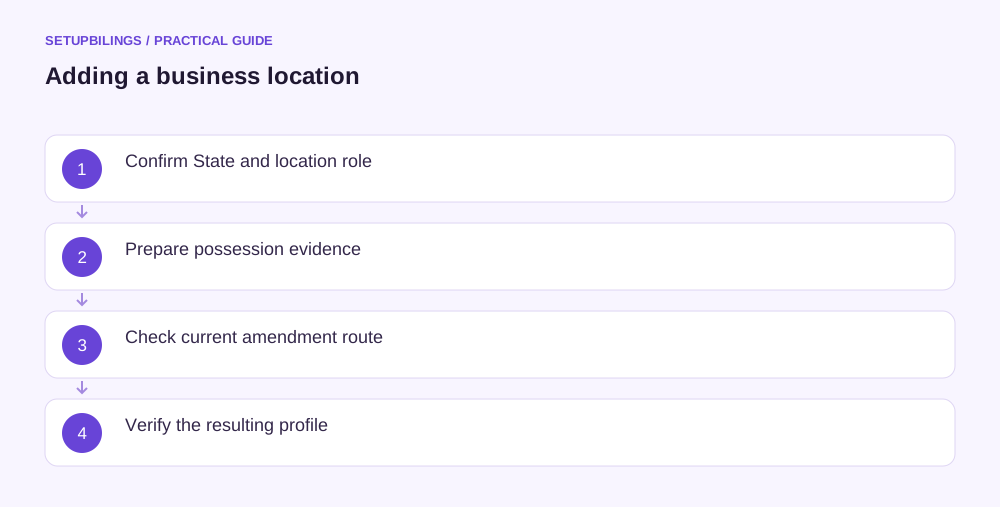
Decide whether the location belongs in this registration
An additional place of business is not simply another customer address. Review what the business does there: storing goods, dispatching orders, maintaining an office or carrying on other business activity. Confirm the location's State and the legal person using it before opening an amendment draft.
A location in another State cannot be treated as an ordinary additional address under an existing State GSTIN merely to avoid reviewing separate registration. Similarly, special cases such as SEZ locations need their own analysis. Settle the registration map first so the amendment is filed against the correct GSTIN.
Check the amendment route at the filing date
GSTN's profile guidance identifies additional-place changes within the established core amendment process, with officer approval reflected in the certificate. However, the GST Council's 8 October 2026 release recommended automatic acceptance of registration amendments other than specified principal-place changes. The 9 October PIB FAQ describes the intended additional-place process through FORM GST REG-14.
These official materials have different purposes and are not interchangeable. A Council recommendation does not by itself establish an amended rule's commencement. Before filing, check the implementing notification and the live portal route for your registration. Do not promise automatic acceptance solely from the October announcement or rely unquestioningly on an older screenshot.
The practical preparation remains the same: accurate location details, required premises evidence, a truthful event date and an authorised submission. If the portal continues to route the change for processing, track the application and any notice. A saved draft is not evidence that the additional place has been added.
Prepare the premises evidence
Match the document pack to ownership, rental, lease, sharing or consent. CBIC's 17 April 2025 instruction explains the relevant premises evidence categories for registration. For rented premises, the treatment of lessor identity proof differs between registered and unregistered agreements. For consent premises, permission, consenter identity and suitable ownership-supporting evidence should tell a consistent story.
Check the applicant name and complete property description. A lease in the name of a related company is not automatically permission for this registrant. Where the arrangement involves a warehouse operator or shared office, understand what right the business actually has and obtain documents relevant to that right rather than relabelling it for convenience.
Scan all relevant pages, especially unit schedules, signatures and extensions. Follow the current portal upload limits and formats without sacrificing legibility. Keep a document index and the originals so a later clarification can be answered by reference to the exact evidence, not a fresh collection exercise.
Record activities and the effective event
Prepare a short location sheet showing address, State, nature of possession, business activities, contact person and start date. Distinguish a stock storage point from an office where only administration takes place. The activities selected should match the real use, not every option available in the form.
Record when the business actually began using the premises and retain supporting records such as possession correspondence, the agreement and the first stock movement. Do not choose a convenient recent date to conceal an earlier opening. Review the amendment timing requirements and how the portal records the date, particularly where the business is already operating there.
Illustratively, a Hyderabad wholesaler rents a second warehouse in the same State and moves ₹7.5 lakh of goods there on 12 August. Its amendment file should identify the correct warehouse, storage activity, possession terms and actual opening timeline. If an old unit remains in use, adding the new warehouse should not accidentally delete the old one.
Enter and review the application
Log in to the official GST portal for the intended registration and use the available registration amendment workflow. Review existing principal and additional locations before entering the new one. Check any location count or related business-detail field so the form's summary agrees with the addresses actually entered.
After map selection, review floor, building, road, locality, district, State and PIN. Upload the relevant proof and provide the date and reason requested by the form. A useful reason states the actual event, such as opening a storage warehouse, rather than a vague phrase that does not explain the change.
Preview the complete application, including existing locations, before authorised submission. Use the signing method required for the entity and workflow. Keep the acknowledgement, submitted application and attachments. If processing is required, use the ARN to track status and respond through the prescribed route to any clarification.
For a business using many storage sites, give each location an internal code linked to its exact address. Check that dispatch software and the GST premises register use the same mapping. This reduces confusion where two warehouses share an industrial-estate name but occupy different plots or units.
Verify the result and update operations
After the change is accepted or approved under the applicable process, review the taxpayer profile and download the current registration certificate. Confirm that the new address appears correctly and that the principal place and other locations remain accurate. Preserve the former certificate so the registration history can be traced.
Tell the relevant internal teams which GSTIN applies to transactions from the location. Update dispatch masters, stock records and documents as needed, and review any certificate or GSTIN display requirements at the premises. Adding an address is not a substitute for correctly documenting stock movements and customer supplies.
Maintain a premises register with opening, renewal and closure dates. Reconcile it to the GST profile periodically so closed warehouses do not remain indefinitely and new sites are not forgotten. The amendment is complete when the official profile and the business's actual location records agree, not when someone merely emails a lease to the accounts team.
Sources and references
- GSTN: Viewing the taxpayer profile and registration certificate
- GSTN: Amendment of non-core registration fields
- CBIC Instruction 03/2025-GST, 17 April 2025
- GSTN: Tracking registration applications before login
- GST Council: Recommendations of the 57th meeting, 8 October 2026
- PIB: FAQs on amendment in GST registration, 9 October 2026