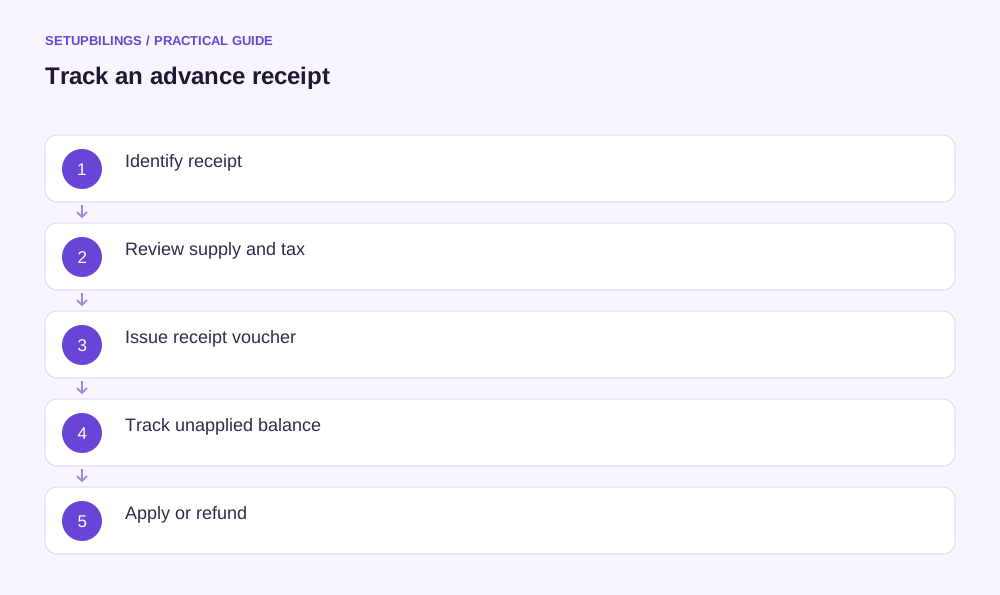
Prepare a receipt voucher when recording an advance covered by section 31(3)(d), using the particulars prescribed by Rule 50. Identify the intended supply, payer, receipt date, amount and relevant tax treatment before issuing the document. An advance receipt is not the same as the final tax invoice. Keep a separate advance account so the amount can later be traced to the supply, adjustment or refund.
Identify the payment before allocating tax
Match the bank or UPI receipt with the customer and order. Obtain written allocation where one payment covers several orders or includes settlement of an older invoice. A narration saying “advance” is useful evidence but may not explain which supply the payer intended to fund.
Read the contract to distinguish an advance from a refundable security deposit or another receipt. Their terms and actual application can differ. Do not classify every incoming amount as consideration for an immediate completed supply, and do not leave genuine advances indefinitely in a suspense account because an invoice has not yet been prepared.
Review goods and services separately
Advance-tax treatment is not identical for all supplies. Notification 66/2017-Central Tax provides a special procedure for covered goods supplies, with scope and later amendments to be checked. Do not extend that treatment automatically to services or excluded categories. The underlying documentation and advance register remain important even where advance tax is not payable under the applicable procedure.
For services, examine section 13's time-of-supply framework and the actual receipt facts. Confirm classification, rate, place of supply and reverse-charge status where relevant. A customer requesting a receipt without tax does not itself change the applicable liability.
Complete the Rule 50 fields
Record the supplier's name, address and GSTIN; voucher number and date; recipient identity and GSTIN or UIN where registered; description of the intended goods or services; and advance amount. Include the applicable tax rates and amounts, inter-State place-of-supply particulars, reverse-charge indication and prescribed authentication.
Use a consecutive series within the sixteen-character limit and unique for the financial year. Keep the bank reference and order number as additional traceability fields. They help reconciliation but should not replace the voucher's own identity. Test the customer copy to ensure long references do not cut off essential fields.
Illustrative service advance
Assume a customer pays ₹23,600 as a tax-inclusive advance for a service with a confirmed aggregate rate of 18%, and the reviewed facts make tax payable on the advance. The illustrative taxable portion is ₹20,000 and tax ₹3,600. For an ordinary intra-State supply in a State, the assumed components are ₹1,800 CGST and ₹1,800 SGST.
The receipt voucher should distinguish the gross amount received from the tax calculation. If the agreement instead provides ₹23,600 as an exclusive advance plus tax, the amount required differs. Confirm the commercial terms before extracting tax from an amount that the customer expected to be entirely applied to the exclusive price.
Link instalments to one advance ledger
A customer may make several payments before final billing. Record each receipt separately with its date, voucher and remaining unapplied amount. Do not replace earlier receipt dates with the latest instalment date, because tax timing can depend on when each amount was received.
Suppose the customer pays ₹11,800 and later ₹23,600 under the same assumed inclusive 18% treatment. The combined receipts are ₹35,400, comprising ₹30,000 base and ₹5,400 tax. The order file should show both receipts and their individual tax workings, not a single unexplained opening balance copied into the final invoice.
Adjust against the final invoice without duplication
If the final reviewed service value is ₹50,000 plus ₹9,000 GST, the total invoice is ₹59,000. Applying the illustrative ₹35,400 receipts leaves ₹23,600 to collect. The tax reporting working must also recognise the advance-tax adjustment so the ₹5,400 already accounted for is not treated as a second unrelated liability.
Keep the final invoice's full supply value visible. An advance adjustment reduces the outstanding balance; it is not automatically an invoice discount. Link every applied receipt voucher and show any unapplied balance. This makes the customer statement and advance register reconcile to the same amount.
Resolve unknown details through a controlled exception
Rule 50 includes prescribed treatment where the rate or nature of supply cannot be determined at receipt. Review those provisions rather than selecting a convenient zero rate or assuming the customer's local address resolves the issue. Identify exactly what information is missing and obtain it promptly.
Do not use an uncertainty provision as a permanent substitute for contract review. When the intended supply becomes clear, reconcile the original receipt treatment with the approved transaction and appropriate reporting process. Preserve the actual receipt and later decision dates instead of overwriting the original record.
Close advances deliberately
Review old unapplied receipts each month. Confirm whether supply is pending, the receipt belongs to an older invoice, the order is cancelled or a refund is due. Where no supply and no tax invoice follow, examine the refund-voucher route under section 31(3)(e).
A good receipt voucher begins a traceable chain from money received to the eventual supply or refund. Clear identity, date, tax treatment and adjustment references prevent advance balances from becoming duplicate billing, unexplained customer credits or incorrect GST timing.