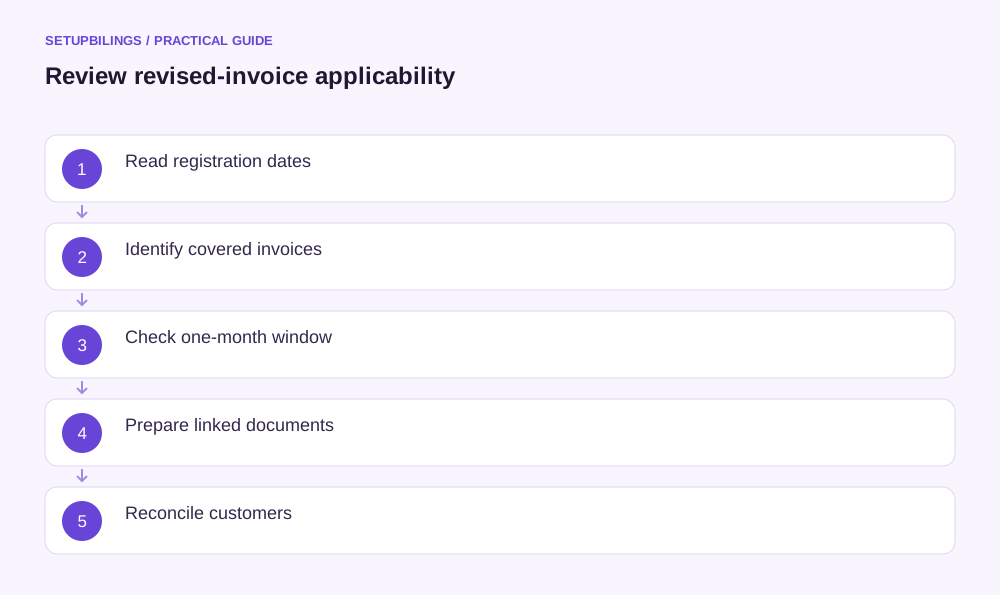
Review revised tax invoices when a registration certificate is issued with an effective registration date earlier than the certificate's issue date. Section 31(3)(a) permits revised invoices against invoices already issued for the intervening period, within one month from certificate issuance and in the prescribed manner. This is a specific facility. Do not treat “Revised Invoice” as a universal correction document for every pricing, GSTIN or tax error discovered later.
Establish the two registration dates
Obtain the actual registration certificate and identify its effective date and issue date. Keep the application and relevant correspondence available if the dates are disputed. Do not infer the effective date solely from when the business first applied, first crossed a threshold or first received a GSTIN message.
List supplies and invoices issued in the covered period. A business may have many commercial bills but only some fall between the two relevant dates. Map the issuing establishment and registration so documents from another State or legal entity are not swept into the exercise simply because the trading name is similar.
Calculate and control the issue window
The statutory period is one month from certificate issuance, rather than an unlimited opportunity to revise historical documents. Put the deadline into the work plan as soon as the certificate arrives. Confirm its computation and complete customer-detail collection and approval in time.
Do not assume that a customer payment delay extends the period. Prepare an exception list for missing recipient GSTINs, incomplete original records and unclear prices. Give each entry an owner. Waiting for all customers to respond before reviewing any invoice can leave the entire exercise until the last day.
Preserve the original invoice relationship
Rule 53 requires revised-invoice particulars, including the prominent document description, supplier identity, number and date, recipient details and the corresponding original document reference. Retain the original invoice rather than overwriting it in the accounting system. The revised document should show what it replaces or relates to clearly.
Use an approved series within the prescribed numbering requirements and prevent duplicate issue. Keep an internal schedule showing original invoice number and date, revised number and date, taxable value, tax heads, total and dispatch to the customer. That schedule supports both customer reconciliation and the business's reporting review.
Illustrative registration-period review
Suppose a business receives its certificate on 18 July with effective registration from 1 July. It identifies a taxable supply invoiced on 10 July for an agreed ₹30,000 plus applicable tax. Assume the confirmed aggregate rate is 18% and no other valuation issue applies. The illustrative revised tax amount is ₹5,400 and total ₹35,400.
The business should verify that the supply falls within the statutory interval and issue within the permitted one-month window. It must also review the correct tax heads and reporting. This example does not mean every earlier ₹30,000 customer bill can automatically receive ₹5,400 extra: a fixed tax-inclusive bargain needs a different price calculation.
Reconcile inclusive and exclusive commercial terms
Read the accepted price terms for each invoice. If an original fixed price already includes the tax burden, extracting GST from that amount differs from adding tax on top. Keep customer agreements and explain the revised document's balance rather than assuming registration changes the commercial bargain.
For a fixed ₹35,400 inclusive amount at an assumed 18% rate, the base is ₹30,000 and tax ₹5,400. If ₹35,400 was already collected, the revised document should not create another ₹5,400 receivable merely because the tax is now displayed separately. The ledger and customer statement need the same settlement logic.
Check consolidated-document permissions carefully
Rule 53 contains provisions for consolidated revised invoices to unregistered recipients and a specific inter-State condition. Review the current wording and thresholds before selecting that route. Do not assume that all registered customers or every large inter-State sale can be combined into an anonymous total.
Even where a consolidated document is permitted, preserve the underlying sales schedule and evidence. Record recipient State, original bills, values and classification details needed for the applicable treatment. A consolidated output should simplify the permitted document process, not erase transaction records or make tax-head allocation impossible.
Distinguish later errors from this facility
An invoice issued long after the certificate date with an incorrect quantity or recipient registration is not automatically a registration-window revised invoice. Determine the appropriate correction, credit-note, debit-note or reporting route from the actual facts. Keep the issued history and any relevant electronic invoice status.
Similarly, a taxpayer's voluntary change of print template does not create a legal reason to reissue all documents as revised tax invoices. Correct the source data and follow the applicable process for affected transactions. The heading should reflect the statutory purpose, not merely the fact that a second PDF was generated.
Close the exercise with a complete register
Check that all eligible original invoices were reviewed, revised documents were issued where appropriate and customers received clear references. Reconcile taxable values, taxes and collections with the books and applicable returns. Record unresolved issues and their treatment rather than quietly excluding difficult entries.
A revised-invoice exercise succeeds when the registration dates, issue window, original references and commercial balances remain aligned. That gives both parties a reliable tax document for the covered period without using revision as a substitute for the correct process on unrelated invoice errors.