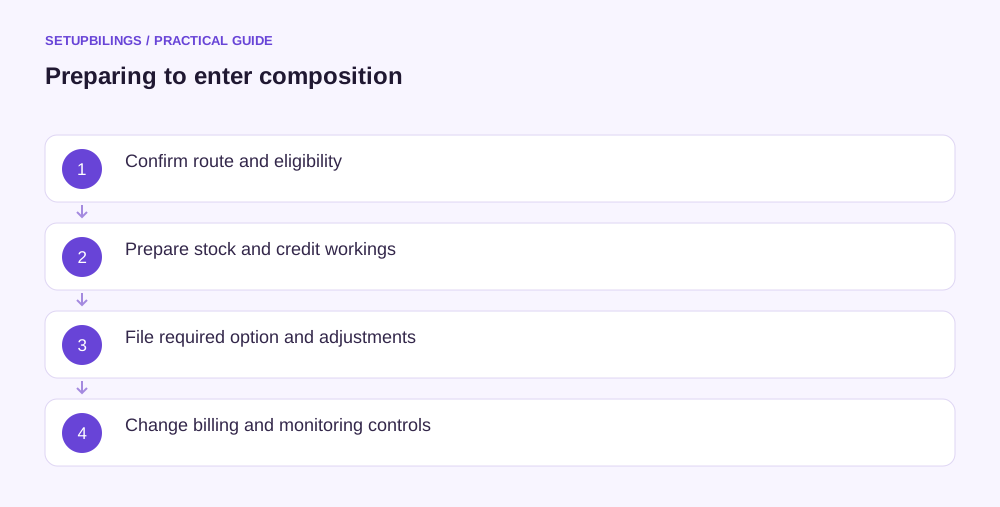
Fix the entry route and effective period first
Preparation differs between a new applicant choosing composition during registration and an existing normal taxpayer opting for a later financial year. Establish which situation applies and identify the intended effective period. Do not assume an existing taxpayer can retrospectively label earlier normal-tax invoices as composition sales merely because it prefers a lower payment.
The registration and composition rules describe the relevant intimation routes, including FORM GST CMP-02 for an existing registered person. Check the current filing window, applicable rules and portal availability for the intended year. A saved draft or an internal decision to change scheme is not the same as a successfully filed option.
Build the evidence supporting eligibility
Keep the PAN-wide turnover calculation, supply classification and State-specific limit review together. Identify the selected composition category and show how each relevant condition is met. A one-line note stating “sales below limit” leaves unanswered questions about services, excluded goods, outward geography and other registrations under the same PAN.
Review current and planned transactions. Relevant intra-State goods sales through e-commerce operators have a post-October 2023 framework, while service and inter-State restrictions need their own assessment. Retain the platform agreement and delivery settings if the scheme decision depends on how online orders will be handled.
Ask each branch or business under the PAN to confirm its activities and intended scheme position. Common-PAN conditions make coordination necessary. A head office should not file an option based only on its own ledger while another State registration continues an incompatible activity unknown to the preparer.
Take a stock and asset snapshot
For an existing normal taxpayer entering composition, prepare the stock position for the relevant transition date under section 18 and the rules. Identify inputs held in stock, inputs contained in semi-finished or finished goods and relevant capital goods. Link quantities to purchase and production records rather than using only an estimated total value.
The records should show item, quantity, location, purchase invoice, tax originally credited and the calculation basis for the transition adjustment. Capital goods have a prescribed reduction method, so keep acquisition and credit dates available. Do not apply a flat invented percentage to every asset merely to simplify the spreadsheet.
Illustratively, a local appliance trader plans to enter composition with ₹9 lakh of stock and several older display assets. Its record pack should distinguish resale inventory from capitalised equipment and identify any credit previously taken. Reversing a guessed percentage of the stock's selling price would not reproduce the tax-credit calculation required by the legal provisions.
Reconcile the special credit adjustment
Section 18(4) addresses payment of the specified credit-equivalent amount where a person who availed input credit opts for composition, with the remaining credit balance lapsing after the prescribed adjustment. Review the applicable calculation and declaration rules, including FORM GST ITC-03 where required, before assuming the credit ledger can continue to fund ordinary composition payments.
Tie the calculation to the stock schedule and electronic ledger. Separate amounts already reversed from amounts still requiring adjustment, and check how the payment is to be made. A general journal entry in the books does not, by itself, complete a portal declaration or payment required under the GST rules.
Check the current declaration deadline and any applicable certification requirement using the actual amount and form. Retain the filed statement, acknowledgement and payment evidence. The opt-in and credit-adjustment tasks should each have a completion marker so one is not forgotten after the other produces a success message.
Prepare customer documents and price records
Composition taxpayers cannot collect tax from customers and use the prescribed bill-of-supply framework. Update future document templates from the appropriate date and include the required composition wording. Do not leave a normal invoice template charging separate GST active simply because the software's scheme field has changed.
Review price lists, open quotations, customer contracts and purchase orders. A buyer expecting a normal tax invoice may need a factual discussion about the new arrangement. Do not promise that a composition bill provides the same input-credit outcome as a normal tax invoice, or describe customer tax as a separately recoverable composition charge.
Keep earlier normal-tax invoices intact and traceable. Returns, credit notes and collections relating to those transactions require review based on their original facts and timing. Do not rewrite historical sales as composition bills merely to make the new document sequence look uniform.
Review purchase commitments around the entry date as well as stock already received. An order placed before the transition and delivered afterward may belong to a different record population from goods on hand at the cut-off. Keep order, receipt and invoice dates visible so the transition schedule follows the required facts rather than the date a purchase was approved.
Set the ongoing composition controls
Prepare the payment and return calendar for the actual category and current period. Keep reliable turnover, purchases, stock and relevant reverse-charge records. Composition reduces some normal-tax processes but does not remove the need to understand transactions or maintain evidence supporting continued eligibility.
Set a running turnover check and a route for approving new activities before launch. The person accepting an inter-State order or adding a service line should know when to ask for a scheme review. Record who will prepare and sign filings and who monitors notices after the transition.
After filing the option, verify the profile and effective scheme position, complete the special credit tasks and test the first bill of supply. A useful entry file connects the eligibility decision, opening stock, credit adjustment and new billing behaviour so the business actually operates in line with the option it selected.
Sources and references
- CBIC: Central Goods and Services Tax Act, consolidated through August 2021
- CBIC: CGST Rules, official compilation including registration amendment rules
- GSTN: Applying for normal taxpayer registration
- Notification 14/2019-Central Tax: composition turnover limits
- Notification 36/2023-Central Tax: goods supplied through ECOs by composition taxpayers