Reconcile daily UPI collections by comparing the sales or invoice payment record with confirmed merchant transaction data, then connecting those payments to bank credits or provider settlement balances. Keep pending attempts, failures, reversals and refunds identifiable. A customer screenshot or the day's expected UPI sales total is not a substitute for confirmed receiving-side evidence.
The correct bank comparison depends on the arrangement. Some collections appear directly in a business bank account; others pass through a provider's settlement process. Map the actual route before assuming every customer payment should appear as a separate same-day bank credit.
Define the day and collection channels
Consider an illustrative Bengaluru homeware shop reconciling its evening close. It records the sales cut-off, counter, QR or merchant identifier and intended receiving account. Transactions around midnight or shift change need consistent treatment so they are not omitted or counted on both days.
Obtain the sales payment-method report, merchant transaction history, bank statement or transaction detail, and provider settlement report where used. Keep the original reports and the extraction time because a pending status can change after the shop first reviews it.
BHIM's official help describes transaction history and reporting payment issues using transaction references. RBI's failed-payment framework distinguishes transaction categories, which is another reason not to apply one assumed resolution period to every pending UPI case.
Compare expected and confirmed collections first
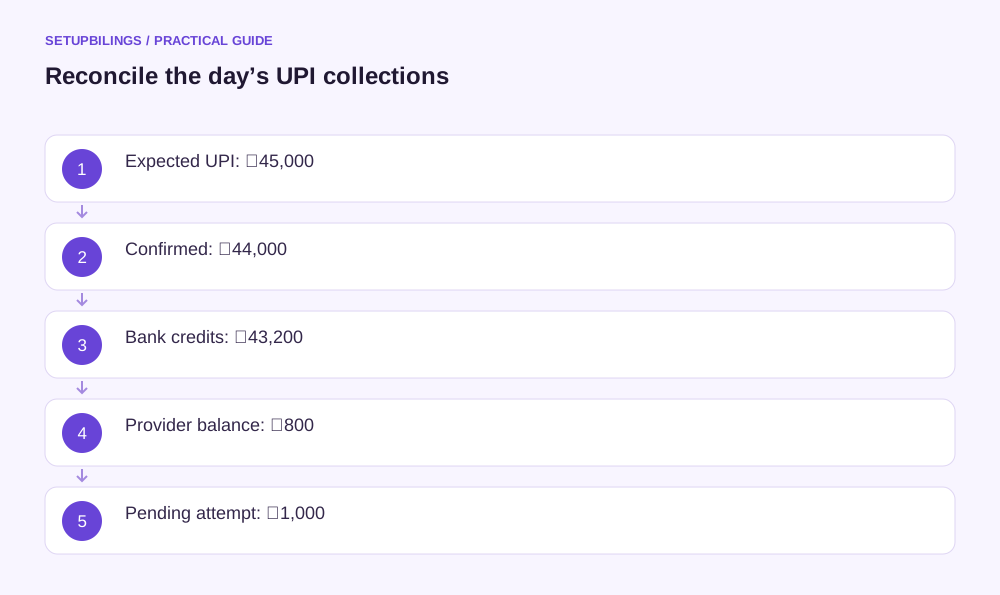
The shop's illustrative sales records show ₹45,000 expected by UPI. Receiving-side evidence confirms ₹44,000, while ₹1,000 remains unconfirmed. The shop checks the underlying sale and keeps its unpaid or unresolved payment status visible according to the actual facts.
A pending payment does not automatically cancel a valid completed sale. Conversely, an attempted payment on an abandoned order does not automatically establish revenue. Confirm the commercial event and payment event separately.
Use invoice or bill references where available. Several ₹500 transactions can occur at the same counter, so amount-only matching is weak. Connect payment identifier, amount, time and the specific sale before declaring it paid.
Connect confirmed payments with bank or provider balances
The ₹44,000 confirmed payments comprise ₹43,200 already credited to the bank and ₹800 confirmed in the provider records but not yet bank-settled at the cut-off.
| Illustrative daily bridge | Amount |
|---|---|
| Sales marked for UPI collection | ₹45,000 |
| Less unconfirmed payment attempt | ₹1,000 |
| Confirmed customer collections | ₹44,000 |
| Bank credits matched | ₹43,200 |
| Confirmed provider balance awaiting settlement | ₹800 |
| Confirmed collection bridge | ₹44,000 |
The ₹800 remains identifiable as provider-held or settlement-clearing money under the actual arrangement. It is not a bank receipt until the bank credit occurs. The ₹1,000 is a different exception: payment itself is not yet confirmed.
Do not combine these two items into one generic “bank delay.” They have different evidence and follow-up. One needs settlement tracking, while the other needs transaction-status and customer-payment resolution.
Check the sales allocations as well as the total
A correct ₹44,000 total can still contain wrong matches if two customers paid the same amount. Review duplicate references, repeated amounts and any sale marked paid without a confirmed payment link.
A single customer may split a bill across UPI and cash, or make two UPI payments. Retain the component allocation rather than expecting one bill to equal one bank movement. Check that the combined receipts do not exceed the bill without an identified customer credit.
If the same confirmed payment appears in both merchant and bank imports, match them as evidence of one receipt. Do not create two accounting receipts merely because two source reports show the event.
Treat deductions, refunds and reversals explicitly
Where a provider reports deductions, obtain the actual fee or adjustment detail and follow its signs. Do not assume every difference is a transaction fee or that all UPI arrangements have identical charges. The agreement and actual report determine the bridge.
Link a refund to the original transaction and its commercial reason. A provider reversal or failed-payment correction is not automatically a customer return. Check what happened to the goods or invoice before changing sales records.
Preserve both gross payment and reversal information. Netting a ₹1,000 receipt and ₹1,000 reversal to zero without references hides the history needed if the customer later queries the payment.
Assign the exceptions before closing the shift
Give the ₹1,000 pending attempt an owner, transaction reference, latest status and next check. Give the ₹800 provider balance an expected settlement basis and later bank-match action. Use the actual provider cycle and current transaction facts rather than promising a universal credit time.
If receiving-side confirmation is unavailable, follow a clear handover or credit-authorisation procedure for goods already supplied. Staff should know who decides how the unresolved sale is handled and how a later duplicate payment will be identified.
Check the shift handover
Assign transactions near the shift boundary consistently and retain the actual timestamp. If the evening team hands a pending attempt to the next day’s preparer, carry its original bill and reference with it. Otherwise, the same item can be treated as missing on one day and as a new sale on the next.
Review the next day's clearing
Match later bank credits and updated statuses to the original exception list. Do not create fresh sales when earlier confirmed provider balances settle. Close each exception only when evidence shows its actual outcome.
Daily UPI reconciliation works when sales, payment status and bank settlement remain connected but distinct. The shop should finish with confirmed receipts, supported money awaiting settlement and a small owned list of unresolved attempts. That gives the owner an accurate view of both customer payment and available bank cash.