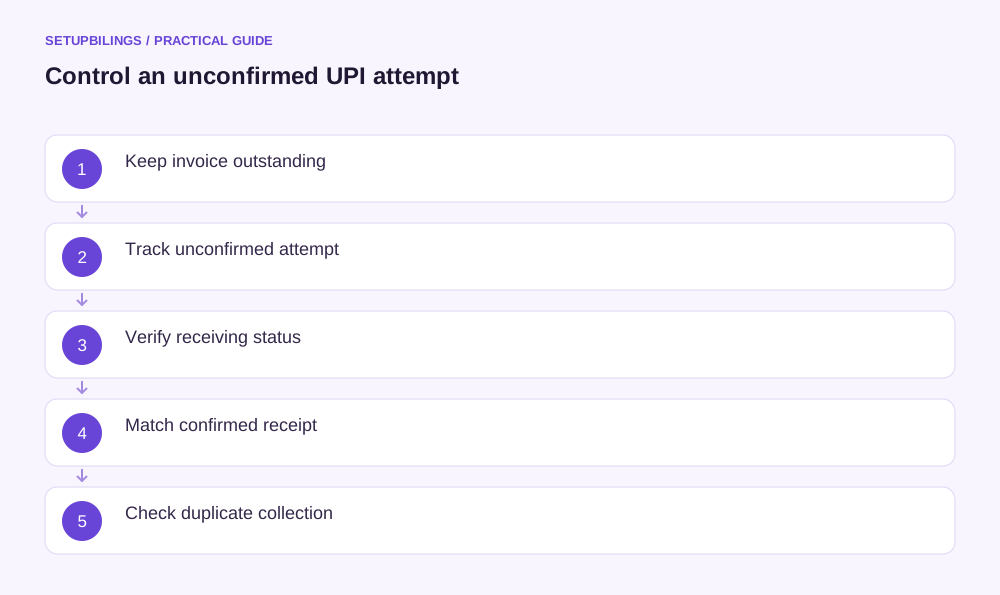
When UPI shows pending, keep the payment unconfirmed until reliable receiving-side evidence establishes the outcome. Record the sale or order according to what actually happened commercially and the applicable invoicing basis, while tracking the unresolved payment separately. Do not enter a confirmed bank receipt solely because the customer shows a debit or a pending screen.
A pending status describes payment processing, not whether goods were delivered or a sale was earned. The shop needs separate evidence for those questions. A clear exception record prevents both an unpaid completed sale from disappearing and an abandoned order from becoming unsupported revenue.
Verify the receiving-side position
Consider an illustrative Pune stationery retailer with a ₹2,500 customer bill. Goods have been supplied and the invoice is valid under the example's facts. The customer attempts UPI and sees a pending status, while the merchant has no confirmed receipt.
Staff checks the merchant transaction history and receiving account or provider status using the actual transaction reference. A screenshot can help locate the attempt, but it does not substitute for confirmation at the receiving side.
BHIM's official help describes checking transaction status and raising issues with a transaction reference. RBI's failed-payment framework distinguishes a funds transfer from a merchant-payment confirmation failure. Use the category and current evidence when pursuing resolution rather than assuming one timeline fits every pending attempt.
Keep the invoice outstanding until settlement is supported
For the retailer's valid completed sale, the ₹2,500 invoice remains unpaid while the payment is unresolved. No confirmed ₹2,500 bank receipt is created. Keep the customer, bill, attempted payment reference, time and latest status connected.
If the transaction later succeeds and the bank or provider evidence supports receipt, record or match it once and allocate it to the invoice. If it fails without a merchant receipt, resolve the attempt without inventing a bank refund from the merchant.
For an order not fulfilled, assess the order and invoice status separately. Do not issue a sale cancellation solely to make a pending payment report disappear if the commercial sale actually remains valid.
Show the possible outcomes explicitly
| Illustrative event | Confirmed merchant collections | Invoice or customer position |
|---|---|---|
| ₹2,500 invoice supplied; attempt pending | Nil | ₹2,500 remains outstanding |
| Replacement payment confirmed | ₹2,500 | Invoice settled |
| Original attempt also later confirms | ₹5,000 total | ₹2,500 customer excess requires resolution |
The final row is a possible duplicate-collection case, not a prediction. It shows why staff should not simply tell a customer to retry repeatedly and then discard the earlier references.
If instead the original attempt fails and no merchant money arrives, confirmed collections remain ₹2,500 from the replacement payment. The customer's bank may handle its failed debit separately; the merchant should not post an additional refund unless its own actual obligation and payment support one.
Control a replacement payment
Before accepting a replacement, check the latest original status and record that a second method or attempt is being used. Retain both references and identify which confirmed receipt settled the bill. Follow the business's authorised process for releasing goods or allowing temporary customer credit.
Do not treat the replacement as a second sale. It is another attempt to settle the same ₹2,500 obligation. If both succeed, recognise the excess appropriately and arrange the supported resolution rather than leaving the customer invoice credited invisibly.
A refund or return of excess must be linked to the actual duplicate collection and handled through a verified process. Avoid sending money to an unrelated QR or account supplied in an unsolicited message.
Keep provider balance and bank cash separate
A provider may confirm receipt before the amount is paid into the merchant bank. In that case, the customer-payment question can be resolved while the settlement question remains open. Track the provider or clearing balance and later bank credit under the actual arrangement.
Do not classify a confirmed payment awaiting provider settlement as still “customer pending” merely because the bank has not received the payout. Conversely, do not treat an unconfirmed attempt as a provider receivable without evidence supporting that classification.
Official provider reports can distinguish payment records from settlement records. Obtain the reports relevant to the account, without assuming every system exposes identical fields or statuses.
Assign a follow-up and preserve changes
Record who will check the transaction again, what evidence is required and how the customer will be contacted. Preserve the status history where it affects decisions. A later successful status should remain connected to the pending attempt, not entered as an unrelated new receipt.
Raise an issue through the relevant bank or provider's official process if unresolved, retaining the case reference. Do not promise the customer an exact reversal or compensation outcome without checking the applicable category and facts.
Keep payment evidence free of authentication secrets. The shop needs transaction identifiers and status information, not the customer's UPI PIN or banking password.
Distinguish pending requests from pending payments
A request awaiting customer approval is not necessarily an executed payment awaiting confirmation. Identify which stage the provider actually reports before assigning an accounting receipt or a bank follow-up.
Close the bill and payment exception together
At resolution, confirm the valid invoice balance, total actual collections and any customer excess or refund. Check that the original pending record is closed by evidence and not left available for a second allocation.
The useful result is a truthful separation: what the business sold, what payment is confirmed and where the money currently sits. That allows staff to handle a pending UPI attempt without overstating bank cash, losing a receivable or collecting twice for the same sale.