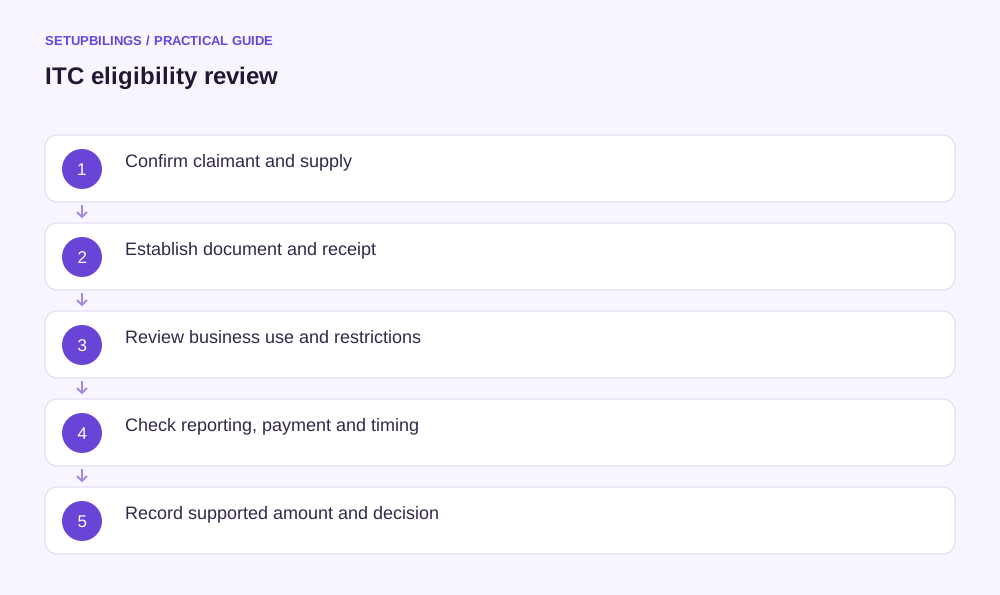
Begin with the person claiming the credit
Input tax credit is available under the GST framework to an eligible registered person subject to the applicable conditions and restrictions. Establish which GSTIN received the supply and which registration proposes to claim. A purchase made by one company cannot simply be claimed by another group company because both share an owner or accountant.
Check the taxpayer's category and the period. A normal registered business, composition taxpayer, non-resident taxable person and special credit-distribution role do not have identical entitlements. Keep the registration identity and status with the review so an invoice is assessed against the correct legal person rather than a brand name.
Establish the supply and business connection
Describe what was purchased and how it is used or intended to be used in the course or furtherance of business. Match the invoice to the contract, purchase order and activity. An expense posted to an office account is not automatically a business input, while an item bought before production begins can still need an intended-business-use assessment.
Separate personal use, exempt activities and common use before calculating the claim. Business purpose is necessary but does not override an express blocked-credit provision. A director's car may support business travel yet still require the specific motor-vehicle restriction review; calling it an operational necessity does not answer that question.
If the purchase supports several GST registrations, identify the actual recipient and applicable distribution or supply process. The ISD framework changed from April 2025 for relevant input-service invoices received on behalf of distinct persons. An internal allocation spreadsheet cannot automatically substitute for the prescribed current mechanism.
Confirm the document and actual receipt
Hold the prescribed tax-paying document appropriate to the transaction. An ordinary supplier tax invoice, debit note, bill of entry, ISD document or relevant reverse-charge document can serve different situations under the rules. A pro forma invoice, quotation or bank transfer advice is not automatically a substitute for the required document.
Then establish receipt of the goods or services. Goods-receipt records, delivery evidence, service outputs and acceptance records should connect to the invoice. The law includes specified deemed-receipt situations, such as delivery to another person on the registered recipient's direction. Do not insist that every qualifying good must physically enter the claimant's own warehouse.
Where goods covered by one invoice arrive in lots or instalments, review the last-lot condition rather than claiming solely because the first carton arrived. For services, a supplier's invoice date is not proof that all contracted work has been performed. Record the actual service period and evidence supporting receipt.
Apply restrictions before treating tax as recoverable
Review section 17(5) for the actual category and exceptions. Motor vehicles, certain employee benefits, food, construction, personal consumption, lost goods and gifts require particular attention. The analysis should identify the operative wording and facts; a generic list headed “all business expenses eligible” is not a useful control.
Construction cases need current-law care. Finance Act 2025 amended the own-account construction wording concerning plant and machinery with retrospective effect specified in the amendment. Do not apply an older summary or judgment-based explanation without checking the operative amendment and the actual asset.
For capital goods, check the interaction with depreciation on the tax component and any common-use rules. For purchases serving taxable and exempt activities, review the appropriate apportionment method. A permanent restriction and a temporary failure of a condition should be recorded differently because their later treatment may differ.
Reconcile supplier data and other conditions
Compare the purchase record with the applicable GSTR-2B information and supplier reporting. Current section 16 includes communication and restriction conditions in addition to possession and receipt. A matching statement entry is useful evidence, but it does not independently prove business use, delivery, absence of a block or satisfaction of every statutory condition.
Check the operative supplier-tax and return conditions and investigate actual filing gaps. Do not guarantee a claim merely because a supplier's GSTIN is active. Conversely, distinguish a missing or wrongly reported invoice from a permanently ineligible expense; the follow-up and final decision can be different.
Track the supplier-payment condition, including the relevant 180-day review for covered supplies and the proportionate treatment of unpaid amounts under current Rule 37. Reverse-charge supplies have a distinct position. Keep the invoice value, tax, payments and credit history together instead of applying one vendor's closing balance to every bill.
A useful review sheet also records who can resolve each missing fact. Warehouse staff can confirm delivery, procurement can obtain a corrected invoice and the tax preparer can assess the applicable restriction. Assigning the question correctly prevents a hold from being cleared merely because the wrong team could not find the evidence.
Calculate and authorise a supported amount
Illustratively, a manufacturer receives an invoice with ₹18,000 of GST. Its review identifies ₹3,000 relating to a separately supported ineligible component and ₹15,000 requiring normal eligibility checks. The maximum supported claim is not automatically ₹18,000, and the remaining ₹15,000 is not confirmed until receipt, reporting, timing and other conditions are resolved.
Record the decision, reason, amount and return period. Use separate statuses for eligible, blocked, awaiting evidence, temporarily reversed and validly reclaimed. Retain the source documents and reconciliation that support each status. This makes the claim review reproducible when a new employee or adviser later examines the account.
Finally, check the applicable claim deadline and special relief, if any, for the specific period. The review is complete when the business can explain both why the credit qualifies and how the amount reached the return. That is a stronger basis than treating the tax column of the purchase ledger as an automatic credit balance.
Sources and references
- CBIC: current CGST section 16, eligibility and conditions
- CBIC: current CGST section 17, apportionment and blocked credits
- CBIC: Central Goods and Services Tax Act, consolidated through August 2021
- CBIC Circular 170/02/2022-GST: reporting ITC and reversals
- Notification 16/2024-Central Tax: commencement of revised ISD provisions
- CBIC: current CGST section 20, including 2025 amendments
- Finance Act 2025, section 124: construction credit amendment
- Notification 19/2022-Central Tax: document and supplier-payment rule amendments
- Notification 26/2022-Central Tax: proportionate supplier-payment reversal