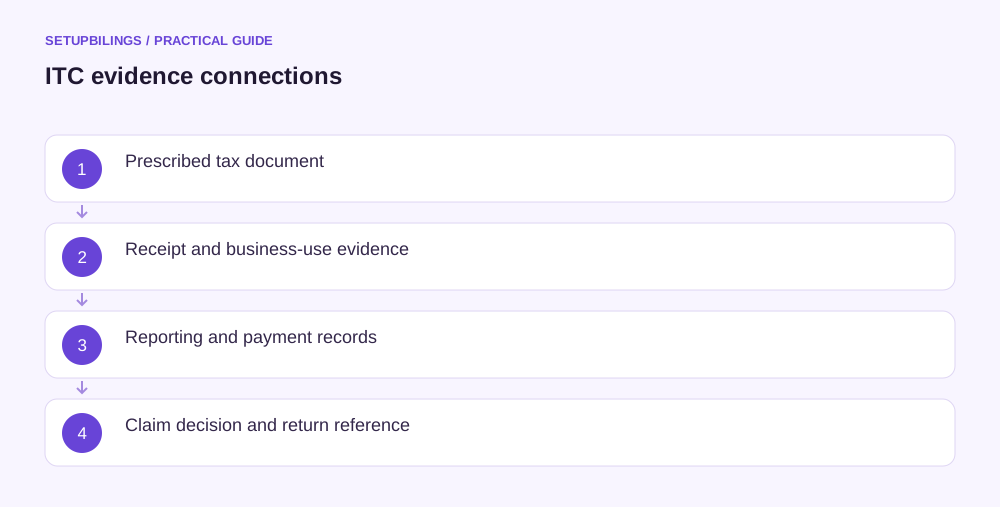
Match the document to the transaction
An input tax credit review starts with the prescribed tax-paying document for the type of supply. Rule 36 recognises different documents for ordinary purchases, debit notes, imports, specified reverse-charge cases and ISD credit. Do not force every transaction into an ordinary supplier-invoice checklist or assume any document showing a GST amount is sufficient.
Identify the actual transaction first. A quotation supports a proposed purchase, a pro forma invoice can request payment and a receipt proves money moved, but these do not automatically replace the tax document required for the claim. Keep them as supporting context without mislabelling their legal purpose.
Check the recipient and tax particulars
Read the supplier identity, recipient GSTIN, document number, date, description, value, tax heads and other applicable particulars. Compare them with the contract and purchase master. A supplier's active registration does not fix an invoice issued to the wrong company or branch GSTIN.
Where a mandatory detail is missing or wrong, obtain the appropriate correction from the supplier through the proper process. Do not edit a supplier PDF internally and treat the altered version as a genuine tax invoice. Retain the original and correction history so the accounting entry can be connected to what the supplier actually issued and reported.
Rule 36 contains conditions concerning document particulars and specified minimum information in relevant cases. Review the actual rule rather than inventing a universal rule that every minor formatting defect either destroys credit or can always be ignored. The nature of the omission and the operative requirements matter.
Add proof that goods or services were received
For goods, link the purchase order, dispatch details, delivery acknowledgement, inward register and inspection record where relevant. For services, link the agreement, service period, deliverables, completion or acceptance records and responsible business contact. A payment confirmation does not prove that the contracted supply was received.
Some legal receipt conditions can be satisfied through specified deemed-receipt arrangements. For direct delivery to a customer on the buyer's instruction, preserve the instruction, supplier delivery evidence and the relationship between the purchase and onward supply. Do not create a fictitious warehouse receipt for goods that legitimately never entered that warehouse.
If one invoice covers several lots, identify the full lot schedule and final receipt date. If a service spans periods, identify what was supplied and accepted rather than assuming the entire invoice represents a completed service on issue date. These records support both the timing review and later dispute resolution.
Explain business use and restrictions
Attach a short purpose note where the invoice description does not explain use. A project code, department allocation, asset register or customer contract can establish the connection more clearly than a broad statement that the expense was approved by management. Approval and tax eligibility are different decisions.
Keep additional evidence for categories with specific restrictions or exceptions. Motor-vehicle seating and use, employee-benefit legal obligations, construction asset classification and gift-distribution terms may change the answer. A file that omits those facts cannot establish an exception merely by displaying a large tax amount.
For common taxable and exempt use, retain the allocation workings and turnover evidence under the applicable rules. For capital goods, preserve capitalisation and depreciation records. The document pack should show why the selected method applies, not only the final number copied into the purchase ledger.
Connect supplier reporting and payments
Reconcile the invoice with the relevant GSTR-2B and other current reporting information. Record missing entries, GSTIN mismatches, amount differences and corrections separately. An invoice appearing in the statement does not confirm all conditions, while an unresolved difference should not disappear into a general month-end adjustment.
Maintain invoice-level payment allocation for the covered supplier-payment condition. Keep bank, UPI, set-off or other legally relevant settlement evidence and explain the amount applied to each bill. A supplier account that is overall in credit can still contain an unpaid invoice requiring review if the allocation is unclear.
Illustratively, a ₹1,18,000 purchase contains ₹18,000 of GST and is paid through two transfers. The file should identify which transfer settled which part of the bill, not merely attach a bank statement with dozens of unrelated entries. If part of the amount remains unpaid, the relevant credit history and current payment-condition rule can then be assessed accurately.
For digital records, retain a stable invoice identifier across folders, purchase entries and reconciliation sheets. A file named only final bill can be confused with a later correction. Add the supplier, document number and date to the index so the reviewer can locate the actual version supporting the claim without searching through several unrelated email attachments.
Use an evidence index with open items
Create a one-page index listing the tax document, receipt evidence, business purpose, restriction review, statement match, payment status and claim period. Mark missing items with an owner and follow-up date. Do not label a file complete because the invoice scan exists while the service acceptance or recipient correction remains outstanding.
Keep document versions controlled. A revised invoice, credit note or corrected supplier statement should be linked to the original record. Preserve the reasoning for an earlier claim, reversal or hold so later staff can understand whether new evidence changes the conclusion or merely confirms what was already known.
The strongest ITC file is proportionate to the transaction. A routine stock purchase may need a simple connected record set, while an unusual construction or employee-benefit item requires more analysis. The goal is a clear chain from the correct tax document to a supported, timely claim, with unresolved facts visible before filing.
Sources and references
- CBIC CGST Rules compilation through September 2021
- CBIC: current CGST section 16, eligibility and conditions
- CBIC: current CGST section 17, apportionment and blocked credits
- CBIC Circular 170/02/2022-GST: reporting ITC and reversals
- Notification 19/2022-Central Tax: document and supplier-payment rule amendments